
Agentic AI in Action — Designing Guardrails for Agentic AI Without Stifling Innovation

Agentic AI in Action — Designing Guardrails for Agentic AI Without Stifling Innovation
Agentic AI is steadily moving from experimentation into real enterprise systems. Unlike traditional automation or assistive AI, agentic systems do not simply respond to instructions. They observe context, reason over data, make decisions, and take action toward defined outcomes.
This shift introduces a fundamental challenge. How do organizations allow AI systems to act autonomously while still maintaining trust, accountability, and control?
The instinctive response is often to introduce more rules, more approvals, and more restrictions. Unfortunately, this approach often strips agentic AI of the very qualities that make it valuable. The real question is not whether agentic AI needs guardrails. It does. The question is how to design guardrails that enable innovation instead of suffocating it.

Why Agentic AI Changes the Control Conversation
Traditional systems are predictable. A rule is triggered and an action follows. Control is achieved by defining every possible path in advance.
Agentic AI operates differently. It functions in environments where signals are incomplete, conditions evolve, and decisions must be made based on probability rather than certainty. These systems are designed to adapt, not just execute. Applying rigid control models designed for deterministic systems leads to two outcomes. Either the agent becomes ineffective, or teams begin bypassing controls to regain speed.
Effective governance for agentic AI requires a shift in mindset. Control must move away from prescriptive instructions and toward principled boundaries.
The Cost of Over Constraining Autonomy
When guardrails are poorly designed, agentic AI turns into little more than a complex rules engine. Every action requires approval. Every deviation is blocked. Every decision is second guessed.
This results in slower systems, frustrated teams, and reduced trust in AI outcomes. Innovation stalls not because the technology failed, but because it was never allowed to operate as intended.
Over constraining agents also creates a false sense of safety. When humans override decisions constantly, accountability becomes blurred. It becomes unclear whether outcomes are driven by the system or by human intervention.
A Practical Mental Model for Guardrails
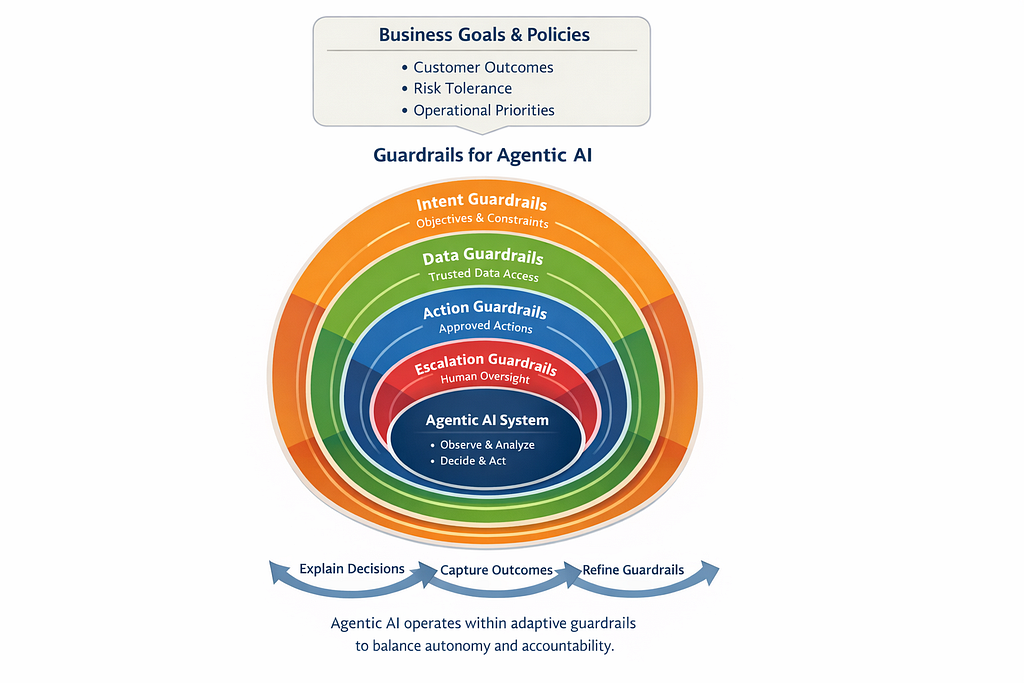
Guardrails for agentic AI work best when treated as intentional boundaries rather than restrictive rules. The goal is not to limit what an agent can do in every situation, but to clearly define where it has freedom to operate and where it must slow down, explain itself, or escalate.
This mental model breaks guardrails into four complementary types.
Intent Guardrails
Intent guardrails define the purpose of the agent. They answer a simple but critical question. What is this agent allowed to optimize for.
Instead of prescribing exact steps, intent guardrails articulate outcomes. They align the agent with business objectives such as improving customer experience, reducing operational risk, maintaining data accuracy, or controlling costs.
Clear intent allows agents to make reasonable tradeoffs when faced with ambiguity. Without it, even technically correct decisions can become misaligned with business priorities.
A simple way to express intent is through a policy definition.
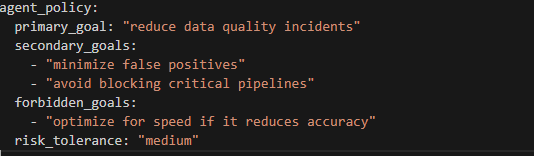
This kind of definition does not tell the agent how to act. It tells the agent why it exists.
Data Guardrails
Data guardrails define the information landscape the agent can operate within. They specify which data sources are trusted, how fresh the data must be, and what quality standards must be met before data is used in decision making.
Agentic systems are only as reliable as the data they reason over. Allowing unrestricted access to incomplete, outdated, or unverified data introduces risk that no downstream control can fully correct.
Data guardrails focus attention on reliable signals and prevent decisions based on noise or misleading context.
For example, access can be limited to approved sources.

Freshness and trust thresholds can also be enforced before reasoning begins:
SELECT *
FROM DATA_QUALITY_METRICS
WHERE snapshot_ts >= DATEADD(‘hour’, -24, CURRENT_TIMESTAMP())
AND trust_score >= 0.85;
Action Guardrails
Action guardrails define what an agent is allowed to do in the real world. They distinguish between actions that can be executed independently and actions that require human confirmation.
Not all decisions carry the same level of impact. Low risk actions may be fully automated. Higher impact actions may require review or approval.
This avoids an all or nothing approach to autonomy and allows responsibility to expand gradually as trust increases.
A simple pattern is to define action tiers:

When an action requires confirmation, the agent proposes rather than executes.

This design preserves speed while maintaining accountability.
Escalation Guardrails
Escalation guardrails define when an agent must pause and involve a human. These situations often arise due to low confidence, conflicting signals, or potentially high impact outcomes.
Escalation is not a failure of autonomy. It is a deliberate design choice that acknowledges the limits of automated reasoning.
Confidence thresholds are a common trigger.

Conflicting evidence is another.

By making escalation explicit, organizations preserve human judgment where it matters most while still allowing agents to operate efficiently in routine scenarios.
Putting Guardrails Into Perspective
As agentic AI systems move closer to real world adoption, success depends on more than autonomous reasoning alone. These systems must operate within a balanced framework that supports transparency, responsibility, adaptability, and innovation. The following visual captures this balance by placing the agent at the center, surrounded by four reinforcing principles.

Together, these elements show how explainability, governance, evolving guardrails, and well defined boundaries work in concert to enable autonomy without sacrificing trust or control.
We will briefly look at each.
Explainability Is a Guardrail
Explainability is often treated as an optional addition to agentic AI systems. In practice, it is one of the most effective guardrails available.
When an agent is required to explain why it took an action or made a recommendation, it introduces accountability without restricting autonomy. The agent remains free to reason and act, but its reasoning must be visible. This shifts the conversation from whether the system followed a rule to whether the decision made sense given the context, intent, and data available at the time.
Consider an agent responsible for monitoring data quality across critical reporting tables. One morning, the agent recommends pausing a downstream report refresh. Rather than issuing the recommendation in isolation, it explains that it observed a sudden increase in missing customer identifiers, traced the affected rows to a recent upstream change, and recognized that similar patterns previously resulted in inaccurate executive reports. The explanation does not force an automatic outcome, but it makes the reasoning transparent and inspectable.
This transparency acts as a natural braking mechanism. When an agent struggles to clearly articulate its reasoning, it is signaling uncertainty. That uncertainty can trigger escalation or additional review without requiring rigid controls upfront. Over time, these explanations become an operational asset. They help teams identify recurring failure patterns, understand where intent or data guardrails may be too loose or too restrictive, and refine action boundaries based on observed outcomes rather than assumptions.
Perhaps most importantly, explainability preserves human confidence. Stakeholders are far more likely to trust autonomous systems when decisions can be understood after the fact, even when no human intervened in real time.
In this way, explainability does not slow innovation. It enables safe autonomy by making decisions inspectable, discussable, and continuously improvable.
Effective Governance Strategies
Effective governance for agentic AI is about enabling autonomy within clear ethical, legal, and organizational boundaries. This becomes critical when agents interact with customer data, sensitive business information, or personally identifiable information.
Governance should start with clear ownership and purpose. Every agent needs a defined mandate, accountable stakeholders, and measurable outcomes. This ensures autonomy remains aligned with business intent.
Protecting customer data and PII must be foundational. Agents should only access data explicitly authorized for their task, with sensitive attributes masked or minimized wherever possible. Access should be contextual, time bound, and auditable to prevent unintended exposure.
Visibility matters more than restriction. Logs of data access, reasoning context, actions, and explanations provide transparency for compliance, investigation, and continuous improvement. These signals help detect drift and risk early. Human oversight should focus on high impact decisions and sensitive data interactions rather than routine actions. Governance frameworks must also allow rapid adjustment, enabling access to be narrowed or autonomy reduced when risk is detected.
As regulations, data landscapes, and agent behavior change, guardrails must adapt. Governance that grows with agentic systems allows innovation to scale without compromising customer trust.
Guardrails Must Evolve
Guardrails are not optional in agentic AI systems. They are a prerequisite for safe adoption. Promoting autonomy without acknowledging risk creates fragile systems that fail under real world pressure.
Agentic AI systems learn. Their operating environments change. Business priorities shift. Guardrails designed as static policies quickly become outdated.
Effective governance embraces this reality by designing for change. Guardrails should be reviewed continuously, informed by observed agent behavior, explanations, escalation patterns, and real outcomes. Overrides and escalations are not just safety mechanisms. They are signals that reveal where intent, data boundaries, or action authority need adjustment. This feedback driven approach allows organizations to safely increase autonomy over time instead of locking systems into conservative defaults.
Agentic AI systems that succeed over time are not the ones with the most restrictive controls. They are the ones with time-tested, effective guardrails designed to learn, adapt, and mature alongside the agents they govern.
Innovation Thrives on Good Boundaries
The purpose of guardrails in agentic AI systems is not to prevent action. It is to enable meaningful action at scale. Innovation does not emerge from unrestricted autonomy, nor does it survive under excessive control. It thrives when systems operate within clearly defined boundaries that provide direction, safety, and accountability.
Good boundaries create confidence. When agents understand their intent, data context, and scope of authority, they can act decisively without hesitation. At the same time, humans gain confidence knowing that decisions remain observable, explainable, and reversible when necessary.
Boundaries also accelerate learning. Clear limits make it easier to evaluate outcomes and understand why a decision succeeded or failed. Without boundaries, failures are ambiguous and difficult to diagnose. With them, feedback becomes actionable and improvement becomes continuous.
Perhaps most importantly, boundaries scale innovation. As organizations grow more comfortable with agentic behavior, autonomy can expand deliberately rather than abruptly. Low risk decisions become automated first. Higher impact decisions follow once trust is earned through consistent performance and transparent reasoning.
Agentic AI does not require freedom without limits. It requires structure that allows it to explore, adapt, and improve without compromising trust or responsibility. When guardrails are designed as enablers rather than obstacles, they transform autonomy from a risk into a sustainable advantage.
In this sense, good boundaries do not restrict innovation. They are what allow it to endure.
As we are noticing in recent times, Agentic AI changes how intelligent systems participate in enterprise decisions. With that shift comes the need for a new approach to control. Well designed guardrails make autonomy practical, not risky. They align agents with business intent, trusted data, and accountable action while preserving the ability to adapt and learn. When governance is treated as an evolving system rather than a static rule set, innovation scales safely. Autonomy grows with confidence, trust is maintained, and agentic AI moves from experimentation to dependable operation.
Guardrails do not limit agentic AI. They are what allow it to succeed.
The sample guard rails example templates mentioned in the blog can be found here
Agentic AI in Action — Designing Guardrails for Agentic AI Without Stifling Innovation was originally published in Towards AI on Medium, where people are continuing the conversation by highlighting and responding to this story.
