
A curious trig identity

Here is an identity that doesn’t look correct but it is. For real x and y,

I found the identity in [1]. The author’s proof is short. First of all,

Then
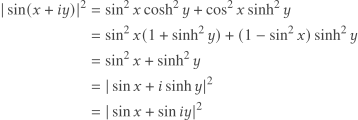
Taking square roots completes the proof.
Now note that the statement at the top assumed x and y are real. You can see that this assumption is necessary by, for example, setting x = 2 and y = i.
Where does the proof use the assumption that x and y are real? Are there weaker assumptions on x and y that are sufficient?
[1] R. M. Robinson. A curious trigonometric identity. American Mathematical Monthly. Vol 64, No 2. (Feb. 1957). pp 83–85
The post A curious trig identity first appeared on John D. Cook.
Like
0
Liked
Liked
