The Morning I Finally Looked Up at the Bridge

I was not inspecting bridges that morning. I was just trying to get to our construction technology lab in Jabi.
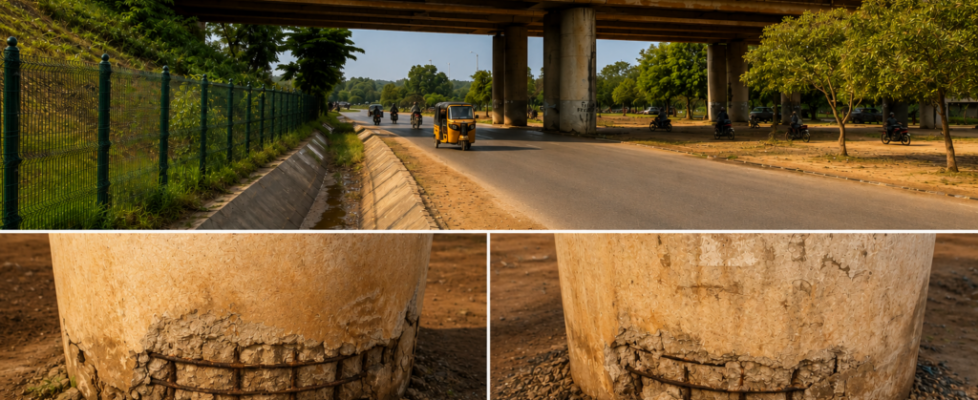
It was the rainy season. The taxi from Lugbe couldn’t take me all the way, so the driver dropped me on the bridge at the Area 1–Airport Road interchange. From there, I walked down the ramp to catch a keke, just as I had done dozens of times before.
I walked past the concrete drainage channel, the green mesh fence, and the red laterite soil that turned to thick mud after heavy rain. Then I found myself standing beneath the bridge deck in its cool shade, waiting with wet shoes for the next keke (auto rickshaw).
Several okadas (motorcycle taxis) were parked along the edge. A few other people stood around, sheltering from the drizzle. Nobody was looking up. Most mornings, I didn’t either.
But that morning, something made me look.
I walked closer to the nearest pier. Low on the column, the concrete had spalled off in a rough ring. Underneath I could see horizontal steel — reinforcement bars circling the column, heavily rusted. A reddish stain ran down, and at the bottom there was a small puddle that never seemed to dry.
I stepped up and touched it. The steel felt gritty beneath my fingers, rough with corrosion. I stood there with my hand on that exposed, corroding steel, probably the only person who had ever really looked.
My first thought came fast: This bridge might be failing.
My mind filled in the rest of the story
A truck must have hit it. I walked around the pier looking for scrape marks. There weren’t any. The damage was fairly even all the way around. Whatever caused it had been happening slowly.
That night, when I came back home, I pulled out an old reinforced concrete textbook. I wanted confirmation that I was right to be worried.
The book didn’t give it to me.
The first serious sections I read weren’t about collapse. They were about cracking. I read the page twice. Somewhere in my head, I had quietly decided that cracking and failure were basically the same thing.
Standing under that bridge with my hand on the rust, I hadn’t been asking if the structure was safe. I had been asking if it looked wrong.
Those are two very different questions.
If concrete cracks, why doesn’t everything fall apart?
The rust I touched wasn’t the whole story.
Beneath the surface, the reinforcing steel remains bonded to the surrounding concrete. That bond allows the concrete between cracks to continue carrying some tension, even after visible cracks appear.
In other words, a crack isn’t the same thing as structural failure.
As more cracks develop, the steel gradually takes on a greater share of the load. The member loses stiffness, but that doesn’t mean it has reached its limit. Ultimate failure occurs much later, typically after significant yielding of the reinforcement, crushing of the concrete, or severe loss of bond.
I sat back and thought about the pier again.
The rust hadn’t disappeared. Neither had the exposed steel.
My first conclusion under that bridge wasn’t completely wrong. It was simply incomplete.
The damage wasn’t automatically catastrophic. But it also wasn’t nothing.
Instead of asking whether the bridge was failing, I started asking what the damage was actually telling me.
That morning stayed with me.
Afterwards, I noticed I had started looking at structures differently. I became less interested in spotting damage and more interested in understanding what the damage actually meant.
It’s one of the reasons I’ve become drawn to structural health monitoring. Because no matter how careful you are, a quick look — even with your hand on the concrete — is rarely enough.
It’s been over a month now. I still take that same route most mornings. I still wait under the bridge with the Okada riders and others who never look up. The rust is still there. The spalling hasn’t been fixed. The ring of exposed steel looks exactly the same.
As far as I can tell, the bridge hasn’t changed at all.
The only thing that changed was the person standing beneath it.
I still don’t know whether that bridge needs any urgent repairs. Only an engineering investigation could answer that.
What I do know is that morning taught me something every engineer eventually learns: damage tells a story, but only if you ask the right question.
