GPT-5.6 Sol, Terra, and Luna: OpenAI’s New Naming Scheme Is Actually a Strategy

Three tiers, one generation, and a benchmark chart with a story inside it: the flagship now scores more per token, not just more.
OpenAI just moved the GPT-5.6 family to general availability, and the most revealing thing about it isn’t any single benchmark — it’s the shape of the release. Instead of one model, you get three: Sol (flagship), Terra (balanced, everyday), and Luna (fastest, cheapest). In the new naming system, the number identifies the generation while Sol, Terra, and Luna are durable capability tiers that can advance on their own cadence — sun, earth, moon.
This post covers what each tier actually is, the token-efficiency story that the launch charts quietly tell, the new ultra multi-agent mode, and — because vendor launch posts deserve scrutiny — where independent numbers say GPT-5.6 leads and where it clearly doesn’t.
The three tiers, and what they cost
The family maps cleanly onto a price-performance ladder, priced per million tokens:
- Sol — $5 input / $30 output. The flagship for the hardest problems: complex coding, long-horizon agentic work, cybersecurity, research.
- Terra — $2.50 / $15. Competitive with GPT-5.5 while being 2x cheaper; the high-volume production tier.
- Luna — $1 / $6. The fastest, most affordable option for routine work, drafting, and summarization.
Two smaller API details matter for anyone running agents at scale: prompt caching got more predictable, with explicit cache breakpoints and a 30-minute minimum cache life — though cache writes are now billed at 1.25x the uncached input rate (reads keep the 90% discount). If your workloads lean on caching, that’s a real pricing change to model, not a footnote.
The chart that tells the real story: intelligence per token
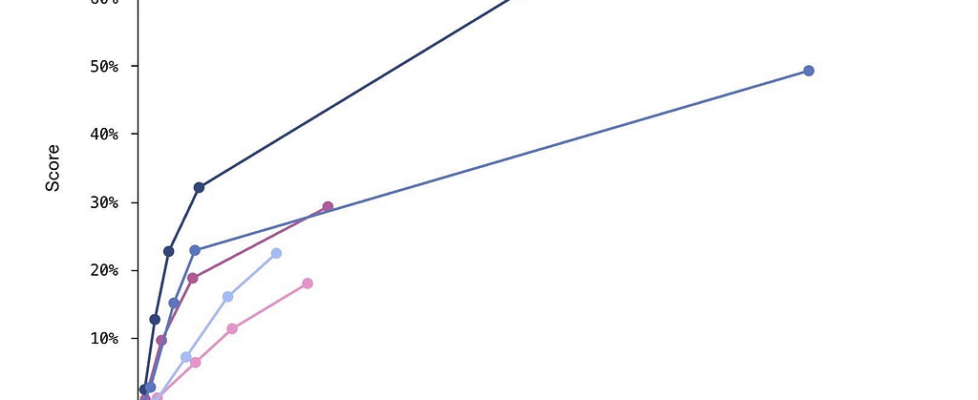
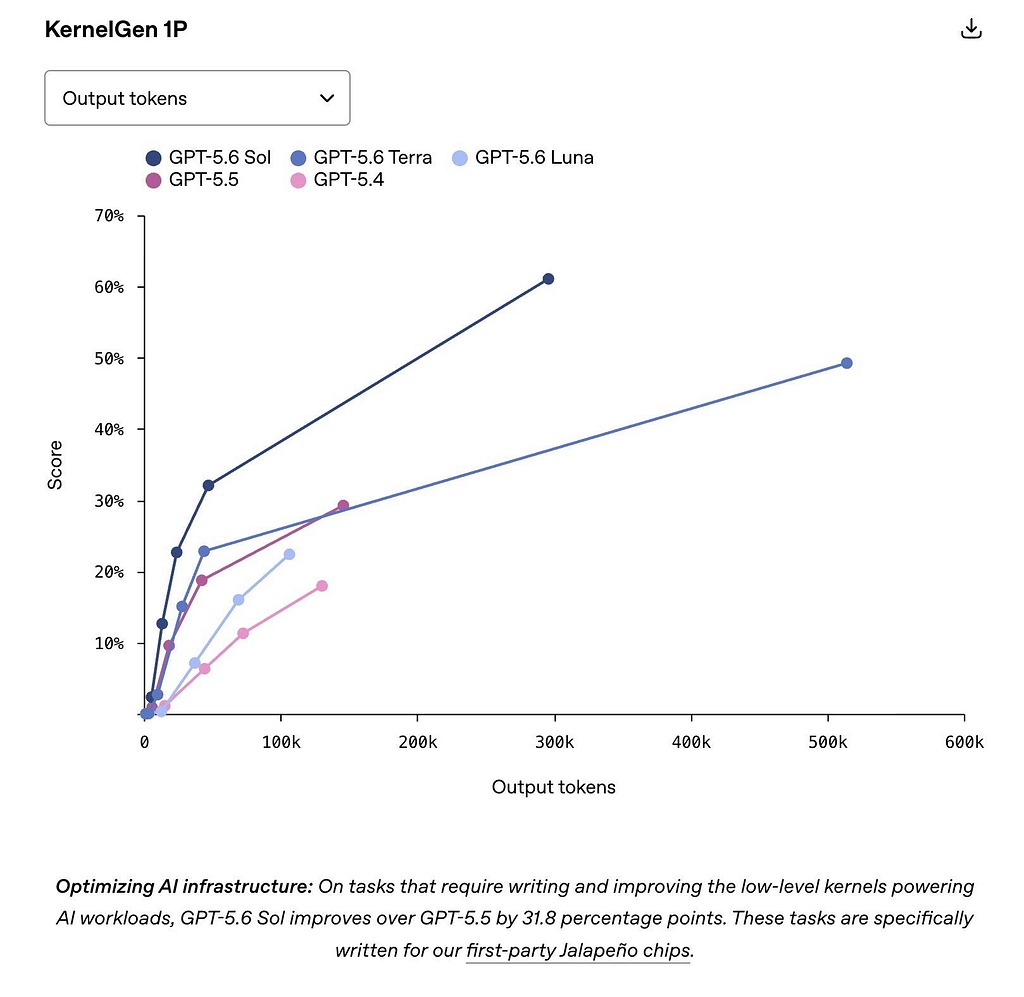
Look at the KernelGen 1P chart from the launch — the benchmark for writing and improving the low-level kernels powering AI workloads, written specifically for OpenAI’s first-party Jalapeño chips. GPT-5.6 Sol improves over GPT-5.5 by 31.8 percentage points. But the more interesting signal is where the curves sit: Sol reaches ~61% using roughly 300K output tokens, while Terra needs over 500K tokens to reach ~49%, and GPT-5.5 topped out near 30% at ~150K.
That’s the launch’s actual thesis: more intelligence from every token. Sam Altman’s framing was that Sol is 54% more token-efficient on AI coding tasks than previous models. Independent analysis backs the Pareto point — Artificial Analysis noted that Sol defines a new frontier of intelligence versus output tokens (while flagging that Terra and Luna are not on that frontier). For agentic workloads where token consumption compounds across hundreds of steps, efficiency-per-token arguably matters more than the raw ceiling.
ultra: four agents in a trench coat
The most novel capability isn’t a model — it’s a setting. The new ultra effort level coordinates four agents in parallel by default across workstreams, trading higher token use for stronger results and faster completion. The measured effect is real: on Terminal-Bench 2.1, ultra lifts Sol from 88.8% to 91.9%.
Developers can build the same pattern themselves via the multi-agent beta in the Responses API, and there’s a second, quieter power feature: Programmatic Tool Calling, which lets GPT-5.6 write and run in-memory JavaScript (in an isolated V8 runtime with no network access) to orchestrate tools — calling them in parallel, using loops and conditionals, and processing intermediate results before returning an answer. Instead of a token-hungry sequence of individual tool calls, the model writes a small program that does the coordination. That’s a genuinely different tool-use paradigm.
The honest scoreboard
The launch claims deserve the usual both-sides read, and the independent numbers oblige:
Where GPT-5.6 leads:
- Artificial Analysis Coding Agent Index: Sol sets a new state of the art at 80.0–2.8 points above Claude Fable 5 — while using less than half the output tokens and costing about a third less.
- Agents’ Last Exam (long-running professional workflows across 55 fields): a new high of 53.6 for Sol.
- The tier economics are striking: OpenAI claims Terra performs just above Fable 5 and Luna outperforms Opus 4.8, each in roughly a third of the time at about a quarter of the estimated cost.
Where it doesn’t:
- SWE-Bench Pro: Sol scores 64.6% — roughly 15 points behind Claude Mythos 5’s 80.3% (and Fable 5’s 80%). On one of the most-watched coding evals, the gap is real and large.
- Broad intelligence: Fable 5 still edges Sol on the Artificial Analysis Intelligence Index (59.9 vs 58.9) — though at about three times the cost per task.
- Tool use: on Toolathlon, Sol’s 58% trails both Fable 5 (61.7%) and Opus 4.8 (59.9%) — and amusingly, Luna edges out Terra there, inverting the tier order.
- Long context: Luna drops to 41.3% on the 8-needle MRCR retrieval test at long ranges — a reminder the cheap tier has cheap-tier limits.
So the honest summary is: state of the art on agentic coding efficiency, behind on the hardest software-engineering benchmark and on broad intelligence — but at a fraction of the cost. Which one matters depends entirely on your workload.
One more thing worth knowing: the cyber posture
GPT-5.6 launched with an unusual preamble. The initial release was a limited preview to roughly 20 vetted organizations, with plans shared with the U.S. government ahead of launch — a consequence of the developing cyber Executive Order framework. The reason: all three models crossed OpenAI’s “High” cyber capability threshold (Sol hit 96.7% on internal capture-the-flag testing), so the release shipped with OpenAI’s most robust safety stack to date, aimed at supporting defensive work (threat modeling, code review, patching, blue-teaming) while constraining offensive use. Some dual-use API calls may be blocked or paused for extra review.
That pattern — frontier capability arriving pre-negotiated with government, staged through trusted partners — echoes what Anthropic did with Mythos, and it’s increasingly the shape of frontier releases. Worth internalizing: the gap between “the model exists” and “you can use it” is becoming a policy artifact, not just an engineering one.
The takeaway
GPT-5.6 is less a single model launch than a repositioning: a tiered family named for celestial bodies, a flagship optimized for intelligence per token rather than raw ceiling, a built-in multi-agent mode, and a programmatic tool-calling paradigm that turns orchestration into code. The competitive picture is genuinely mixed — SOTA on coding-agent efficiency, clearly behind on SWE-Bench Pro — which mostly means the “which model” question now has a real answer other than “the biggest one”: it depends on whether your bottleneck is capability or cost-per-task.
OpenAI’s announcement is here, with the earlier preview post here; independent numbers come from Artificial Analysis and OpenAI’s published eval tables. If you’re running agents, the experiment worth doing first is Terra-vs-your-current-model on your own traces — the tier economics are the part of this launch most likely to change your bill.
GPT-5.6 Sol, Terra, and Luna: OpenAI’s New Naming Scheme Is Actually a Strategy was originally published in Towards AI on Medium, where people are continuing the conversation by highlighting and responding to this story.
