Why the Best AI Engineers Are Becoming Full-Time Skeptics

The differentiating skill isn’t building faster anymore — it’s knowing exactly what not to believe
There’s a version of “AI engineer” that the job market still advertises: someone who can wire up a model, write a slick prompt, stand up a RAG pipeline, and ship. That version is already being commoditized. Frameworks do most of the wiring now. Prompt templates are a Google search away. The scaffolding that used to take a skilled engineer a week takes a competent one an afternoon.
The engineers pulling ahead right now aren’t the ones who build fastest. They’re the ones who believe the least.
Not in a cynical, nothing-works sense. In a specific, disciplined sense: they’ve stopped taking benchmark numbers, vendor claims, demo videos, and their own model’s confident-sounding output at face value. They’ve made doubt a working method instead of a personality trait. Call it what it is — professional skepticism has quietly become a core engineering skill, and most teams haven’t updated their hiring or their culture to reflect it.
The Job Changed Underneath the Title
A few years ago, the bottleneck in AI engineering was capability. Could the model do the thing at all? That question is mostly answered now. Today’s bottleneck is trust calibration — knowing exactly how much to believe a system that is, by design, built to sound persuasive whether or not it’s right.
That’s a different skill set entirely. Building a pipeline is a construction problem. Deciding whether the pipeline’s output can be trusted in production, at scale, under edge cases nobody tested for, is an epistemics problem. The best engineers I’ve seen operate this way have effectively become in-house skeptics: people whose primary contribution isn’t writing the integration, it’s deciding what not to believe about it.
What Skepticism Actually Looks Like Day to Day
This isn’t abstract. It shows up as specific, repeatable habits that separate senior AI engineers from engineers who happen to have “AI” in their job title.
They interrogate benchmarks before they cite them. A model topping a leaderboard tells you almost nothing about how it’ll behave on your specific domain, your specific data distribution, your specific edge cases. Skeptical engineers ask what the benchmark actually measured, whether the eval set could plausibly overlap with training data, and whether the task resembles their production workload at all — before they let a benchmark number influence a single architectural decision.
They treat demos as marketing, not evidence. A polished demo is optimized for the one path that was rehearsed. Skeptical engineers assume the un-rehearsed paths are where the system breaks, and they go looking for those paths deliberately, before a customer finds them first.
They distrust their own eval suite as much as the model. This is the one most teams miss entirely. An eval suite written by the same team that built the feature tends to test for the failures that team already anticipated — and stays blind to the ones it didn’t. Skeptical engineers periodically ask an outsider, or an adversarial process, to try to break their own evals, not just their model.
They separate “the model said so” from “it’s true.” Confident phrasing and correct phrasing are produced by the same mechanism and are not correlated the way our intuitions assume. Engineers who’ve internalized this stop reading fluency as a proxy for accuracy — a habit that’s surprisingly hard to unlearn once you’ve spent months talking to a system that never sounds unsure.
They ask what happens when the vendor changes something. Model behavior isn’t static. A silent version bump, a quietly updated system prompt on the provider’s side, a deprecated endpoint — any of these can shift outputs in ways that never show up in a changelog. Skeptical engineers build monitoring for drift, not just monitoring for uptime.
The Named Pattern: Benchmark Laundering
There’s a specific failure mode worth naming, because it’s everywhere and rarely called out directly: benchmark laundering — the practice of citing an impressive aggregate score as if it certifies real-world reliability, when the benchmark and the production task share little more than surface similarity.
It happens at the vendor level, when marketing pages lead with leaderboard rankings that say nothing about tool use, long-context degradation, or domain-specific factuality. It happens at the team level too, when an internal eval score gets reported upward as “we’re at 94% accuracy” without anyone asking 94% of what, measured how, against which distribution of real user queries.
Skeptical engineers are the ones who stop the laundering at the source — inside their own team, before it reaches a roadmap decision.
A Trust Pipeline, Not a Build Pipeline
Most teams have a clear build pipeline: prompt, retrieval, generation, output. Fewer teams have an explicit trust pipeline sitting alongside it — the sequence of checks a claim has to survive before it’s allowed to influence a decision.
Claim (benchmark score, demo result, model output)
        │
        ▼
  Source check ── Who produced this, and what's their incentive?
        │
        ▼
  Distribution check ── Does the test data resemble our real traffic?
        │
        ▼
  Adversarial check ── Has anyone tried hard to break this?
        │
        ▼
  Drift check ── Will this still hold true next month, on a new version?
        │
        ▼
  Cleared for production decision-making
Skip a stage, and you’re not being efficient — you’re just moving the failure downstream, to a point where it’s more expensive and more visible.
Naive vs. Skeptical, Side by Side
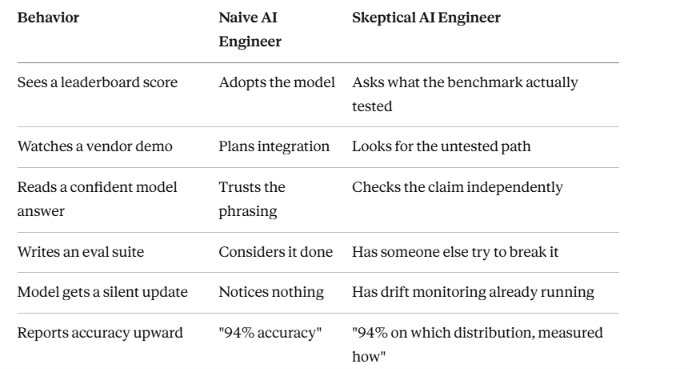
None of this makes the skeptical engineer slower by default. It makes them slower once, early, and dramatically faster later — because they’re not the ones debugging a production incident that a five-minute adversarial check would have caught in review.
This Isn’t Cynicism — It’s a Different Relationship With Confidence
There’s a version of this posture that curdles into “nothing works, don’t bother trying,” and that’s not what separates the best engineers. The useful version is closer to what good scientists and good auditors already do: hold claims to a standard proportional to what’s riding on them, without needing to distrust everything equally or reflexively.
That distinction matters because unmanaged skepticism is its own failure mode — a team that re-litigates every model output from scratch never ships anything. The engineers actually pulling ahead have built calibrated skepticism: they know which claims are cheap to verify and verify them by default, and which claims are expensive to verify and reserve deep scrutiny for the ones that matter most — a model behavior shipping to production, a benchmark driving a six-figure vendor decision, an eval result about to be reported to leadership.
Why This Is an Organizational Gap, Not Just an Individual Trait
Most companies still hire and promote for build velocity. Ship fast, integrate fast, demo well. Almost none of them have a formal role, a review process, or even language for the person whose job is to slow the team down at exactly the right moments — to be the one who asks “how do we know that’s true” before a decision gets made instead of after it fails in production.
That gap is why the best engineers end up doing this work informally, on top of their actual job description, absorbing the organizational cost of skepticism personally instead of it being built into how the team operates. Teams that name this function explicitly — that treat “who verified this claim” as a normal part of a technical review, the same way “who reviewed this PR” already is — end up with fewer expensive surprises than teams that leave it to whichever engineer happens to have the instinct.
The Actual Skill Being Selected For
Strip away the tooling and the frameworks, and the differentiator left standing isn’t who can build an AI system fastest. It’s who can correctly judge how much to trust it once it’s built — and who’s disciplined enough to keep asking that question after the initial launch excitement wears off, when it’s tempting to stop checking.
The best AI engineers aren’t becoming skeptics because it’s fashionable. They’re becoming skeptics because it’s the only remaining skill that can’t be templated, automated, or copied from a framework’s default config. Everything else about building with AI is getting easier. Knowing when not to believe it is getting harder — and more valuable — every year.
Why the Best AI Engineers Are Becoming Full-Time Skeptics was originally published in Towards AI on Medium, where people are continuing the conversation by highlighting and responding to this story.
