What Is Retrieval-Augmented Generation (RAG)? A Complete Guide for Businesses

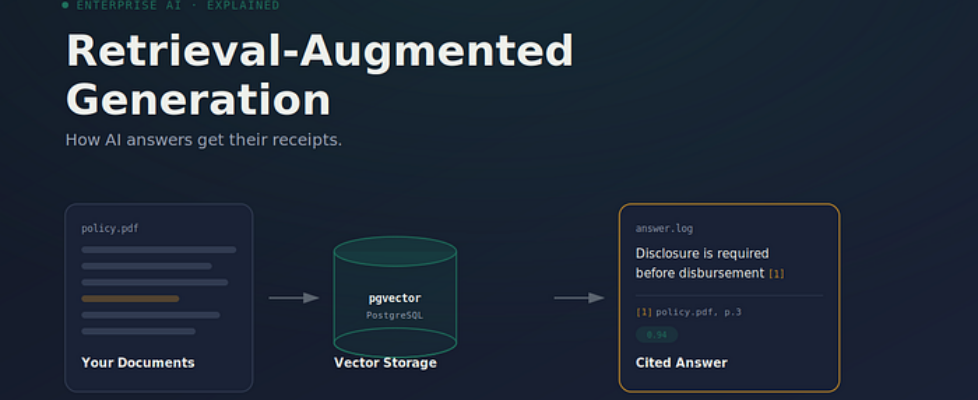
Author(s): Anthony Usoro Originally published on Towards AI. RAG Image If you’ve spent any time with ChatGPT, Claude, or any large language model, you’ve probably run into this moment: you ask a specific question about your business, your industry, or a recent event, and the AI gives you an answer that sounds completely confident — and is completely wrong. This isn’t a bug you can patch. It’s a structural limitation of how large language models work, and it’s the reason a growing number of businesses — especially in regulated or high-stakes sectors — are turning to an architecture called Retrieval-Augmented Generation, or RAG. This guide explains what RAG actually is, how it works under the hood, why it matters for businesses in Nigeria and across Africa specifically, and what to watch out for if you’re evaluating a RAG system for your own organization. The problem RAG was built to solve A large language model (LLM) like GPT-4 or Claude is trained on a massive, fixed snapshot of text. Once training ends, that knowledge is frozen. Two problems follow from this: The model doesn’t know your data. It has never seen your internal policy documents, your product catalog, your customer records, or last month’s regulatory circular. If you ask about them, it has nothing to retrieve from — so it does the next best thing: it predicts what a plausible answer would look like. Sometimes that prediction is right. Often, especially on specific or technical questions, it isn’t. The model can’t show its work. Even when an LLM does happen to get something right, it can’t point to where that answer came from, because it isn’t “looking anything up” — it’s generating text based on statistical patterns learned during training. Both problems are tolerable for casual use. They’re disqualifying for a bank verifying a compliance requirement, a hospital referencing a treatment protocol, or a law firm citing a contract clause. In those settings, an answer without a verifiable source isn’t useful — it’s a liability. RAG exists to close this gap. What RAG actually is Retrieval-Augmented Generation is an architecture that combines two things: A retrieval system, which searches your own documents and data for the passages most relevant to a question. A generation system (the LLM), which reads those retrieved passages and uses them to write an answer — instead of relying purely on what it memorized during training. In plain terms: instead of asking the model “what do you know about X,” you first hand it the most relevant facts about X from your own data, and then ask it to answer. The model’s job shifts from “recall a fact” to “read this evidence and summarize it accurately” — a task LLMs are dramatically better at. This is also why RAG answers can carry citations. Because the system knows exactly which document and passage it pulled the answer from, it can show that source alongside the response, so a human can verify it in seconds. How a RAG system actually works, step by step Behind the scenes, a production RAG pipeline usually has five stages: 1. Ingestion Your documents — PDFs, Word files, spreadsheets, scanned forms, HTML pages, database records — are pulled into the system. A well-built pipeline handles messy, real-world formats, not just clean text files. 2. Chunking Documents are broken into smaller passages, or “chunks,” because feeding an entire 200-page policy manual into a model for every question would be slow, expensive, and imprecise. This step is more delicate than it sounds. Cut a chunk in the wrong place — say, mid-clause in a legal contract — and you can silently strip out the exact detail that would have changed the answer. Good chunking preserves context; careless chunking is one of the most common, hardest-to-notice ways a RAG system quietly degrades. 3. Embedding Each chunk is converted into a vector — a list of numbers that represents its meaning in a way a computer can compare mathematically. Chunks about similar topics end up numerically “close” to each other, even if they don’t share the exact same words. This is what allows the system to find relevant information based on meaning, not just keyword matching. 4. Storage Each vector needs a home that can search millions of them in milliseconds — a job typically done by a vector database. A common choice is PostgreSQL with the pgvector extension, which adds vector search directly into a database most teams already run, rather than setting up a separate system. Chunks are stored alongside their vectors and source metadata (filename, page, section), which is what makes citations possible later. Keeping this on infrastructure you control, instead of a third-party vector service, is often what gets a RAG system past a bank or hospital’s security review. 5. Retrieval When a user asks a question, that question is also converted into a vector, and the system searches the vector database for the chunks whose vectors are closest to it — in other words, the passages most likely to actually answer the question. Many production systems combine this “semantic” vector search with traditional keyword search (a “hybrid” approach), because pure vector search can occasionally miss exact terms, like a specific product code or clause number, that keyword search catches reliably. 6. Generation with citation The retrieved chunks are handed to the LLM along with the original question, and the model is instructed to answer using only that evidence — and to reference exactly which passage supported which part of the answer. The result: an answer that’s grounded in your actual data, with a paper trail back to the source. RAG vs. fine-tuning: two different tools A common point of confusion is whether RAG and fine-tuning solve the same problem. They don’t. Fine-tuning retrains a model’s internal weights on a specific dataset, which is useful for teaching a model a style, a format, or a narrow skill. It’s expensive, it’s slow to update (you have to retrain to reflect new information), and — […]
