The Future of Learning

AI will transform how we learn
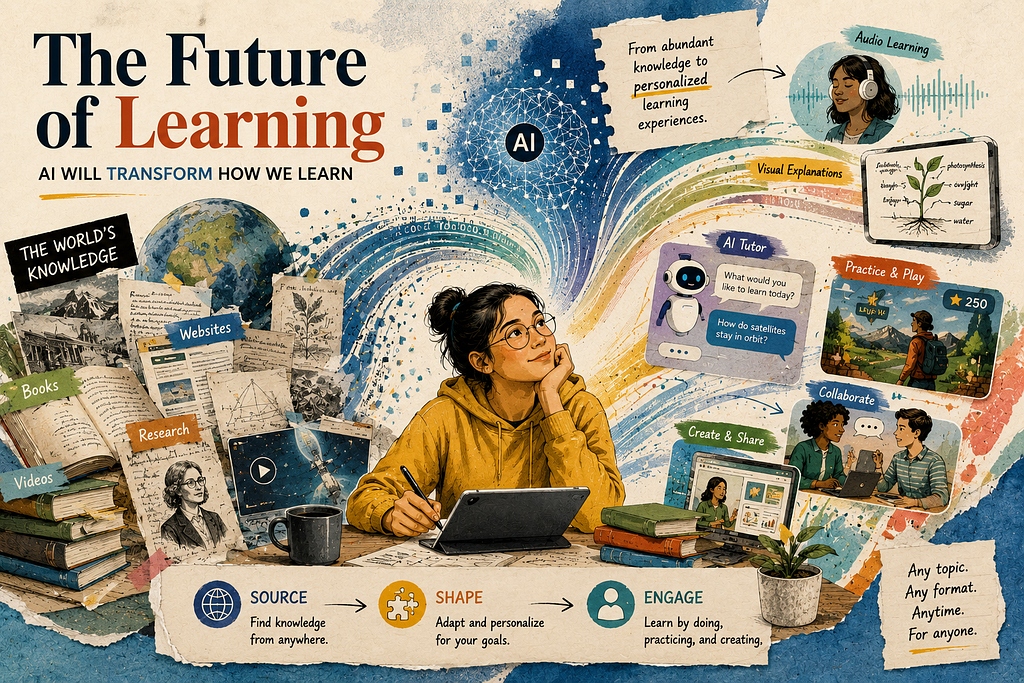
Teaching and learning are rapidly evolving powered by an abundance of knowledge and AI-enabled education. Historically education has been a compromise; diverse groups of learners were given the same instruction and content because it was impractical to personalize it to their needs and abilities. Increasingly, knowledge can be sourced broadly, shaped for a specific learner or goal, and delivered through dynamic experiences that adapt to how people learn. The transition will empower billions of people as the tools and techniques spread and the cost drops.
“Explain how GPS satellite trilateration works to a deep-sea fisherman, written as an immersive, atmospheric podcast with ‘sound effect’ cues, spoken in Irish Gaelic.”
Only five years ago the idea of customized learning content being created and delivered at scale with speed was science fiction. Today this is a plausible prompt that a service like Google’s NotebookLM can deliver in under 5 minutes.
This is enabled by three converging capabilities. First, the internet has made the world’s knowledge to be broadly accessible. Second, AI has made it possible to shape that knowledge, adapting the language, format, examples, scope and depth for a particular learner or specific need. Third, AI can help engage a learner through generative media, interactive interfaces, and conversational agents.
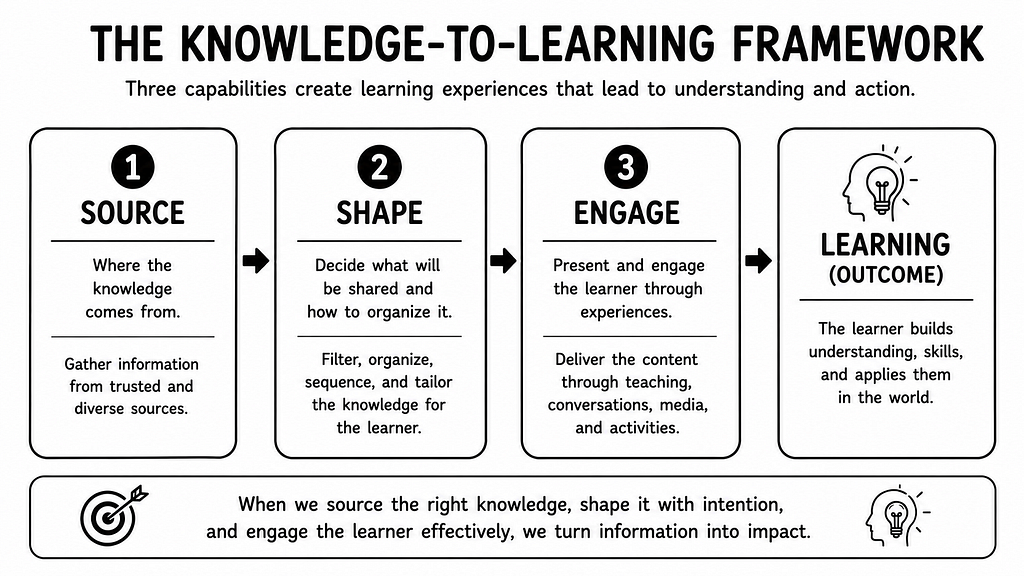
These capabilities apply to both formal education (K-12, university, trade school, etc.) as well as lifelong learners (time of need, hobbyist, the curious, etc). The ability to source knowledge, shape it and engage with a learner is just as relevant to an 8th grader studying math as it is to a DIYer fixing a car, or a family chef trying a new recipe. Every person has the opportunity and need to acquire new skills and knowledge, in some cases out of curiosity and growth and in other cases it is a need for prosperity and survival.
Sourcing Knowledge
Historically, one of the greatest barriers to learning was simply gaining access to relevant material, assuming the knowledge existed at all. Even the best teacher could not cover knowledge that was inaccessible, highly specialized, or scattered across distant sources. The internet dramatically reduced those barriers, though learners still had to find, evaluate, assemble, and interpret the information themselves.
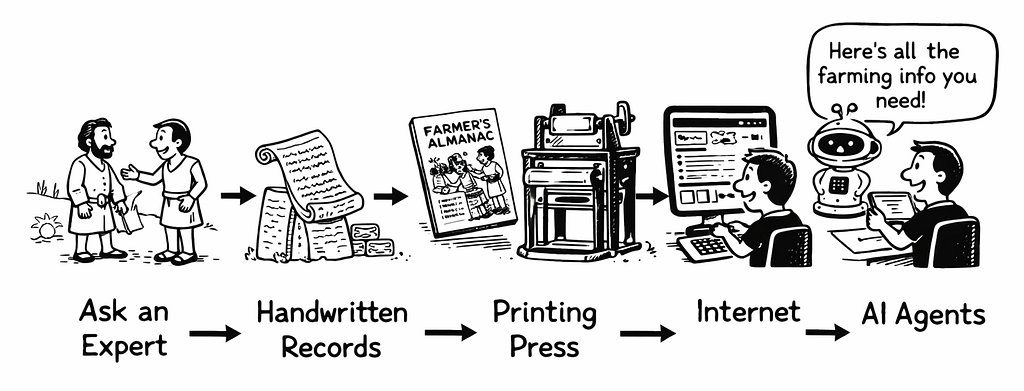
Imagine a person who needed to learn farming in an ancient civilization. The knowledge of when to plant crops, how to manage soil, how to preserve foods all required finding an expert that had already done these things and learning from them. Eventually there were written guides or even a calendar of planting seasons. In more recent history the printing press could provide publications like the Farmer’s Almanac. Only in the last few decades did it become possible to use a computer to search the world’s farming knowledge online, but even that required the learner to search, sort, synthesize, and translate the information themselves. Today, AI systems are emerging that can search, synthesize and repackage the information for specific needs.
Shaping Knowledge
Content can be reshaped for the learner across fundamental characteristics such as level, depth, length, language, style, and format. The same knowledge can become a beginner-friendly explanation, a concise summary, an immersive podcast, a visual diagram, a video, or a lesson grounded in familiar examples and analogies.
Furthermore, content can also be structured for builders and systems. Knowledge can be represented as Markdown, CSV, JSON, or other machine-readable formats, allowing it to move between applications, agents, interfaces, and learning workflows. This portability enables the same knowledge to power many different experiences.
Knowledge has evolved from a scarce and fragmented resource into something abundant and broadly accessible. AI is now making that knowledge increasingly adaptable to individual learners and portable across systems. As these barriers fall, the central challenge for human learning shifts from accessing information to transforming it into durable understanding and practical capability.
Engaging the Learner
Once knowledge has been sourced and shaped, learning still depends on engagement. Learners need to encounter the material, retrieve it, apply it, receive feedback and revisit it over time. Historically, personalizing that engagement has been difficult and expensive, so learners were often grouped into cohorts and taught through a shared lesson. The shared lesson was often too slow for advanced learners and too fast for those struggling with the content. AI makes it increasingly possible to create learning experiences that adapt to individual needs while still scaling efficiently.
How We Learn
It is important to take a step back to summarize how we as humans learn. The key is having the learner exposed to knowledge, retrieving that knowledge, and then applying the newly acquired knowledge in progressively more sophisticated situations over time. Below is a framework to think about the types of interactions you can have to acquire knowledge.
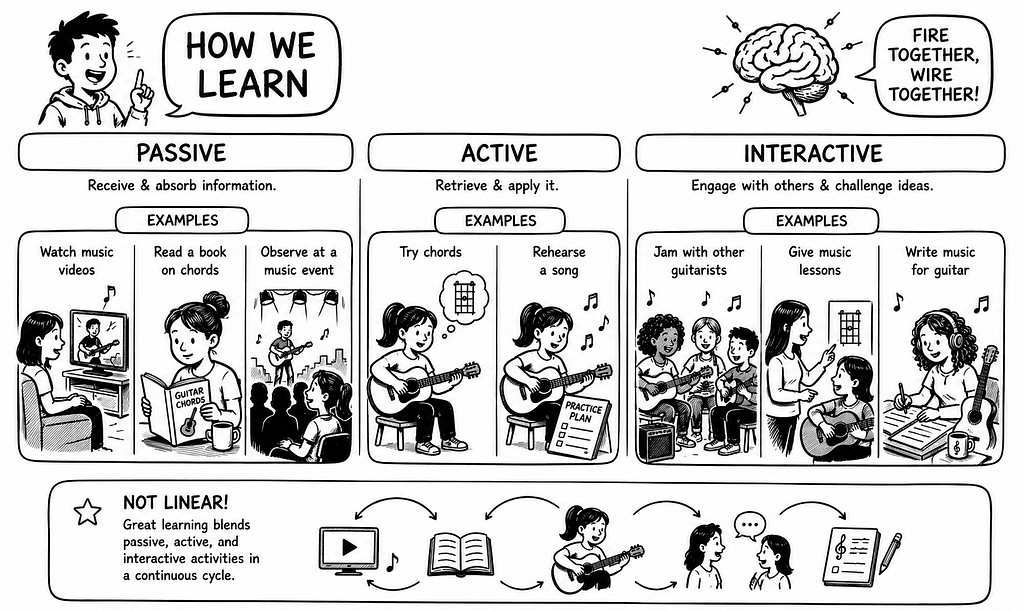
- Passive learning includes watching, listening and even reading where the learning is observing others, but does not have to themselves perform (or attempt) the skill. This can be useful for introductions for orientation, overviews or even triggering cross topic associations, but is limited in building repeatable expertise.
Example: A learner starts to consume guitar playing music videos, reads a book on chords, and pays attention at a musical event to the guitarist’s fret positions.
- Active learning is recalling and engaging the skill through activities like testing, practicing, summarizing, etc. where the learner must retrieve knowledge from their memory and see if they can put it to use. This is very effective in reinforcing those neural pathways.
Example: The learner picks up a guitar, tries chords, and rehearses a song.
- Interactive learning involves internalizing concepts further, by reconstitution through teaching, dialogue, debate, and contribution of the topic. It pushes deeper retrieval and abstraction as the learner must contend with other’s mental models (i.e. schemas), challenging or evolving their own understanding.
Example: The learner has a jam session with other guitarists, gives music lessons, and writes music for the guitar.
These modes are not linear as an effective learning experience will engage the learner with many activities incorporating passive, active and interactive lessons. The design of the experience can optimize how effective it is, keeping lessons engaging and novel, while putting the learner in a flow state where they are challenged but feel the lesson is achievable.
Applying AI Capabilities to the Learning Process
Using these modes of learning we can start to think about how curriculum development and the learning experiences are evolving with innovation. AI has unlocked always-available learning partners that can deliver any lesson in the world personalized to the ability, preferences and even mood of a learner. I have jokingly stated that “imagine you could have Duolingo for any topic… Duolingo for Greek History, Duolingo for Fixing a Bosch Dishwasher, Duolingo for Poodle Training, etc.” The truth is that this can be done and more.
Consider the types of capabilities that AI is enabling:
- Learning Tools and Games: A coding agent can create a set of flash cards, a game or simulation that makes interactions more engaging.
- Multimodal: AI can transform the same content into various text formats, audio, images, diagrams, video, chats, and more.
- A Collaborator: A chatbot can be a mentor, critic, debate partner, or role-playing partner. Importantly this is often a 1:1 interaction allowing both the focus and pacing to be specific to the learner’s needs.
- Dynamic Curriculum: AI can evaluate performance, strategize lessons, and orchestrate what I need to learn next and how to deliver it.
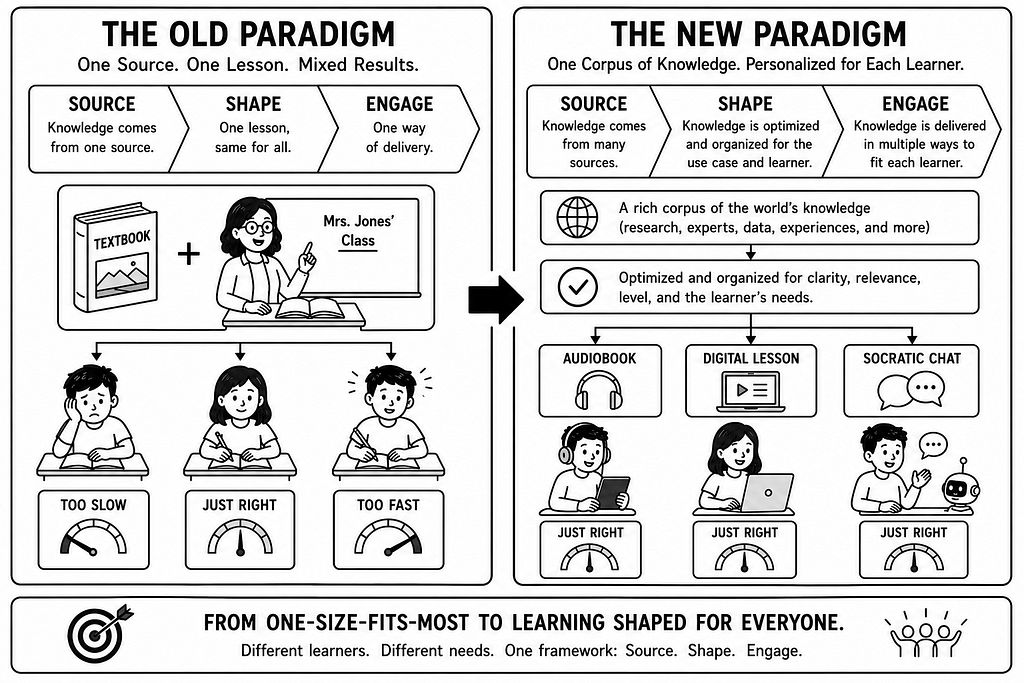
The power of these features is that they shift knowledge delivery from static one to many content to dynamic personalized content that is presented in engaging ways. And while the features existed pre-AI (e.g. Duolingo Spanish employs many of them), it was cost-prohibitive and not feasible to offer all subjects optimized for an individual learner.
A Gallery of the Possible
The raw ingredients to power the next generation education experiences are available to students, learners, and builders everywhere. Building on a foundation of knowledge access and content shaping, the learning experience will be optimized and we will see an explosion of approaches, techniques, and experiments on how we learn. These techniques will evolve and cross-pollinate across formal education, on-demand learning needs, and personal hobby solutions.
By combining these building blocks, we can design solutions for any niche:
Global Veterinary Companion
- Use Case: A student in a remote village wants to learn animal care in their local language.
- Sources: Global textbooks, agricultural records, and husbandry practices.
- Shape: Translate into local language, simplify technical material and generate relevant examples.
- Engage: A multilingual AI tutor with voice-based lessons and care simulations.
Small Business Entrepreneurship
- Use Case: A first-time founder in San Francisco needs to navigate local licensing and taxes.
- Sources: SF business regulations, zoning laws, and tax requirements.
- Shape: Consolidation, summarization, simplification, and examples
- Engage: A step-by-step startup guide paired with an “SF Small Biz Tycoon” simulation game.
Skilled Trade Readiness
- Use Case: A worker wants to learn a high-stakes trade and practice safely before entering the field.
- Sources: Trade manuals, safety standards, and vocational training materials.
- Shape: Sequence concepts, reduce jargon, create a vocabulary list and skill progressions.
- Engage: VR simulations and gamified challenges that track skill progression and provide instant feedback.
Reviving Heritage Cooking
- Use Case: A grandchild wants to revive family recipes written in a language they don’t speak.
- Sources: Family cookbooks, regional food history, and cultural cooking records.
- Shape: Translate, create structured recipes from incomplete information, identify substitute ingredients.
- Engage: Step-by-step audio walkthrough.
DIY Auto Restoration
- Use Case: A car enthusiast wants to restore a 1965 Mustang without being an expert mechanic.
- Sources: Manufacturer manuals, repair databases, YouTube videos, and diagnostic data.
- Shape: Reduce jargon, organize information for retrieval and troubleshooting, and add generated diagrams/images.
- Engage: Real-time troubleshooting via conversational assistant and visual overlays.
These are five use cases of millions. We each have unique situations and needs that would benefit from knowledge. What if they were all unlocked?
In Summary
For most of human history, knowledge was a trickle. In the last few decades it has become a torrent. Today with AI enabled capabilities the new challenge is not simply access, but transformation: how do we source the right knowledge, shape it for a specific learner or need, and engage people in ways that build durable understanding and practical capability?
The foundation is set. Knowledge is abundant. AI can help shape that knowledge for different abilities, goals, formats, and contexts. Learning experiences can now be created, personalized, and optimized in ways that were once too expensive or specialized to pursue.
There will not be one solution to learning. There will be many platforms, tools, teachers, experts, learners, and builders creating experiences for different needs. The opportunity now is to experiment with these capabilities and help build a future where more people can learn what they need, when they need it, in a way that works for them. In turn, these tools will help steer our future, address historical education inequities, and help transition our society to a knowledge-abundant future.
The Future of Learning was originally published in Towards AI on Medium, where people are continuing the conversation by highlighting and responding to this story.
