Memory & Persistence: Give Your AI a Brain That Doesn’t Reset— Prompt to Profit · Day 16 of 30

Every conversation, AI starts with amnesia. But there’s a way to build genuine institutional memory — and it changes everything about how you work.
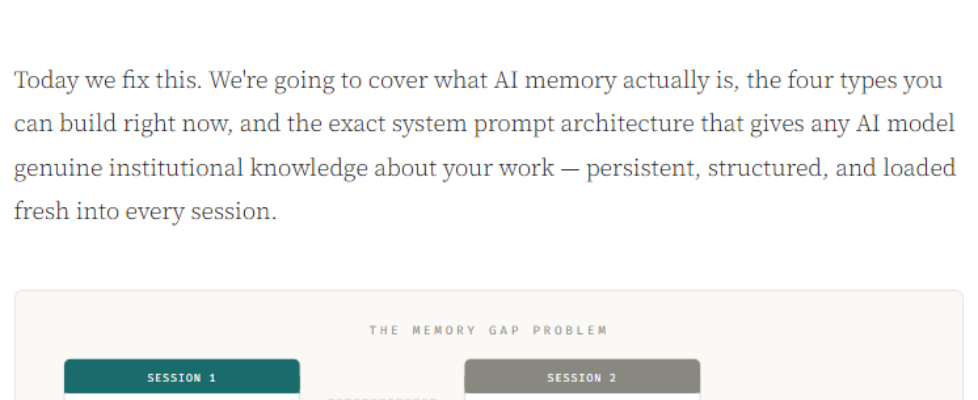
There is a frustration every serious AI user eventually runs into, usually around the third or fourth week of daily use. You’ve built a relationship with this tool. You’ve taught it your voice, your audience, your business model, your preferred output format. Then you open a new conversation and it has forgotten all of it. Every session begins the same way: the blank slate, the generic responses, the need to re-explain context you’ve explained twenty times before.
This isn’t a bug. It’s a fundamental architectural property of how large language models work — they have no persistent state between sessions. Each conversation is, from the model’s perspective, the first time it has ever met you. The context window closes, the state evaporates, and the next session begins fresh.
But here is what most people miss: the problem isn’t that AI has no memory. The problem is that most people have never built one for it.
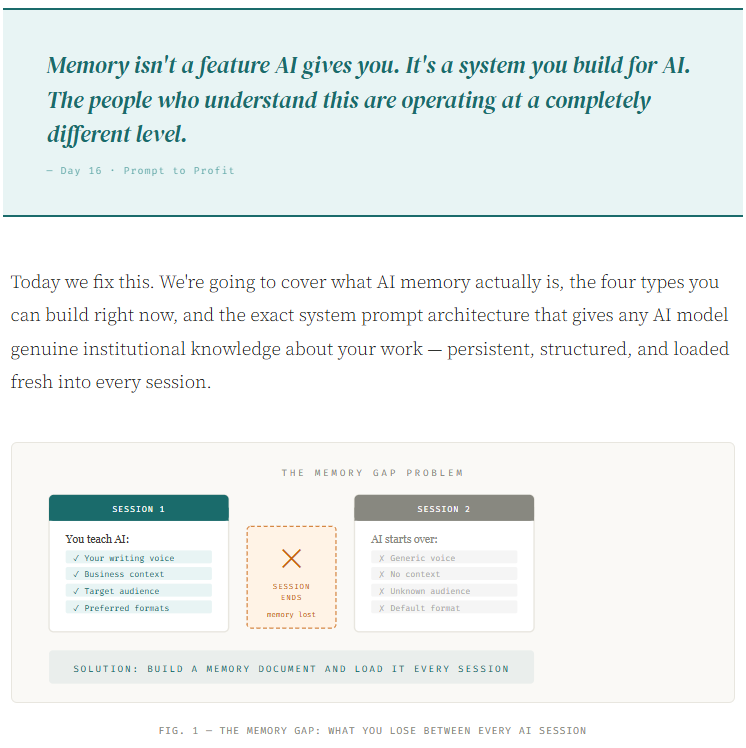
The Four Types of AI Memory
Not all memory is the same. Before you build anything, it helps to understand the taxonomy — because different types of memory serve different purposes, and the best AI memory systems combine all four.
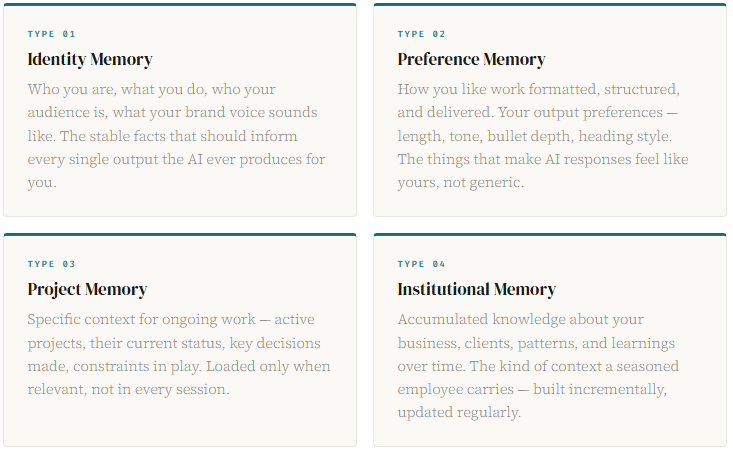
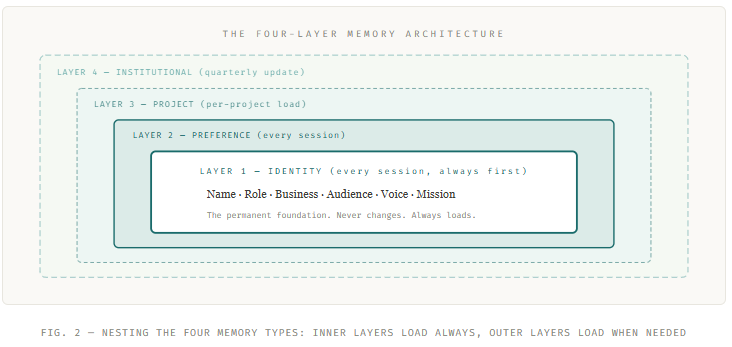
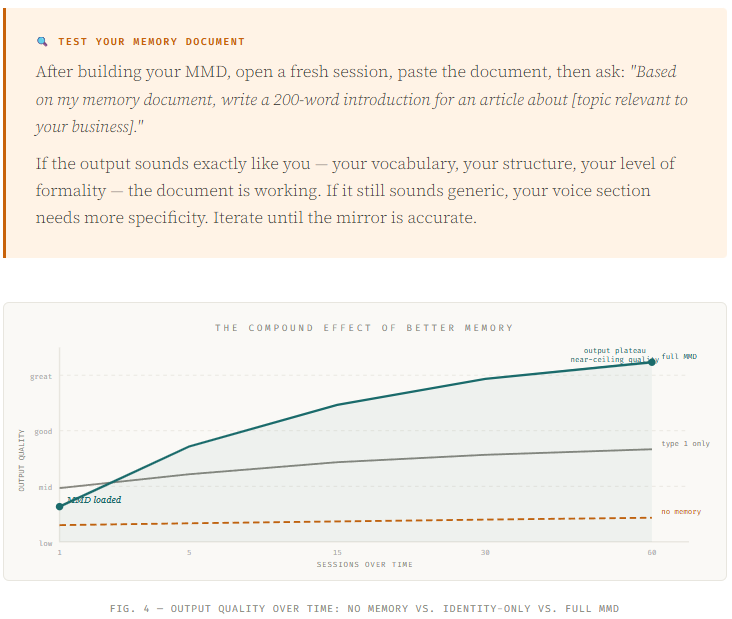
The most common mistake is building only Type 1 (identity) and wondering why AI still feels generic. A well-designed memory system layers all four — with Type 1 and 2 loaded into every session, Type 3 loaded for relevant work, and Type 4 built and maintained as a living document.
Building Your Master Memory Document
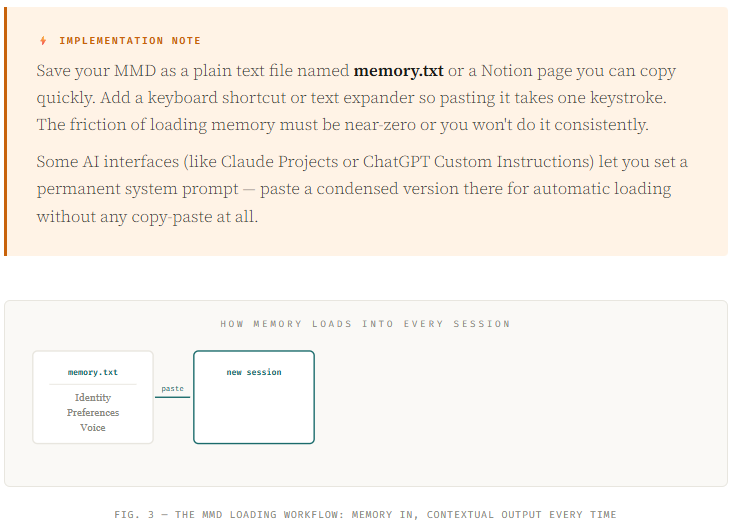
The most practical implementation of AI memory is a single structured document — your Master Memory Document (MMD) — that you paste at the top of every new session. It takes about an hour to build properly, and it transforms every AI interaction you have from that point forward.
Here is the exact template. Fill in the brackets with your real information. Be specific — vague memory produces vague outputs.
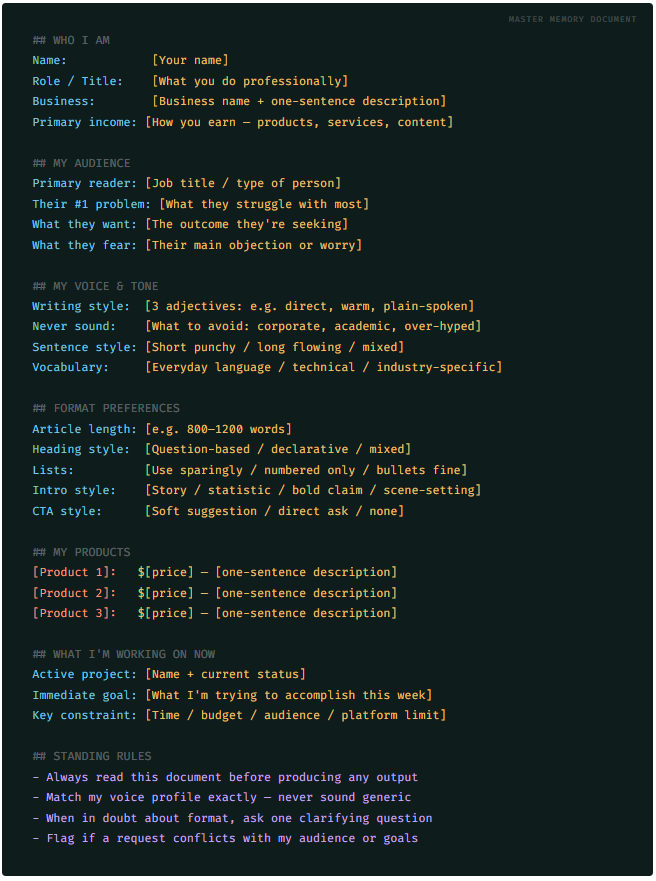
That’s your memory foundation. It fits in under 500 words. It loads in under three seconds. And from the first line of your next task prompt, you’re working with an AI that knows you — not a generic assistant that has to be briefed from scratch every time.
Advanced: The Living Memory Update Loop
A memory document that never changes eventually becomes stale. The highest-leverage practitioners treat memory as a living system — updated incrementally as they learn and build.
The mechanism is simple. At the end of any session where something important was established — a new product launched, a style decision made, an audience insight discovered — add a note to your MMD. Keep it to one or two lines. Over time, this becomes a genuinely powerful institutional knowledge base.
You can also ask AI to help maintain it. After a productive session, paste your current MMD and the session summary and prompt: “Based on our conversation today, what should I add, update, or remove from my memory document? Keep additions to two lines or fewer.” The model will identify what’s new, what’s changed, and what’s worth preserving — you review, approve, and update. Memory that grows with you.
The context window closes at the end of every session. That’s not going to change. But the quality of what loads at the start of every new session — that’s entirely within your control. The people who have built good memory systems aren’t fighting the amnesia. They’ve engineered around it. And the gap between their AI outputs and everyone else’s gets wider every week.
Build the document. Load it consistently. Update it quarterly. The ceiling on what your AI can produce for you is determined almost entirely by how well it knows you. Give it the knowledge to do its best work.
Tomorrow, Day 17, we move from memory to Voice Cloning — the advanced technique for training AI to reproduce your exact writing style so precisely that readers can’t tell the difference between what you wrote and what the AI drafted.

For more resourcces and documents, please refer to the links in my profile page: Faheem Munshi — Medium
Memory & Persistence: Give Your AI a Brain That Doesn’t Reset— Prompt to Profit · Day 16 of 30 was originally published in Towards AI on Medium, where people are continuing the conversation by highlighting and responding to this story.
