
LLM Fallback Architecture: How to Keep AI Apps Working When Models Fail


Most AI applications do not fail because the model is weak. They fail because every request depends on one model, one provider, one region, one schema path, and one retry loop.
A reliable LLM app treats fallback as architecture, not as a last-minute catch block.
If you build with large language models long enough, you learn a painful lesson: the happy path is not the product. The product is what happens when the primary model times out, returns malformed JSON, hits a rate limit, changes behavior after an update, or quietly gets slower during peak demand.
Developers are feeling this now because modern AI stacks are no longer simple wrappers around one completion endpoint. A production app may call a fast model for classification, a stronger model for reasoning, an embedding model, a reranker, a tool-calling agent, a vision model, and a safety classifier. Each call can fail differently. A retry that helps one layer can make another layer more expensive or less reliable.
Frameworks have started to expose this as a first-class concern. LangChain documents model fallback middleware, LiteLLM positions routers as gateway-level primitives, and provider docs recommend exponential backoff. Those pieces are useful, but they do not answer the larger design question: when should an AI team retry, switch models, degrade the feature, or stop?
This guide is for developers, AI engineers, founders, and technical leads who want an LLM fallback architecture that protects users without hiding bad behavior from the team.
The Real Problem Is Not Provider Downtime
Provider downtime is the easy failure to understand. The harder failures look normal from the outside. The request returns a 200 response, but the JSON is invalid. The model answers, but ignores the required tool. The fallback model works, but cannot follow the same structured output contract. A region returns intermittent 429s. A background worker retries a long prompt until the bill becomes the incident.
Recent developer discussions around Gemini API 429s, region fallback, API fetch failures, and hanging retries show the same pattern: people can usually add a retry. They struggle to build a policy. One thread asked how to tell which model actually handled the request. Another described fallback across regions. A separate discussion noted how default queue retries can multiply one stuck model call.
Those are not random complaints. They are symptoms of the same missing layer: a fallback control plane.
A retry loop answers, “Can I try again?” A fallback architecture answers, “What is the safest useful thing to do next, and how will we know it happened?”
What LLM Fallback Architecture Actually Means
LLM fallback architecture is the design of alternate paths for AI requests when the preferred path is unhealthy, slow, too expensive, unsafe, or unable to satisfy the contract. It includes retries and provider switching, but it also includes graceful degradation, human review, schema validation, model capability tiers, observability, cost budgets, and product-level decisions about what users should experience when confidence is low.
A mature fallback design defines six things before production traffic arrives:
- Which failures are retryable and which are not.
- Which fallback model or provider can safely replace the primary model for each task.
- Which output contracts must be preserved across every fallback path.
- Which requests should degrade to a simpler feature instead of chasing perfect output.
- Which failures require human review, user messaging, or queueing for later.
- Which metrics prove the fallback path is helping instead of hiding a bigger incident.
The most important word is safely. A weaker model may be fine for rewriting a notification. It may be dangerous for legal analysis, medical triage, payment disputes, code execution, or data deletion. Fallback is not simply “try the next cheapest model.” It is a capability match under failure.
Start With Failure Types, Not Vendor Names
A common mistake is to start by listing providers: primary OpenAI, fallback Anthropic, fallback Gemini, local model. That sounds robust, but it skips the question that matters: why did the first call fail? Different failures deserve different responses.
Transport and network failures
These include connection resets, DNS problems, gateway errors, and temporary service unavailability. A short retry with jitter can be enough. If the same provider or region keeps failing, move the request to a healthy route and open the circuit for the bad route.
Rate limits and quota exhaustion
OpenAI’s rate-limit guidance recommends exponential backoff and warns that unsuccessful requests still count against per-minute limits. That second point matters. A blind retry loop can turn a rate-limit event into a traffic jam. For 429 errors, you usually want bounded retries, jitter, a retry budget, and then a fallback route or queue.
Latency spikes
Slow is a failure when the user is waiting. For interactive features, use a latency deadline: if the primary model does not respond within a threshold, launch a fallback request or return a simpler response. For background jobs, enforce a cost and retry budget.
Contract failures
This is where many LLM apps break. The model returns text instead of JSON. A required field is missing. A tool call is malformed. A citation field contains a sentence instead of a URL. Retrying the same prompt may work once, but it can also create inconsistent behavior. Contract failures need validation, repair, and sometimes stronger instruction following rather than just another provider.
Capability failures
The model answered, but the answer is not good enough. Maybe it failed an eval, used the wrong language, refused a benign request, or could not handle the context size. These failures should route by task capability, not by generic availability.
Policy and safety failures
Some requests should not fallback to a more permissive path. If a safety classifier blocks an action, switching to a different model to get an answer is not resilience. It is policy bypass. Your fallback layer should preserve safety decisions across providers.
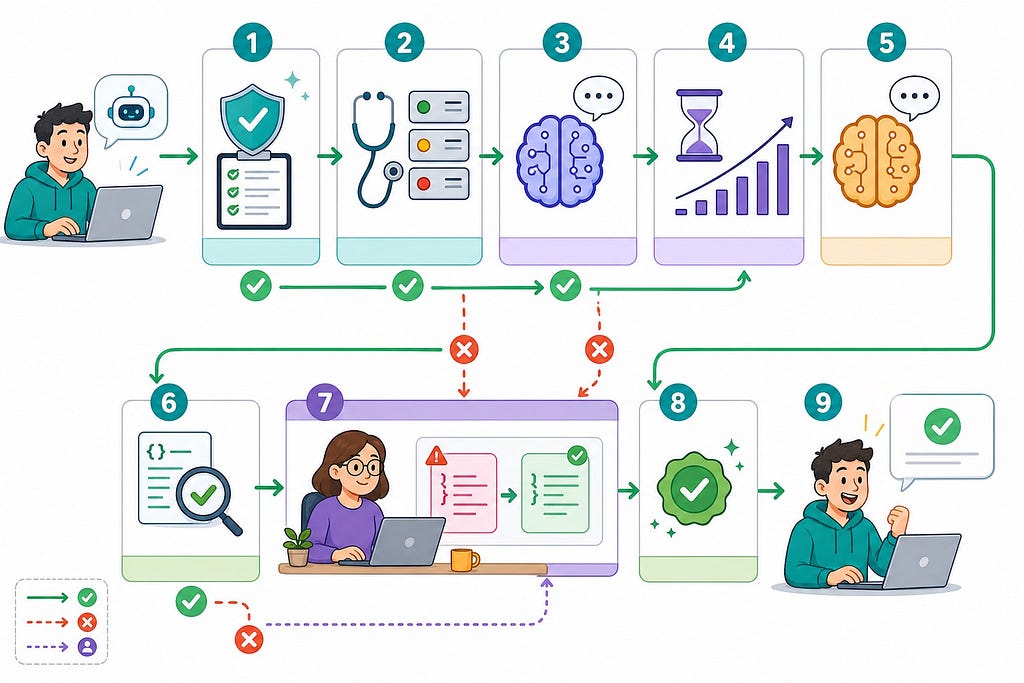
A Practical Fallback Decision Tree
The simplest useful fallback design is a decision tree. It needs to be explicit.
The fallback path should be understandable enough that a new engineer can debug it during an incident.
For each AI task, define a policy like this:
- Validate the request before calling a model.
- Check whether the preferred route is healthy and under budget.
- Call the primary model with a timeout and trace ID.
- Retry only if the error is retryable and the retry budget allows it.
- Validate the output against the task contract.
- If validation fails, run a repair path or a stronger fallback model.
- If confidence is still low, degrade the product behavior or send to review.
- Log the route, reason, cost, latency, validation result, and final outcome.
During an incident, nobody wants a clever chain of hidden callbacks. They want to know why a request moved from model A to model B, whether that was expected, and whether users saw a degraded result.
The Four Fallback Patterns Developers Actually Need
1. Same-model retry with backoff
Use this for transient failures. It is the right first step for many 429, 500, 502, 503, and network errors. Add jitter, a maximum attempt count, a maximum total duration, and retry metrics.
Do not use unlimited retries for long-running background tasks. If a queue, serverless function, and LLM client all retry independently, one user action can trigger many model calls. Put one layer in charge of retries and make the others conservative.
2. Equivalent model fallback
Use this when another model can satisfy the same product contract. For example, a support summarization task may safely move from one fast general-purpose model to another. The fallback model must support the same response format, language requirements, safety policy, and latency target.
Framework support can help here. LangChain’s model fallback middleware can try alternative models in sequence after a failed model call. LiteLLM’s router layer can centralize provider exceptions and model routing. These tools reduce plumbing, but the policy is still yours.
3. Capability-tier fallback
Sometimes the fallback should be stronger, not cheaper. If a compact model fails schema validation twice, the right move may be a larger model with better tool-use behavior. If a long-context task fails because the fallback model cannot handle the input window, you may need to summarize, retrieve less, or queue the request instead of switching blindly.
This is where task taxonomy helps. Label tasks by capability: extraction, classification, rewrite, retrieval answer, reasoning, code generation, multimodal analysis, tool execution, or safety review. Each category gets its own fallback ladder.
4. Product degradation fallback
Not every AI feature deserves another model call. If a generated insight cannot be produced reliably, show a simpler deterministic answer. If an assistant cannot complete a workflow, save the draft and ask the user to continue later. If a recommendation engine is uncertain, return rule-based recommendations and mark the AI enhancement unavailable.
Good degradation protects trust. It says, “We can still help, but we will not pretend the AI path succeeded.”

Example: A TypeScript Fallback Wrapper
The code below is deliberately small. It shows the core idea: classify errors, enforce budgets, validate output, and record the route.
type ModelRoute = {
  name: string;
  provider: "primary" | "backup" | "local";
  timeoutMs: number;
  maxAttempts: number;
  call: (input: unknown, signal: AbortSignal) => Promise<unknown>;
};
type FallbackResult<T> = {
  value: T;
  route: string;
  attempts: number;
  degraded: boolean;
};
function isRetryable(error: unknown): boolean {
  const status = (error as { status?: number }).status;
  return status === 429 || status === 500 || status === 502 || status === 503 || status === 504;
}
function sleep(ms: number) {
  return new Promise((resolve) => setTimeout(resolve, ms));
}
async function runWithFallback<T>({
  input,
  routes,
  validate,
  trace
}: {
  input: unknown;
  routes: ModelRoute[];
  validate: (raw: unknown) => T;
  trace: (event: Record<string, unknown>) => void;
}): Promise<FallbackResult<T>> {
  let attempts = 0;
  for (const route of routes) {
    for (let attempt = 1; attempt <= route.maxAttempts; attempt++) {
      attempts += 1;
      const controller = new AbortController();
      const timer = setTimeout(() => controller.abort(), route.timeoutMs);
      try {
        trace({ type: "llm_attempt", route: route.name, attempt });
        const raw = await route.call(input, controller.signal);
        const value = validate(raw);
        trace({ type: "llm_success", route: route.name, attempts });
        return {
          value,
          route: route.name,
          attempts,
          degraded: route !== routes[0]
        };
      } catch (error) {
        trace({
          type: "llm_failure",
          route: route.name,
          attempt,
          retryable: isRetryable(error)
        });
        if (!isRetryable(error)) break;
        const delayMs = Math.min(8000, 250 * 2 ** (attempt - 1)) + Math.random() * 250;
        await sleep(delayMs);
      } finally {
        clearTimeout(timer);
      }
    }
  }
  throw new Error("All LLM routes failed validation or availability checks");
}
This wrapper is missing production concerns such as streaming, provider-specific error types, token budgets, circuit breakers, and structured telemetry. But it contains the foundation. The fallback path is not hidden in scattered catch blocks. It is a product decision expressed in code.
Preserve the Output Contract Across Models
Fallback models often fail in boring ways. A primary model returns strict JSON. A fallback model returns prose. A primary model cites sources. A fallback model cites none. A primary model calls tools with valid arguments. A fallback model invents a field.
That is why every fallback path needs contract validation. Use JSON Schema, Zod, Pydantic, type guards, or provider-native structured output features where available. Treat validation failure as a separate signal from provider failure.
For example, a customer-support classifier may require this shape:
{
  "category": "billing" | "technical" | "account" | "other",
  "urgency": "low" | "medium" | "high",
  "summary": string,
  "needsHumanReview": boolean
}
If a fallback model cannot reliably produce that shape, it is not a valid fallback for this task. It may still be useful for a different task. Reliability is contextual.
Add Circuit Breakers Before You Need Them
A circuit breaker prevents your app from sending more traffic to a route that is already failing. Without it, every request discovers the same outage independently. That wastes time, money, and user patience.
A basic LLM circuit breaker tracks recent failures per route. If failures cross a threshold, the route becomes temporarily unavailable. After a cool-down, a few probe requests test whether the route has recovered.
Use route-specific breakers. A provider may be healthy for short text calls but unhealthy for long-context multimodal calls. Do not trip a provider route because users sent invalid input. Do trip it when timeout, 429, or 5xx rates climb above baseline.
Do Not Let Fallback Hide Quality Drift
Fallback can become dangerous when it makes dashboards look healthy. Users get responses, so the incident seems solved. But maybe the fallback model is slower, more expensive, less accurate, or skipping citations. The feature is available, but quality has changed.
Track fallback as a first-class product metric:
- Fallback rate by task, route, model, provider, and customer segment.
- Retry count and retry success rate.
- Output validation failure rate.
- Latency added by fallback and repair steps.
- Cost per successful task, not just cost per token.
- User-visible degradation rate.
- Human review rate after fallback.
- Eval score differences between primary and fallback routes.
The key metric is not “did any model answer?” It is “did the task still meet the product contract?”
Fallback should make incidents smaller, not invisible.
Design Fallback Ladders by Task
One global fallback chain is easy to configure and hard to trust. Production apps need task-specific ladders.
For classification, you may prefer a compact model, then deterministic rules, then human review. For extraction, you may prefer repair, then a stronger structured-output model, then queueing. For conversational support, you may prefer primary chat, backup chat, retrieval-only answer, then escalation. For tool execution, you may prefer no automatic fallback unless the tool arguments validate and policy allows the action.
The ladder should include non-model options. A cache, search result, saved draft, human review queue, or clear user message can be a fallback. Sometimes the best model fallback is no model.
Where Frameworks Fit
You do not need to build everything from scratch. Existing tools can carry pieces of the system.
LangChain’s fallback middleware is useful when you want ordered fallback models after model call failures. LiteLLM is useful when you want a provider-compatible gateway, centralized exceptions, routing, budgets, and operational control. Provider SDKs and docs still matter because they explain error types, rate limits, and recommended backoff behavior.
But do not confuse a router with an architecture. A router can move traffic. It cannot decide whether a fallback answer is acceptable for your product, whether a safety decision should block fallback, or whether a user should see a degraded response.
A Production Checklist for LLM Fallbacks
Before shipping a fallback path, ask these questions:
- Have we defined retryable, validation, policy, and capability failures?
- Does every fallback model support the same output contract required by the task?
- Do we have a maximum retry budget per request and per background job?
- Can we identify which model, provider, region, and route handled each response?
- Do users receive a truthful degraded experience when AI output is unavailable?
- Are safety decisions preserved across fallback routes?
- Do circuit breakers protect failing providers, regions, and model routes?
- Can we compare quality and cost between primary and fallback paths?
- Have we tested fallback under simulated 429s, timeouts, schema failures, and bad outputs?
- Does the runbook explain when to disable a model route manually?
If you cannot answer those questions, the fallback path may still work in a demo. It will not be easy to operate during a real incident.
The Bigger Shift: AI Reliability Is Becoming Product Design
Traditional software reliability often focuses on availability: can the system return a response? AI reliability adds a harder question: is the response trustworthy enough for this action?
That is why fallback belongs in product design, not just infrastructure. A model switch can change tone, accuracy, safety behavior, latency, and cost. A clear degraded answer can protect trust. A silent fallback can damage it.
The best teams treat fallback as part of the user journey. They know which AI features can degrade quietly, which need a visible message, which need review, and which should fail closed. They test those paths before launch and measure the quality gap between primary and fallback routes.
That is the goal: a calm system that knows what to do when the model path is imperfect.
FAQ
What is LLM fallback architecture?
LLM fallback architecture is the design of backup paths for AI requests when the preferred model, provider, region, or output contract fails. It includes retries, model routing, validation, circuit breakers, graceful degradation, observability, and human review paths.
Is model fallback the same as retry logic?
No. Retry logic usually tries the same request again after a temporary failure. Model fallback may switch to another model, provider, region, repair path, deterministic response, cache, queue, or human review workflow. Retries are one part of fallback architecture.
When should an AI app switch to a fallback model?
An AI app should switch when the primary route is unhealthy, rate limited, too slow, over budget, or unable to satisfy the task contract. The fallback model should be approved for that specific task, not just globally available.
Should fallback models be cheaper or stronger?
It depends on the failure. For provider downtime, an equivalent model may work. For schema failures or complex reasoning, a stronger model may be safer. For low-value tasks, a cheaper model or deterministic degradation may be enough.
How do you test LLM fallback behavior?
Simulate 429s, timeouts, 5xx errors, malformed JSON, invalid tool calls, slow responses, and low-quality outputs. Then verify that the fallback route preserves the output contract, logs the reason, respects budgets, and gives the user an acceptable experience.
What metrics matter for LLM fallback systems?
Track fallback rate, retry count, validation failure rate, latency, cost per successful task, degradation rate, human review rate, route-level error rates, and eval score differences between primary and fallback models.
Can frameworks like LangChain or LiteLLM handle fallback automatically?
They can handle useful parts of the plumbing, such as model fallback middleware, routing, provider compatibility, and exception handling. You still need product-specific policy, validation, safety rules, observability, and task-specific fallback ladders.
Sources and Further Reading
- LangChain JavaScript modelFallbackMiddleware reference
- LangChain Python model fallback reference
- LiteLLM documentation
- OpenAI rate limits guidance
- OpenAI Cookbook: handling rate limits
- Gemini API troubleshooting guide
- Google Cloud: handling 429 resource exhaustion errors in LLMs
LLM Fallback Architecture: How to Keep AI Apps Working When Models Fail was originally published in Towards AI on Medium, where people are continuing the conversation by highlighting and responding to this story.
