
They Laid Off 142,000 People to Pay for $725 Billion in AI. No Law Required Them to Say So.

Meta posted $56 billion in revenue the same quarter it cut 8,000 jobs. Cloudflare grew 25% and cut 20% of staff. A breakdown of the transfer that no one was legally required to disclose.

On May 20, 2026, Meta began executing 8,000 layoffs. That same day, California Governor Gavin Newsom signed an executive order acknowledging the problem. On the same day, in Washington, President Trump pulled a planned federal AI executive order hours before it was supposed to be signed.
Three things happened simultaneously, and together they describe the current situation with more precision than any single headline can. Companies are cutting at record speed. The only state government moving is studying the problem. The federal government stepped back.
The workers caught in the middle have no legal right to know whether AI contributed to their dismissal.
The companies executing the deepest cuts in 2026 are simultaneously reporting their strongest-ever quarterly results. This is not a cost-cutting wave. It is a capital reallocation.
The numbers that define 2026
More than 142,000 U.S. tech workers lost their jobs in the first five months of 2026, according to data from workforce analytics firm TrueUp and outplacement firm Challenger, Gray and Christmas. That represents a 33% increase over the same period in 2025, and puts the industry on pace for a full-year total approaching 370,000, close to the post-pandemic record of 430,000 set in 2023.
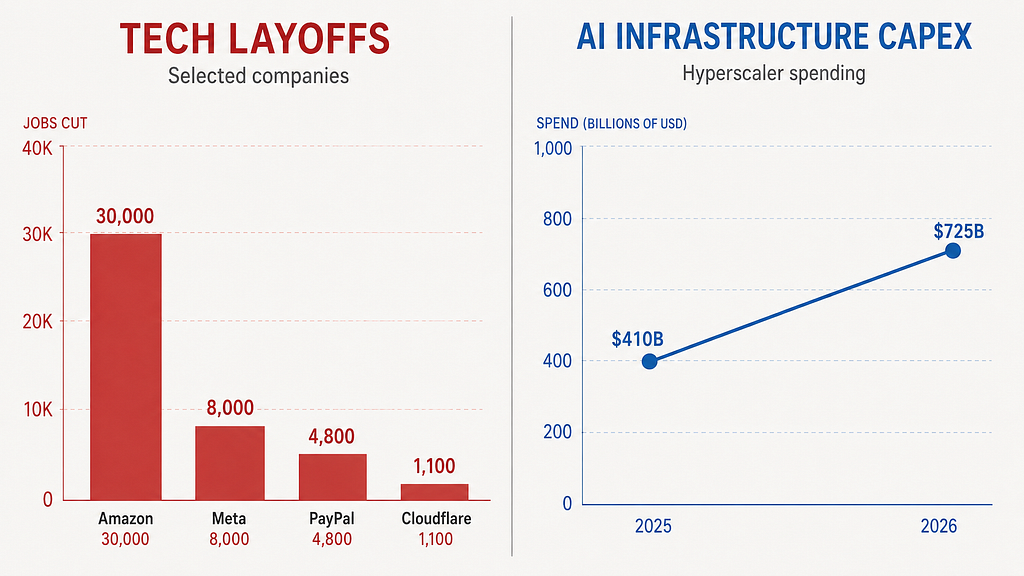
At the same time, the four largest technology companies, Google, Amazon, Microsoft, and Meta, collectively committed $725 billion in capital expenditure for 2026, up 77% from last year’s record of $410 billion. Nearly all of it is earmarked for AI infrastructure: data centers, GPUs, networking equipment, and the power systems to run them.
Both numbers are moving in the same direction, in the same companies, at the same time. That is not a coincidence. Meta’s CFO, Susan Li, told investors on the Q1 2026 earnings call that the planned May layoffs would help the company ‘offset the substantial investments we are making.’ Eight thousand jobs, framed in management’s own language, as an offset to capital expenditure. Meta’s Q1 revenue was $56.3 billion. Its operating margin was 41%.
The script that became a template
What is remarkable about the 2026 layoff wave is how candid the explanations have become. Three years ago, companies used language like ‘strategic realignment’ and ‘macro headwinds.’ In 2026, several CEOs have said the quiet part directly into earnings calls.
Cloudflare cut 1,100 jobs, 20% of its workforce, while reporting 25% revenue growth. Co-CEO Matthew Prince told investors it was ‘the first mass layoff in Cloudflare’s 16-year history’ and framed it as defining ‘how a world-class, high-growth company operates in the agentic AI era.’ The company’s co-founders emailed staff to clarify that the cuts were ‘not a cost-cutting exercise.’ They were about something larger.
PayPal announced plans to cut 4,800 jobs, 20% of its workforce, over the next few years. CEO Enrique Lores told investors the company would ‘remove duplication and layers’ first, then ‘accelerate AI adoption and automation across operations.’ The sequencing was explicit: human reduction, then AI scale.
Mark Zuckerberg, at a Meta town hall, told employees the cuts were a direct consequence of AI infrastructure costs and declined to rule out further reductions in the second half of the year. He also told investors: ‘We are seeing more and more examples where one or two people are building something in a week that would have previously taken dozens of people months.’
Cloudflare said the cuts were not a cost-cutting exercise. Meta said they were an offset to AI investment. Both statements are true at the same time, which is what makes 2026 different from every prior layoff cycle.
The protection gap
On May 21, Newsom’s executive order directed California state agencies to study revisions to the state’s Worker Adjustment and Retraining Notification Act and submit recommendations within 180 days. The order contains no immediate protections. It is a mandate to study the problem and report back by mid-November 2026. The California Labor Federation described it as ‘welcome but not enough.
At the federal level, no law currently requires employers to disclose whether AI contributed to a layoff decision. Colorado’s AI Act, which takes effect June 30, 2026, will require employers to guard against algorithmic discrimination in employment decisions, but it does not require disclosure when AI drives headcount reductions. There is no federal equivalent.
The policy gap is not difficult to explain. The companies spending $725 billion on AI are also among the most politically active in Washington. The Newsom order arrived the day after Meta’s cuts began. The Trump administration pulled its own AI executive order the same afternoon. Both events on the same day, pointing in opposite directions.

What the pace means
TrueUp’s current projections put 2026 on track for 370,000 total tech layoffs, approaching the post-pandemic record set in 2023. The significant difference is context. The 2023 wave followed a period of pandemic-era overhiring and was accompanied by falling revenues. This wave is arriving amid record profits, record margins, and the largest infrastructure-spending commitment in the history of the technology industry.
The Bureau of Labor Statistics’ Information sector — the federal government’s official tech-economy metric peaked at 3.115 million payroll jobs in November 2022. By April 2026, it had fallen to 2.773 million: an 11% decline and 342,000 net jobs lost, even as total U.S. nonfarm employment hit a recordof 158.7 million. Tech is in its own recession that the rest of the economy does not share.
Boston Consulting Group projects that up to 15% of U.S. jobs could be eliminated over the next five years. The Anthropic CEO, Dario Amodei, predicted in 2025 that AI could eliminate roughly 50% of entry-level white-collar positions in the same window. For the 142,000 workers who have already lost their jobs in 2026, the five-year projection is not the relevant timeline.
Tech is in its own recession that the rest of the U.S. economy does not share. 342,000 net tech jobs lost since November 2022. Total U.S. employment hit an all-time record in the same period.
The question nobody can answer yet
Every previous wave of labor-displacing technology eventually created more jobs than it eliminated. The internet, mobile computing, cloud infrastructure each destroyed entire job categories and created others that did not previously exist. The honest version of that argument acknowledges the transition period: real people, with real rent payments and real families, who fall between the old category and the new one.
What makes the current moment different is not the scale of job loss. It is the speed of capital movement. $725 billion is being committed to AI infrastructure in a single calendar year by four companies. The workers being displaced will not receive answers, timelines, or legal notifications about whether AI played a role. The executive order signed in California last week gives them a study due in November.
The gap between what is being built and what is being protected is, right now, the most consequential open question in the tech industry. It is also the question that 142,000 people are living inside, without a map.
If this analysis of the 2026 tech layoff wave is useful to you, consider following for more coverage of how AI is reshaping the workforce in real time. The next round of numbers will be out before summer ends.
They Laid Off 142,000 People to Pay for $725 Billion in AI. No Law Required Them to Say So. was originally published in Towards AI on Medium, where people are continuing the conversation by highlighting and responding to this story.
