When LLMs Meet Knowledge Graphs on the Battlefield

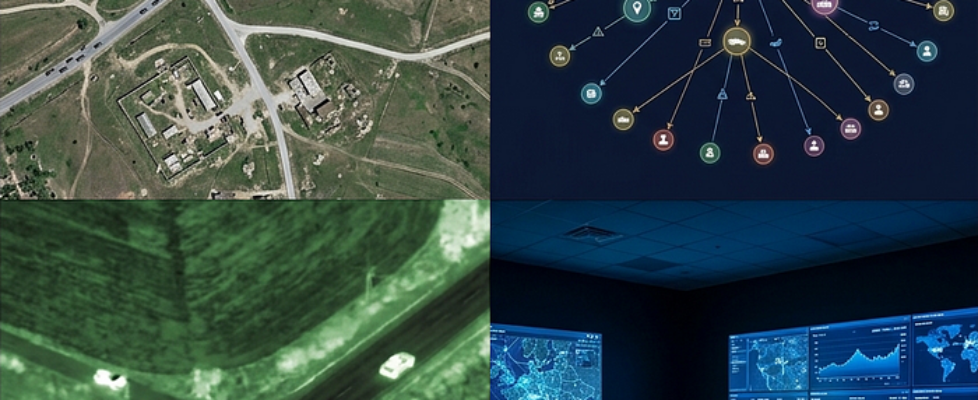
Author(s): Akash Dogra Originally published on Towards AI. The modern intelligence stack: satellite imagery, tactical knowledge graphs, drone surveillance, and command center fusion. When LLMs Meet Knowledge Graphs on the Battlefield How GNNs, LLMs, and ontology-grounded retrieval fuse into the architecture powering modern military intelligence — with the math, the code, and the failure modes. The 90-Second Decision That Broke Standard AI A highly dispersed sensor network detects anomalous activity across a 200-kilometer front. Synthetic aperture radar identifies irregular vehicle tracks near a tree line. Signals intelligence intercepts encrypted, short-burst radio transmissions. A week-old HUMINT report places a high-value commander within 50 kilometers. Open-source intelligence shows sudden civilian supply chain delays. Drone feeds capture thermal signatures obscured by deliberate multispectral camouflage. A human commander has roughly ninety seconds to synthesize this. The decision must comply with International Humanitarian Law — decisively differentiating combatants from protected civilians while mitigating an imminent threat to friendly forces. Standard supervised classifiers fail catastrophically here. The core IID assumption — that training and test data share identical distributions — is actively violated by an adversary whose explicit goal is to operate outside historical patterns. Vanilla LLMs fare no better: they hallucinate confident claims when navigating sparse data and cannot track entities across evolving operational contexts without catastrophic forgetting. Traditional databases are too rigid to handle contradictory, probabilistic evidence in real time. The defense ecosystem recognized this structural gap. DARPA’s Knowledge-directed AI Reasoning Over Schemas (KAIROS) program (2019–2023) initiated the development of systems that identify, link, and temporally sequence complex events from noisy multimedia inputs [1]. Its successor programs now fuel production-grade GNN-LLM hybrids [2]. As of late 2025, the DoD’s GenAI.mil initiative mandates AI-first decision workflows across operational commands [3]. No single algorithm solves this. The real architectural insight is a fusion stack: LLMs provide language-grounded reasoning. GNNs provide relational inference and uncertainty propagation. Knowledge graphs provide the governed semantic substrate that tethers both to operational reality. Knowledge Graphs: The Semantic Backbone Information in warfare is inherently relational. An intercepted signal is meaningless in isolation — its tactical value only emerges when linked to its transmission origin, the adversary’s command hierarchy, and geographic proximity to logistics routes. A knowledge graph models the battlefield through three axes: entities (people, units, locations, weapons), relationships (command hierarchies, supply chains, communications), and temporal dynamics (timestamps, confidence scores, version histories). Formally, the environment is a heterogeneous knowledge graph: G = (V, E, φ, ψ) where V is the node set, E is the edge set, φ: V → T_V maps each node to an entity type, and ψ: E → T_E maps each edge to a relationship type. A heterogeneous military knowledge graph with five typed entities and strictly defined relationships. If the Comms Relay is destroyed, the cascading isolation of Unit Alpha is computable instantly. Even in this reduced five-node configuration, the graph encodes deep tactical structure. If a strike destroys the Communications Relay, the graph explicitly maps cascading consequences: the Commander loses transmission to the Unit contesting the Disputed Territory. No flat database computes this cascading impact with the latency required for combat. Intelligence graphs must be dynamic. Edges appear, disappear, and change confidence as new intelligence arrives, transforming G into a temporal sequence G = {G₁, G₂, …, G_T} where G_t represents battlespace state at time t. Platforms like Palantir Gotham and AIP operationalize exactly this kind of entity-relationship modeling at enterprise scale [4]. Graph Neural Networks: Inferring the Unknown Standard graph databases (Cypher, SPARQL) are exact-match retrieval engines. They return what is explicitly encoded. They cannot infer what is implicitly implied by structure, nor propagate uncertainty through multi-hop reasoning chains. If an adversary uses sophisticated OPSEC to obscure a command link, a standard query returns null. GNNs transform discrete graph topology into continuous vector spaces, enabling probabilistic reasoning over the network itself: Link Prediction: Inferring missing edges — “Who is this unknown actor connected to?”. Node Classification: Inferring entity type from relational context alone Entity Resolution: Determining whether a burner phone MAC address and a physically observed combatant represent the same real-world entity. A GNN classifies an unknown entity as a mobile air defense system — not by observing it directly, but by analyzing the relational gravity of its neighbors. Consider: a new entity appears with only three known edges — proximal to a Logistics Node, detected by an RF Sensor, and observed on a Supply Route. A standard database sees three isolated facts. A GNN propagates neighborhood information, aggregates feature vectors from all three neighbors, and compares the resulting embedding against historical deployments. The output: 87% probability of a mobile air defense system protecting the logistics chain. The model inferred a classified asset by analyzing the negative space of its neighbors. In heterogeneous intelligence environments, standard GNNs are insufficient a SIGINT intercept carries profoundly different epistemic weight than a social media post. Heterogeneous Graph Attention Networks (HAN) address this through hierarchical attention. The semantic-level attention computes meta-path importance: The algorithm learns to prioritize reliable transmission chains (dedicated military comms) over noisy ones (civilian cell networks). This directly mimics how an expert analyst weights source reliability. import torchfrom torch_geometric.nn import HANConvfrom torch_geometric.data import HeteroData# Define a heterogeneous military intelligence graphdata = HeteroData()# Node features: entity embeddings from sensor fusiondata[‘commander’].x = torch.randn(5, 64) # 5 known commandersdata[‘unit’].x = torch.randn(20, 64) # 20 tracked units data[‘location’].x = torch.randn(50, 64) # 50 geolocationsdata[‘unknown’].x = torch.randn(3, 64) # 3 unclassified entities# Typed edges encoding relationshipsdata[‘commander’, ‘commands’, ‘unit’].edge_index = torch.randint(0, 5, (2, 15))data[‘unit’, ‘operates_at’, ‘location’].edge_index = torch.randint(0, 20, (2, 40))data[‘unknown’, ‘proximal_to’, ‘location’].edge_index = torch.tensor([[0,1,2],[5,12,30]])# HAN with meta-path-based attentionmetadata = data.metadata()han = HANConv(in_channels=64, out_channels=32, metadata=metadata, heads=4)# Forward pass: message passing across typed edgesout = han(data.x_dict, data.edge_index_dict)# out[‘unknown’] now contains relational embeddings for classification LLMs as the Reasoning Layer — and Why They Can’t Work Alone GNNs output high-dimensional vectors and probabilistic logits. A battlefield commander cannot make a targeting decision based on a cosine similarity metric. LLMs bridge this gap as the reasoning and human-machine interface layer. But deploying LLMs directly […]
