Perfect Prompt: The 5 Core Components — Prompt to Profit · Day 2 of 30

Most people write prompts the way they send texts. Here’s why that’s costing them hours — and the five-part structure that fixes it forever.
Yesterday, you learned what prompt engineering is and why it matters. You met the ROPE framework and wrote your first structured prompt. If you did the exercise, you already felt the difference.
Today we go one level deeper. We’re going to take a prompt apart — like a watchmaker opening a timepiece — and look at every component that makes it work. Once you see the anatomy, you can never un-see it. Every prompt you write from this point forward will be stronger.
Let’s start with a hard truth.
Why most prompts fail before they begin
When people struggle with AI, they almost always blame the tool. “ChatGPT is useless.” “Claude doesn’t understand me.” But the tool isn’t the problem. The prompt is.

Most people write prompts like they’re googling something: a few words, a vague intention, and a hope that the AI figures out the rest. That works for finding a pizza place. It does not work for getting a client proposal, a marketing strategy, or a structured lesson plan.
The gap between a mediocre prompt and a great one isn’t talent. It’s structure. And structure is learnable in about five minutes — which is exactly what the next diagram will show you.
The anatomy: five layers of a perfect prompt
Think of a perfect prompt as a building. Each floor serves a specific purpose. Leave a floor out, and the structure is weaker. Include all five, and you get something remarkable.
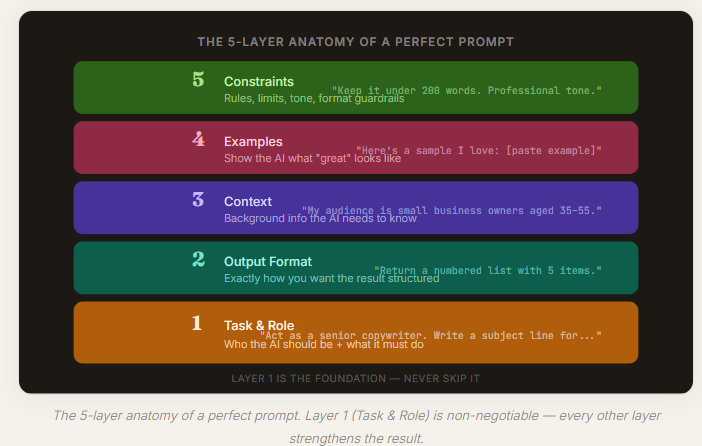
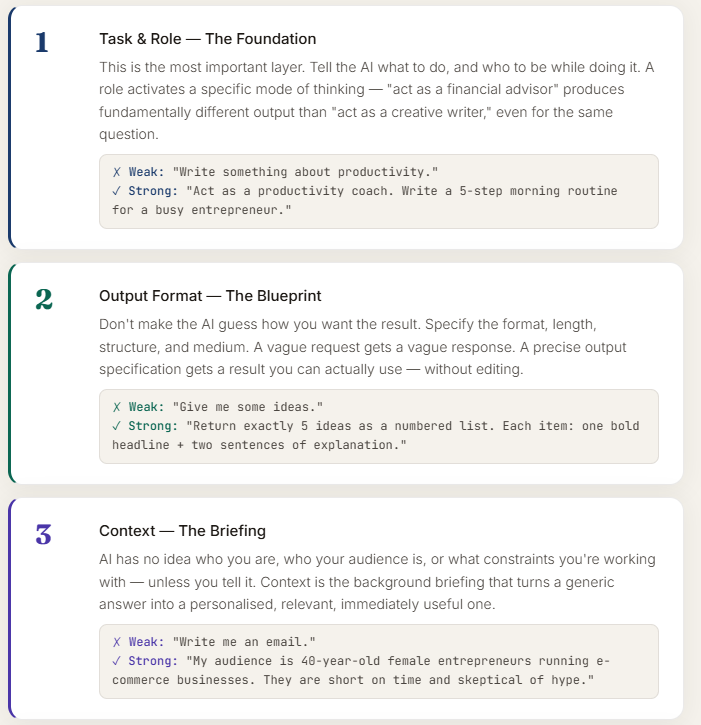
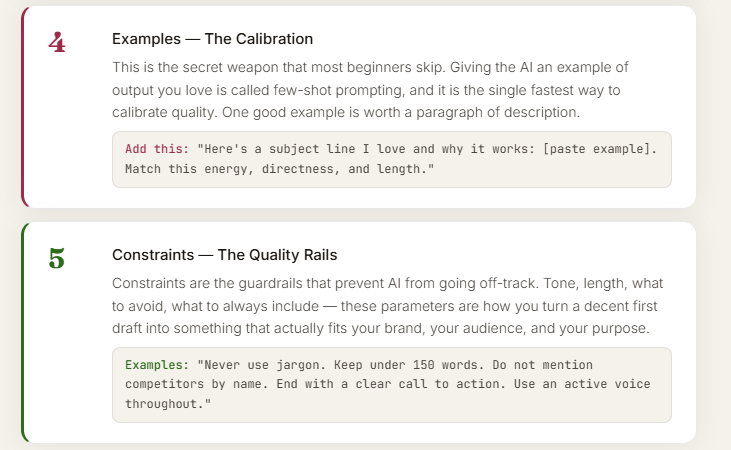
Now let’s walk through each layer so you know exactly what to write — and why it works.
How the components stack: a real-world example
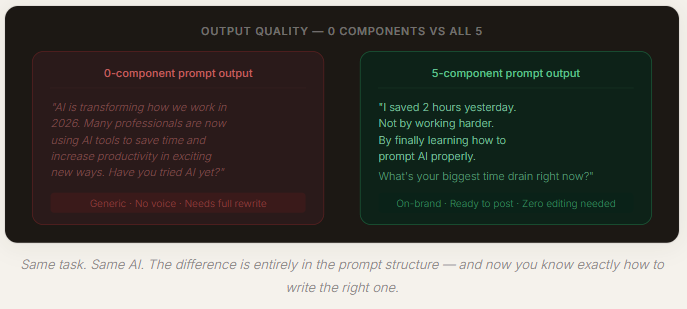
Theory is useful. But watching a prompt transform in front of you is unforgettable. Here’s the same task — writing a LinkedIn post — written with zero components, then with all five.
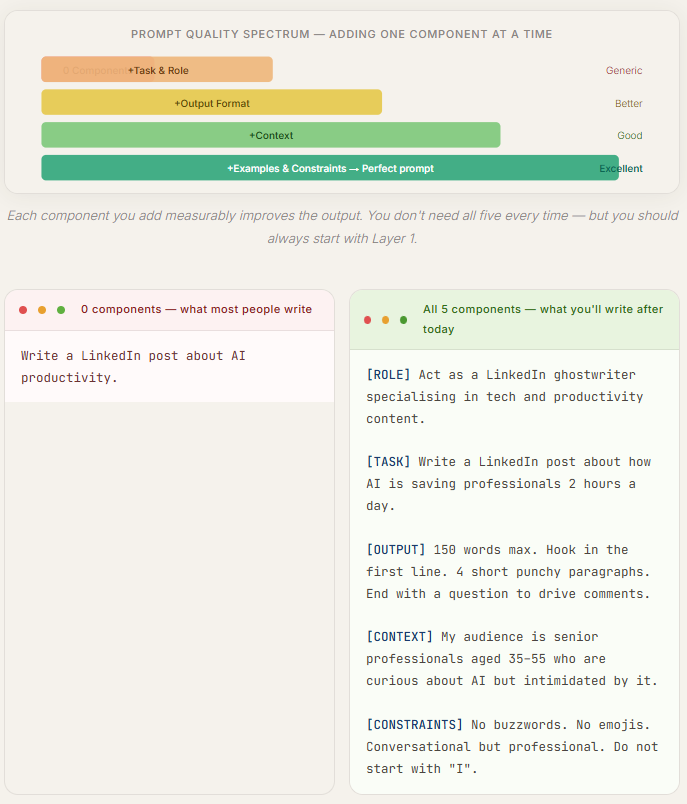
One version gives AI a blurry photograph to work from. The other gives it architectural drawings. The output is different in every way — relevance, tone, usefulness, how much editing it needs before you post it.
The one rule that changes everything
You don’t need to use all five components every time. A quick, low-stakes request might only need Layer 1 and Layer 2. But there is one rule that never changes:
Never skip the Task and Role. It takes six words — “Act as a [role]. Write a [thing].” — and it makes every single output better. Every time. No exceptions.
The more important the output, the more components you add. Writing a quick to-do list? Layers 1–2. Writing a pitch deck for a client? All five. The components scale with the stakes.
What’s coming tomorrow
You now understand the five components of any great prompt. Tomorrow, on Day 3, we go into one of the most powerful of those five — Role Prompting. You’ll learn how to assign expert personas so precisely that the AI genuinely thinks and writes like the specialist you need — whether that’s a copywriter, a CFO, a therapist, or a Navy SEAL strategist.
It’s one of the most immediately useful techniques in this entire series. Don’t miss it.
For more resourcces and documents, please refer to the links in my profile page: Faheem Munshi — Medium
Perfect Prompt: The 5 Core Components — Prompt to Profit · Day 2 of 30 was originally published in Towards AI on Medium, where people are continuing the conversation by highlighting and responding to this story.
