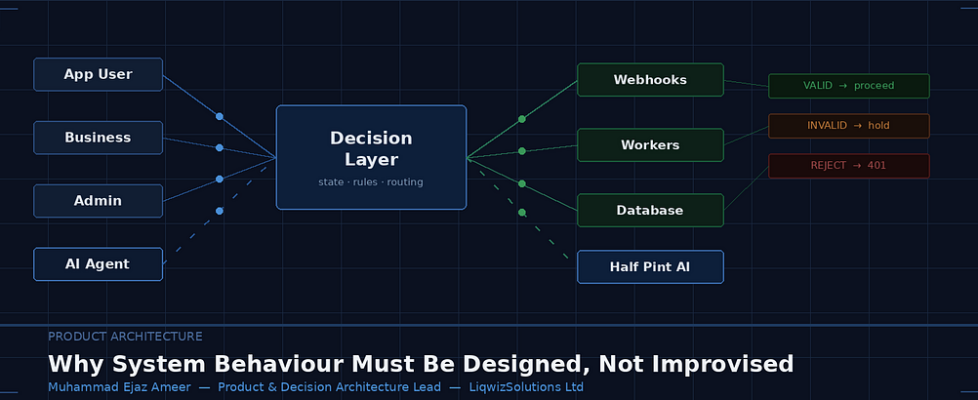
Why System Behaviour Must Be Designed, Not Improvised

Author(s): Muhammad Ejaz Ameer Originally published on Towards AI. By Muhammad Ejaz Ameer, Product & Decision Architecture Lead There is a moment in the life of almost every digital product when the team realises something uncomfortable: the system does not actually know what it is supposed to do. Not because the engineers were careless. Not because the product managers were absent. But because somewhere between the roadmap and the release, nobody formally decided how the system should behave — only what features it should have. This distinction sounds subtle. It is not. It is the difference between a product that operates consistently at scale and one that generates a permanent backlog of edge cases, manual interventions, and operational debt that no sprint ever quite clears. This article makes the case for a different approach: decision-driven architecture — designing system behaviour deliberately, before features are built, so that the product operates through logic rather than through people. The Feature-First Trap Feature-first design is intuitive. A user need is identified. A feature is scoped. The feature is built. The cycle repeats. The problem is not that this process is wrong. It is that it is incomplete. Features describe what a system can do. They do not describe how the system should behave when two features interact, when a workflow reaches an ambiguous state, when a user takes an action the team did not anticipate, or when an external service returns an unexpected result. In feature-first teams, these gaps are filled informally — through Slack messages, manual overrides, support tickets escalated to developers, and judgement calls made by whoever is available. The system does not decide; a person decides, every time. This is not a process. It is organised improvisation. Over time, organised improvisation becomes operational debt. The manual decisions that were supposed to be temporary become load-bearing. The overrides that were supposed to be exceptions become standard practice. The system grows in capability but not in coherence. The team is not failing. The architecture is. What Decision-Driven Architecture Actually Means Decision-driven architecture starts from a different premise: that the system’s behaviour under real operational conditions must be designed explicitly, not discovered gradually. In practice, this means making deliberate decisions about: State — what are the valid states a workflow, record, or entity can exist in? How does it transition between them? What is explicitly not permitted? Rules — what conditions must be true for an action to proceed? Who has authority to override, and under what circumstances? What happens when a condition is not met? Routing — when a process branches, what determines which path is taken? Is that decision made by the system or delegated to a human? If delegated, what happens if no human acts? Edge cases by design — what does the system do when inputs are incomplete, ambiguous, or outside expected parameters? This is not a QA question. It is an architecture question. Ownership — when a decision must be made, which part of the system is responsible for making it? Ambiguous ownership is the root cause of most manual intervention. These are not engineering concerns alone. They are product concerns, because they determine how the product actually behaves for real users in real conditions — and that is fundamentally a product responsibility. The role that sits at this intersection — between product thinking and system design — is what I call product and decision architecture. It is not traditional software engineering. It is not product management in the conventional sense. It is the discipline of ensuring that product intent is encoded into system behaviour, not left to informal execution. Why Product Logic Must Live in the System, Not in People Consider what happens when product logic lives in people rather than systems. A new team member joins. They are not yet familiar with the unwritten rules. They make decisions that are technically permitted by the software but operationally incorrect. Errors propagate before anyone catches them. A senior person is unavailable. A decision that requires their judgement is delayed. A workflow stalls. A customer is affected. The senior person returns, fixes it manually, and the team moves on — having learned nothing systematically. The product scales. The volume of decisions increases beyond what any individual or small team can consistently manage. Quality becomes a function of individual attention rather than systemic design. The product does not degrade because people stop caring; it degrades because the architecture was never designed to carry the operational load. When product logic lives in the system, none of this happens. State transitions are enforced automatically. Routing decisions are made by rules, not by whoever is available. Edge cases produce defined outcomes, not undefined escalations. The system is not dependent on specific individuals maintaining specific knowledge. This is not about removing human judgement from products. Humans should make judgement calls on genuinely novel situations. The goal is to ensure that routine, repeatable decisions — which constitute the vast majority of operational activity — are made by the system, consistently, without requiring human intervention every time. The result is a product that is operationally consistent at any scale, not just when the right people are watching. Workflow Governance: States, Transitions, and Rules The practical implementation of decision-driven architecture begins with workflow governance — the formal design of how workflows move through a system. Most digital products have workflows. An order is placed, processed, fulfilled, and completed. A booking is requested, approved, confirmed, and delivered. An application is submitted, reviewed, decided, and communicated. These are sequences of states connected by transitions. In feature-first design, these workflows are implemented functionally — the transitions happen, but the rules governing them are often implicit, scattered across the codebase, or enforced only at the UI layer. A determined or confused user can sometimes reach states the team never intended. In decision-driven architecture, workflows are modelled explicitly before implementation. Every state is named and defined. Every transition has explicit preconditions. Every actor — user, system, external service — has defined […]
