LAI #121: The single-agent sweet spot nobody wants to admit

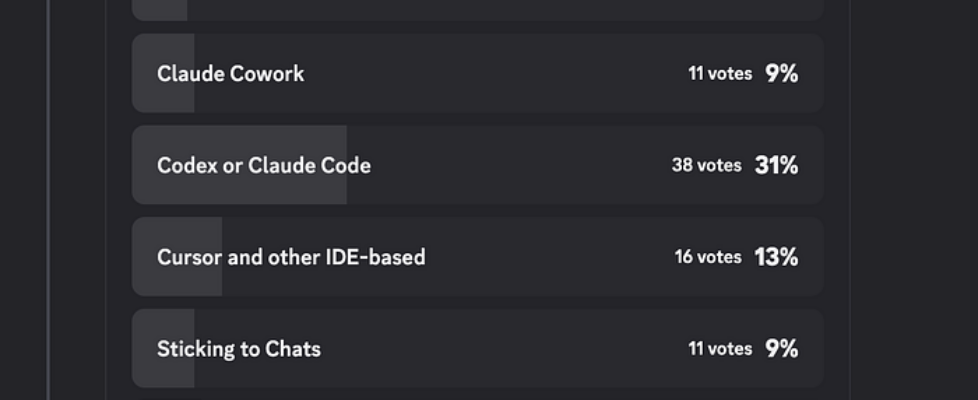
Author(s): Towards AI Editorial Team Originally published on Towards AI. Good morning, AI enthusiasts! Your next AI system is probably too complicated, and you haven’t even built it yet. This week, we co-published a piece with Paul Iusztin that gives you a mental model for catching overengineering before it starts. Here’s what’s inside: Agent or workflow? Getting it wrong is where most production headaches begin. Do biases amplify as agents get more autonomous? What actually changes and how to control it at the system level. Claude Code’s three most ignored slash commands: /btw, /fork, and /rewind, and why they matter more the longer your session runs. The community voted on where coding agents are headed. Terminal-based tools are pulling ahead, but that 17% “Other” bucket is hiding something. Four must-reads covering Google’s A2A protocol, when SFT vs. DPO vs. RLHF vs. RAG actually applies, a time series model that finally listens, and a full clinic chatbot build. We’re also starting a new section this week, AI Tip of the Day, where I share practical tips and takeaways from our courses that you can apply to your projects, read to understand where the industry is heading, and know what tools to focus on. This week, we’re kicking it off with RAG pipelines (if you’ve been here long enough, you know how much we love RAG) and its two failure modes that most of you don’t evaluate separately. Let’s get into it! What’s AI This week, in What’s AI, I am diving into controlling biases in AI agents. Many people assume that as agents become more autonomous, biases will amplify. So today, I will clarify this assumption by explaining what bias actually means in the context of LLMs, why bias isn’t inherently bad, and what fundamentally changes when we move from a simple language model to an autonomous agent. We will also get into how to realistically control bias as autonomy scales, not just at the model level, but at the system level. Read the full article here or watch the video on YouTube. AI Tip of the Day To ensure your RAG retrieval is working correctly, split your evaluation into two layers. For retrieval, measure whether relevant evidence was retrieved using metrics like recall@k and Mean Reciprocal Rank. For generation, measure faithfulness to the retrieved context and the answer’s relevance to the question, often using an LLM judge calibrated against human labels. High retrieval recall with low faithfulness suggests the model had the right evidence, but failed to use it properly. High faithfulness with low retrieval recall suggests the model stayed grounded in the retrieved context, but retrieval surfaced incomplete or off-target evidence. These are two completely different problems with two completely different fixes, and without the split, you can’t tell which one you’re dealing with. If you’re currently building a RAG pipeline and want to go deeper into evaluation, retrieval strategies, and the full production stack, check out our Full Stack AI Engineering course. — Louis-François Bouchard, Towards AI Co-founder & Head of Community We have co-published an article with Paul Iusztin, covering the mental model that prevents you from overengineering your next AI system. Here is what you will learn: The fundamental difference between an agent and a workflow. How to use the complexity spectrum to make architecture decisions. When to rely on simple workflows for predictable tasks. Why a single agent with tools is often enough for dynamic problems. The exact breaking points that justify moving to a multi-agent system. Read the full article here! Learn AI Together Community Section! Featured Community post from the Discord Aekokyreda has built an AI chat platform with RAG and real-time token streaming. The system delivers real-time, token-by-token AI responses using a fully decoupled microservices architecture. It is built with .NET 10 microservices using event sourcing, CQRS, Wolverine sagas, Marten, RabbitMQ, SignalR, Keycloak, and Kong, with an Angular 21 frontend powered by NgRx SignalStore. Check it out on GitHub and support a fellow community member. If you have any thoughts on the token streaming pipeline or the LLM provider abstraction, share them in the thread! AI poll of the week! Most of you are leaning toward terminal-style coding agents (Codex/Claude Code) right now, with IDE-based tools (Cursor, etc.) in second place, and a smaller set either sticking to chat, running a custom stack, or testing newer agent products like OpenClaw/Claude Cowork. The interesting bit isn’t just who’s “winning,” it’s that the center of gravity is clearly shifting from asking for code to delegating changes across a repo, which is exactly where terminals and repo-aware agents feel natural. Also, that “Other” bucket is so big that it’s probably hiding many niche-but-real workflows that aren’t captured by the options. Share some in the thread! Collaboration Opportunities The Learn AI Together Discord community is flooding with collaboration opportunities. If you are excited to dive into applied AI, want a study partner, or even want to find a partner for your passion project, join the collaboration channel! Keep an eye on this section, too — we share cool opportunities every week! 1. Kamalesh_22497 is looking for people to learn and build with through study groups, project collaborations, and discussions. If you are on a similar path, connect with him in the thread! 2. Miragoat is looking for someone who wants to build something meaningful (and profitable). They are trying to combine practical business thinking with AI skills and need someone with a business mindset and an AI background. If that sounds like you, reach out to them in the thread! 3. Majestic_728 is looking for a beginner-level ML/DS study partner to study for an hour every day. If you are interested, contact him in the thread! Meme of the week! Meme shared by rucha8062 TAI Curated Section Article of the week Mastering Claude Code’s /btw, /fork, and /rewind: The Context Hygiene Toolkit By Rick Hightower Context pollution degrades AI coding sessions by filling the context window with unrelated Q&A. This article covers three Claude Code […]
