OpenClaw; Explained Simply

The open source project Jensen Huang called the next ChatGPT, what it actually does, how it works under the hood, and why every company is suddenly asking the same question.
Last week at Nvidia GTC 2026, Jensen Huang walked onstage and said something that stopped a lot of people mid-scroll. He called an open source project called OpenClaw “the most popular open source project in the history of humanity.” Then he said it was “definitely the next ChatGPT.” Then he asked every CEO in the audience: what is your OpenClaw strategy?
That is a lot of weight to put on a project most people outside of developer Twitter had never heard of. So let us actually break down what OpenClaw is, how it works, why it went viral so fast, and what the Nvidia announcement actually means in practice.
Start here: what is an AI agent, really?
Before we get into OpenClaw specifically, we need to quickly align on what an AI agent actually is, because the word gets thrown around loosely.
When you use ChatGPT or Claude in a normal conversation, you type something, the model generates a response, and that is the end of the loop. It is a one shot exchange. The model does not go off and do things on its own. It just produces text.
An AI agent is different. It can perceive its environment, make decisions, take actions, observe the results of those actions, and loop back. It is not just a responder. It is a doer.
Mental model
Think of a traditional LLM as a very smart person who can only answer the questions you put in front of them. An agent is that same person, but now they also have a computer, an internet connection, a file system, and the ability to go work on something and report back when it is done.
That shift from “language model that responds” to “agent that acts” is what the whole industry has been working toward for the past two years. OpenClaw is the project that made it feel real for a lot of developers.
So what is OpenClaw specifically?
OpenClaw is an open source framework created by developer Peter Steinberger. It lets you build and run AI agents locally on your own hardware. The individual agents in OpenClaw are called claws.
What makes it different from just calling an LLM API and writing some orchestration code yourself is the full set of capabilities it gives an agent out of the box.
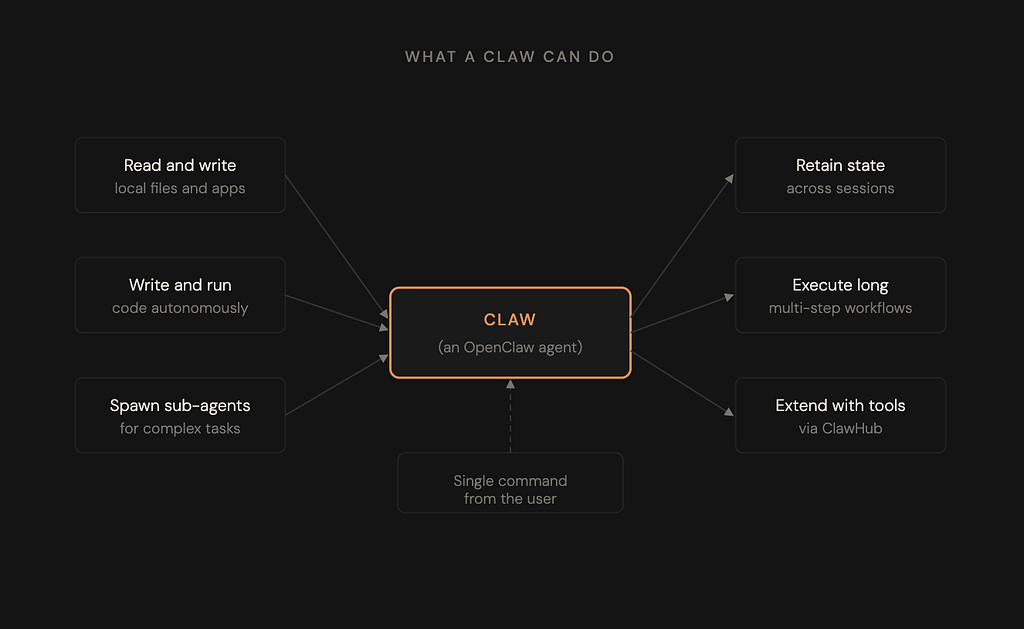
That last point about spawning sub-agents is worth pausing on. A single claw can create other claws to handle pieces of a larger task. This is where the real power is. You give it a goal, not a list of steps. It figures out what sub-tasks exist, delegates them, reassembles the results, and delivers.
Jensen illustrated it with a kitchen design example. You tell the agent to design a kitchen. It goes off, learns the relevant design tools, studies reference images, generates a draft, reflects on what is weak, revises, and comes back with a finished design. No hand-holding. No step-by-step prompting from you.
Why did it go viral so fast?
The numbers are genuinely unusual. OpenClaw hit 250,000 GitHub stars in about 60 days. That is faster than React. Faster than Linux when it was open sourced. Faster than anything comparable.

A few things drove this. First, the developer experience is genuinely simple. You pull down OpenClaw, run one command, and you have a working agent running locally. There is no cloud dependency, no API key wall, no infrastructure setup. It just runs.
Second, it has a marketplace called ClawHub where developers can publish and install tools, called skills, that extend what a claw can do. Think of it like an app store but for agent capabilities. That flywheel drove massive community contribution fast.
Third, the timing was right. Developers had seen the theory of autonomous agents for two years. They wanted something they could actually run, modify, and ship. OpenClaw was the first project that made that feel accessible.
The security problem nobody wants to talk about
Here is the part that does not make it into the hype cycle as much. Because agents can autonomously install tools, write code, and access local files, the attack surface is significant.
Those 824 community skills on ClawHub include some that are malicious. Prompt injection attacks, where a bad actor embeds instructions in content the agent reads, are a real and documented problem. Several governments have issued advisories. Security researchers have published CVEs.
The core tension
The same properties that make OpenClaw powerful (it can access your files, run code, connect to the internet, spawn sub-agents) are exactly what make it risky. An agent with lots of permissions operating autonomously is a large blast radius if something goes wrong.
This is the gap that Nvidia announced it was closing at GTC. Enter NemoClaw.
NemoClaw: OpenClaw with a seatbelt
NemoClaw is Nvidia’s open source enterprise layer built on top of OpenClaw. Nvidia worked directly with OpenClaw’s creator Peter Steinberger to build it. The idea is straightforward: keep everything that makes OpenClaw great, and add the governance and security infrastructure that enterprises need before they can actually deploy it.
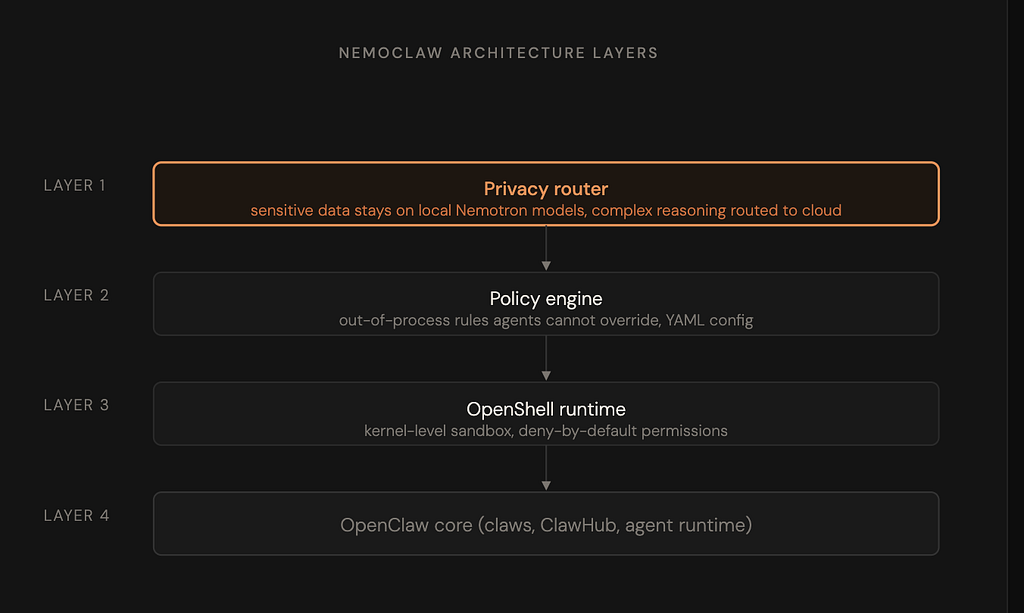
Three controls make up the core of what NemoClaw adds. The first is a kernel-level sandbox through a runtime called OpenShell. Everything runs in a deny-by-default environment. Agents can only access what they are explicitly allowed to access, at the OS level, not just the application level.
The second is a policy engine that runs out of process. This matters a lot. If a compromised agent tries to change its own rules, it cannot, because the policy engine is not running inside the agent. It sits underneath it.
The third is a privacy router. This is probably the most interesting feature commercially. Sensitive data gets handled by local Nemotron models, which never leave the corporate perimeter. Complex reasoning tasks that do not involve sensitive data can be routed to cloud models. You get the intelligence of frontier models without sending proprietary information outside your infrastructure.
How does this connect to the bigger agent story?
If you have been following this series, you have read about MCP, which standardizes how agents connect to tools and data sources. You have read about A2A, which standardizes how agents talk to each other. OpenClaw is the runtime layer that sits on top of both of those protocols.
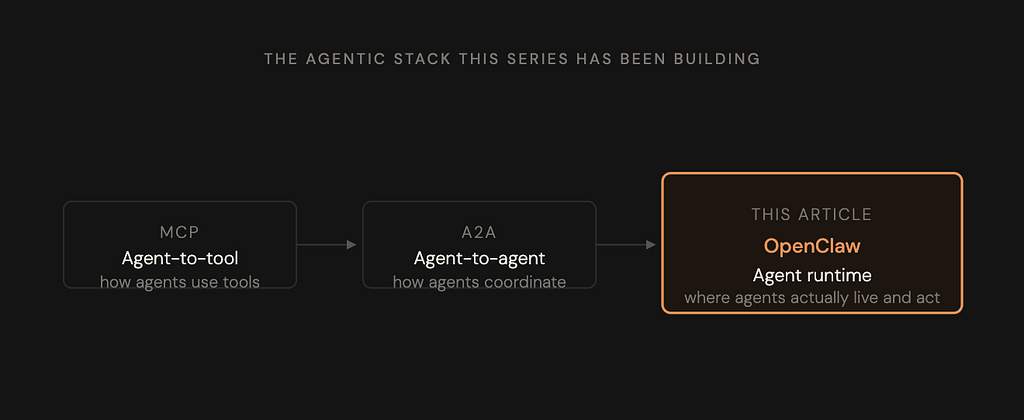
MCP defined the language agents use to pick up tools. A2A defined how agents hand off tasks and collaborate. OpenClaw is the environment where an agent actually exists, reasons, and executes. It is the operating system of the agentic stack.
That framing is why Jensen Huang kept reaching for analogies like HTML, Linux, and Kubernetes. Those were not just technical standards. They were shared infrastructure that the entire industry could build on top of. OpenClaw is being positioned as that layer for autonomous agents.
What you actually need to know
You do not need to memorize the architecture. Here is the practical takeaway in plain language.
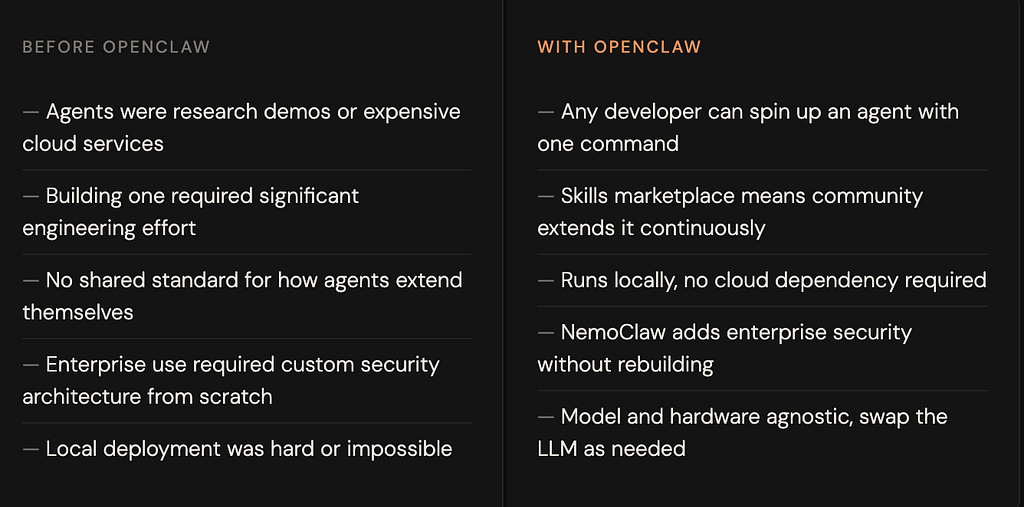
The meaningful shift is this: agents are no longer a premium research feature or an expensive cloud API. They are a developer primitive. The same way you can spin up a web server in three lines of code, you can now spin up an autonomous agent in a single command. That accessibility is what changes the trajectory.
A few things to keep in mind
OpenClaw has real momentum, but it is not a finished story. NemoClaw is in early alpha. Nvidia itself says to expect rough edges and is targeting a production-ready release later in 2026. The security concerns around malicious ClawHub skills and prompt injection attacks are real and not fully solved by NemoClaw’s infrastructure layer alone.
There is also the OpenAI factor. OpenAI acquired OpenClaw in February 2026. That acquisition is a large part of why enterprises were nervous and why Nvidia moved fast to build a vendor-neutral alternative. The fact that the original project is now owned by a major AI lab, while a separate open fork is being championed by Nvidia, means the ecosystem is going to be messy for a while.
What is not in question is the direction. The whole industry is moving toward agents that act rather than models that respond. OpenClaw made that shift visible and accessible. NemoClaw is an attempt to make it safe enough to deploy in real organizations.
“OpenClaw gave us, gave the industry exactly what it needed at exactly the right time. Just as Linux gave the industry exactly what it needed. Just as Kubernetes showed up at exactly the right time.”Jensen Huang, GTC 2026 Keynote
Whether that comparison holds up over the next five years is something we will all find out together. But right now, OpenClaw is worth understanding. Not because Jensen said so. Because autonomous agents are becoming real infrastructure, and this is the stack they are being built on.
OpenClaw; Explained Simply was originally published in Towards AI on Medium, where people are continuing the conversation by highlighting and responding to this story.
