
AWS Bedrock Agents vs. AgentCore: Which AI Stack Should You Use in Production?

Clearing the confusion: When to use Bedrock Agents for out-of-the-box orchestration vs AgentCore for custom AI solutions.
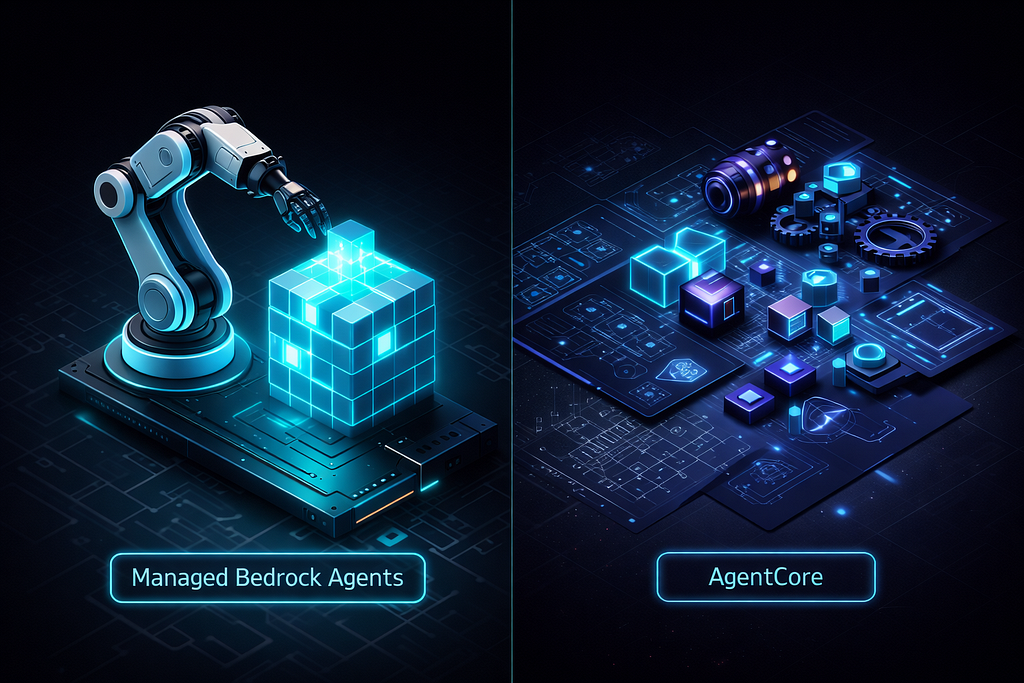
The AI hype is settling, and now the real engineering begins. If you’re building Generative AI on AWS in 2026, you’ve likely hit a wall comparing Amazon Bedrock Agents and the newly released Amazon Bedrock AgentCore.
They sound identical. They both build AI agents. But architecturally, they represent entirely different approaches to solving the same problem.
One is an “easy button” that does the heavy lifting for you. The other is an engine block that lets you build the car yourself.
Let’s break down the exact differences, the code, and how to choose the right infrastructure for your workload.
A Simple Mental Model
To understand the difference, think about web development:
- Bedrock Agents is like using a website builder (like Wix or Shopify). It is fully managed, handles the state, and strings the components together automatically.
- Bedrock AgentCore is like using React or Vue.js. It gives you the fundamental building blocks, but you write the orchestration logic, manage the state, and define exactly how it executes.
1. Amazon Bedrock Agents (The Managed Service)
Bedrock Agents launched first. It is a fully managed capability that automatically orchestrates interactions between foundation models, data sources (Knowledge Bases), and software APIs (Action Groups).
Why use it? Speed to market.
- It manages conversational memory automatically.
- It handles the ReAct (Reason + Act) loop natively.
- It requires minimal code — mostly configuration via the console, CloudFormation, or CDK.
2. Amazon Bedrock AgentCore (The Framework)
AgentCore is AWS’s answer to the developer who said, “Bedrock Agents is great, but I need more control over the orchestration loop.”
AgentCore is a set of APIs and primitives that allow you to build custom agentic workflows. It breaks down the monolithic Bedrock Agent into distinct, composable parts.
Why use it? Absolute control.
- You write the while-loop that governs the agent.
- You can inject custom logic between the “Reason” and “Act” steps.
- You can integrate with tools outside of the AWS ecosystem more natively.

Show Me The Code
Let’s look at how the implementation differs in Python using Boto3.
Example 1: Invoking a Bedrock Agent
With a managed Bedrock Agent, all you do is pass the session ID and the prompt. The AWS backend handles the multiple trips to the LLM, the tool calling, and the memory.
import boto3

client = boto3.client('bedrock-agent-runtime')

def invoke_managed_agent(agent_id, agent_alias_id, session_id, prompt):
    """
    Invokes a fully managed Amazon Bedrock Agent.
    Notice how simple this is: AWS handles the execution loop.
    """
    response = client.invoke_agent(
        agentId=agent_id,
        agentAliasId=agent_alias_id,
        sessionId=session_id,
        inputText=prompt
    )

    # The response comes back as an event stream
    completion = ""
    for event in response.get('completion'):
        if 'chunk' in event:
            completion += event['chunk']['bytes'].decode('utf-8')

    return completion

print(invoke_managed_agent("AG1234567", "AL8901234", "session-1", "Check inventory for SKU-999"))
Example 2: The AgentCore Approach
With AgentCore, you write the loop. This is more verbose, but if you need to intercept the agent’s thought process, log a specific metric mid-flight, or route to a local database before returning to the LLM, this is how you do it.
(Note: AgentCore is accessed via the Bedrock Runtime Converse APIs).
import boto3
import json

client = boto3.client('bedrock-runtime')

# 1. Define your tool
tools = [{
    "toolSpec": {
        "name": "check_inventory",
        "description": "Checks warehouse inventory",
        "inputSchema": {
            "json": {
                "type": "object",
                "properties": {"sku": {"type": "string"}},
                "required": ["sku"]
            }
        }
    }
}]

def run_agentcore_loop(prompt, model_id="global.anthropic.claude-opus-4-5-20251101-v1:0"):
    """
    A custom agentic loop using Bedrock's Converse API (AgentCore primitives).
    YOU control the flow here.
    """
    messages = [{"role": "user", "content": [{"text": prompt}]}]

    # First call: The LLM decides if it needs a tool
    response = client.converse(
        modelId=model_id,
        messages=messages,
        toolConfig={"tools": tools}
    )

    output_message = response['output']['message']
    messages.append(output_message) # Manually update state

    # Check if the model requested a tool
    if output_message['content'][-1].get('toolUse'):
        tool_use = output_message['content'][-1]['toolUse']
        tool_name = tool_use['name']
        tool_inputs = tool_use['input']

        print(f"Agent requested tool: {tool_name} with inputs {tool_inputs}")

        # 2. YOU execute the tool locally
        tool_result_data = "In Stock: 50 units" # Mocked DB call

        # 3. Pass the result back to the model
        tool_result_content = {
            "toolResult": {
                "toolUseId": tool_use['toolUseId'],
                "content": [{"text": tool_result_data}]
            }
        }
        messages.append({"role": "user", "content": [tool_result_content]})

        # 4. Final call to get the synthesized answer
        final_response = client.converse(
            modelId=model_id,
            messages=messages
        )
        return final_response['output']['message']['content'][0]['text']

    return output_message['content'][0]['text']

print(run_agentcore_loop("Check inventory for SKU-999"))
When to Choose Which?
Choose Managed Bedrock Agents if:
- You are building standard RAG (Retrieval-Augmented Generation) applications.
- Your tools are standard REST APIs packaged as AWS Lambda functions.
- You want AWS to handle session memory and persistence automatically.
- Speed of delivery is your primary metric.
Choose Bedrock AgentCore if:
- Your workflow requires complex, multi-step validation logic that doesn’t fit a standard ReAct prompt.
- You need to integrate seamlessly with existing LangChain or LlamaIndex codebases.
- You have stringent security requirements that demand you run the orchestration loop within your own VPC container, rather than relying on the managed Bedrock backend.
- You want granular observability into every micro-step of the reasoning process.
The Verdict
Bedrock Agents is a product. AgentCore is a primitive.
Start with Bedrock Agents. If you hit a wall where you find yourself fighting the framework to get the routing or memory to behave exactly how you want — congratulations, you’ve graduated to AgentCore. Drop down to the primitive APIs and write the orchestration loop yourself.
AWS has finally given us both the easy button and the engine block. Choose wisely.
Are you running agents in production yet? Let me know in the comments if you prefer managed orchestration or writing the loops yourself!
AWS Bedrock Agents vs. AgentCore: Which AI Stack Should You Use in Production? was originally published in Towards AI on Medium, where people are continuing the conversation by highlighting and responding to this story.
