Agentic AI: Redefining Cloud Security in India

From Periodic Testing to Autonomous Defense
Agentic AI is steadily redefining how enterprises conceptualize cloud security and regulatory compliance. Unlike conventional AI systems that operate within narrowly defined instructions such as scanning a network segment or flagging predefined anomalies — agentic AI functions with objective-driven autonomy. It is engineered to interpret and pursue broader operational goals, including maintaining alignment with India’s evolving data protection framework, detecting and containing security incidents within regulatory time thresholds, and enforcing strict data localization controls to ensure sensitive information remains within national boundaries. Once assigned a defined outcome, these systems autonomously determine the necessary sequence of actions, execute them across distributed environments, and continuously recalibrate in response to infrastructural and threat landscape changes.
In practical terms, this represents a transition from reactive automation to anticipatory intelligence. The emphasis shifts from executing repetitive security tasks to deploying adaptive agents capable of context-aware decision-making within dynamic cloud ecosystems. In a regulatory climate such as India’s — where compliance obligations are intensifying under frameworks like CERT-In directives and the Digital Personal Data Protection regime — this evolution is more than technological enhancement; it is architectural realignment. Agentic AI enables organizations to embed resilience, traceability, and regulatory alignment directly into their cloud operations, strengthening both governance posture and institutional trust.
The Regulatory Push: Why Speed and Autonomy Matter
India’s cybersecurity landscape has evolved into a strongly compliance-driven ecosystem in recent years. Regulatory expectations now extend beyond baseline security controls to require demonstrable speed, traceability, and operational accountability. The 2022 CERT-In directive mandates reporting of specified cybersecurity incidents within six hours and requires organizations to retain system logs within India for at least 180 days. The Digital Personal Data Protection (DPDP) Act, 2023 further strengthens this regime by formalizing data principal rights, reinforcing localization requirements, and imposing enforceable obligations around transparency and breach reporting.
At the same time, sectoral regulators — including the Reserve Bank of India (RBI), Securities and Exchange Board of India (SEBI), and Insurance Regulatory and Development Authority of India (IRDAI) — have introduced domain-specific governance models that emphasize real-time monitoring, risk-based supervision, structured incident reporting, and board-level accountability. Together, these measures move organizations away from periodic reviews toward sustained operational preparedness. In this environment, manual log analysis, reactive escalation processes, and retrospective documentation struggle to keep pace with regulatory timelines and evidentiary expectations.
Autonomous agents offer a fundamentally different response model. Designed for autonomous execution, it monitors infrastructure layers, identifies configuration drift, correlates threat intelligence, and maintains audit-aligned records in near real time. Rather than reacting after an incident escalates, these systems can detect emerging risk patterns, simulate potential impact paths, and trigger policy-bound remediation actions proactively.
Indian regulators increasingly expect organizations not just to prepare for audits but to operate in a state of ongoing audit readiness. This requires persistent control validation and machine-verifiable documentation. AI-enabled compliance platforms such as ZenGRC and Compliance.ai illustrate this shift by automating control checks, flagging deviations promptly, and generating structured evidence aligned with governance mandates. The broader outcome is a transition from episodic review cycles to an embedded assurance model where security, regulatory alignment, and operational governance function as an integrated system.
From Periodic to Continuous Penetration Testing
One of the most significant areas where agentic AI is reshaping security operations is penetration testing, a foundational component of cloud security strategy. Traditionally, organizations conducted penetration tests at fixed intervals, engaging security teams to simulate adversarial attacks, identify vulnerabilities, and implement remediation before the next scheduled cycle. While effective in relatively static environments, this periodic model struggles to keep pace with modern cloud infrastructures where new servers, APIs, containers, and microservices are deployed continuously, creating persistent visibility gaps between assessments.
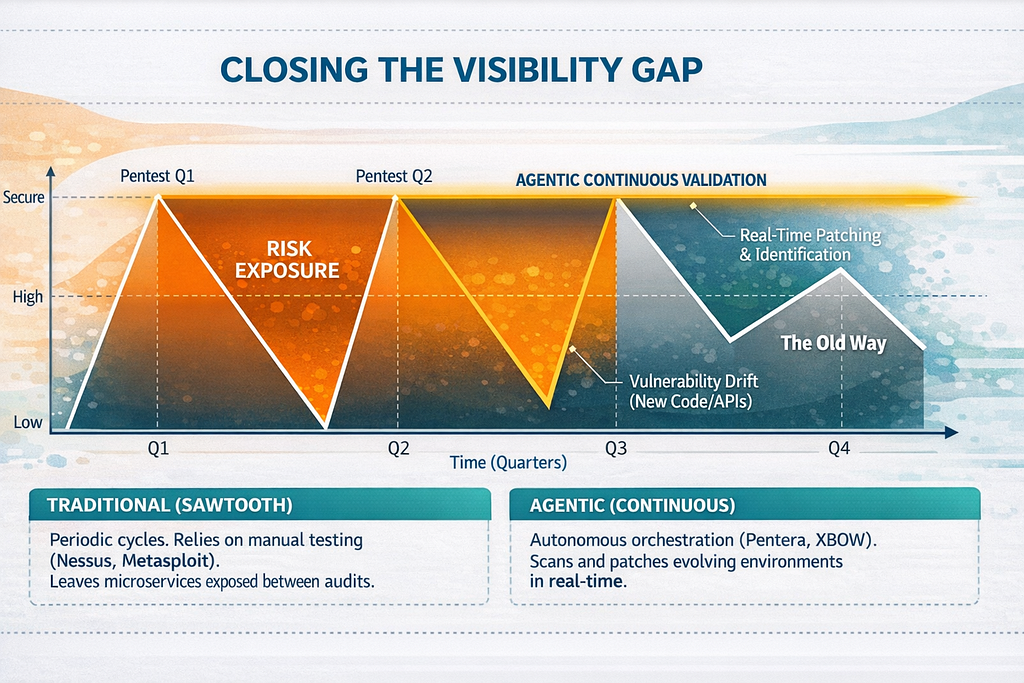
Agentic AI transforms penetration testing from an episodic activity into a continuous validation mechanism. It autonomously monitors evolving environments, discovers newly exposed assets, evaluates them against both known and emerging threat vectors, and recommends — or initiates — remediation actions in accordance with predefined policy thresholds. Instead of relying on quarterly reviews for assurance, organizations maintain an ongoing security baseline aligned with compliance and operational risk requirements.
Large Language Models (LLMs) and advanced AI reasoning systems further enhance this capability by simulating adversarial thinking, chaining multi-step attack paths, and contextualizing findings based on exploit feasibility and business impact. By integrating directly into CI/CD pipelines, these systems embed security testing into the development lifecycle itself, effectively transforming penetration testing from a discrete project into a continuously operating security function.
Leading AI Pentesting Tools Gaining Traction
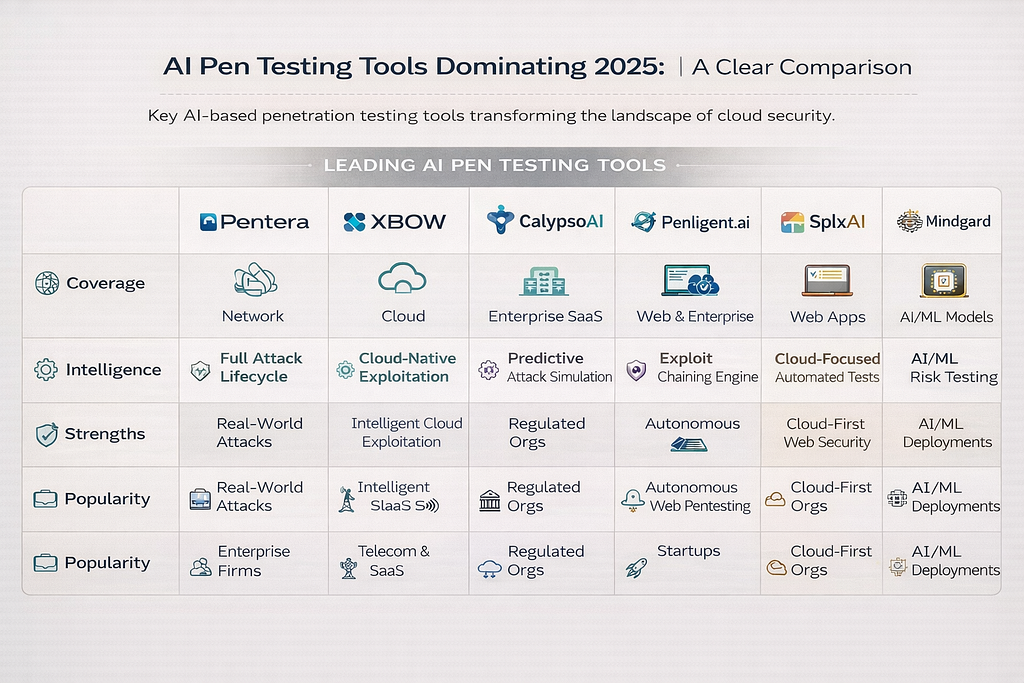
The landscape for AI-driven penetration testing platforms has expanded rapidly in 2025, with several solutions advancing autonomous testing capabilities and realistic adversarial simulation. Pentera has distinguished itself; through automated end-to-end attack emulation, replicating sophisticated threat actor techniques across complex hybrid infrastructures while continuously validating exploitable paths. XBOW has gained traction among telecom and SaaS enterprises in India due to its cloud-native architecture and intelligent exploitation engine, which dynamically prioritizes vulnerabilities based on contextual impact rather than static severity scoring.
CalypsoAI focuses on predictive threat modeling and compliance-oriented automation, integrating with enterprise security ecosystems to deliver continuously validated outcomes with minimal manual intervention. Emerging platforms such as Penligent.ai and SplxAI extend autonomous testing further; Penligent emphasizes multi-stage exploit chaining that mirrors human-led red team methodology, while SplxAI concentrates on application-layer vulnerabilities within cloud-first environments. PentestGPT enhances analyst productivity by providing real-time testing guidance, whereas AutoPentest leverages reinforcement learning to conduct unsupervised exploratory assessments. Meanwhile, Mindgard addresses risks specific to AI and machine learning deployments, validating model robustness and security posture within cloud-integrated architectures.
AI vs. Traditional Pentesting Tools: A Clear Comparison
Traditional security tools such as Burp Suite, Nessus, Metasploit, Nmap, and OpenVAS offer granular visibility and precision during controlled assessments, but they rely heavily on manual configuration, scheduled execution cycles, and predefined scopes that often fail to capture rapidly evolving cloud environments. While highly effective in structured testing scenarios, their dependence on human-driven prioritization and periodic deployment can create visibility gaps as infrastructure, APIs, and workloads change between assessments.
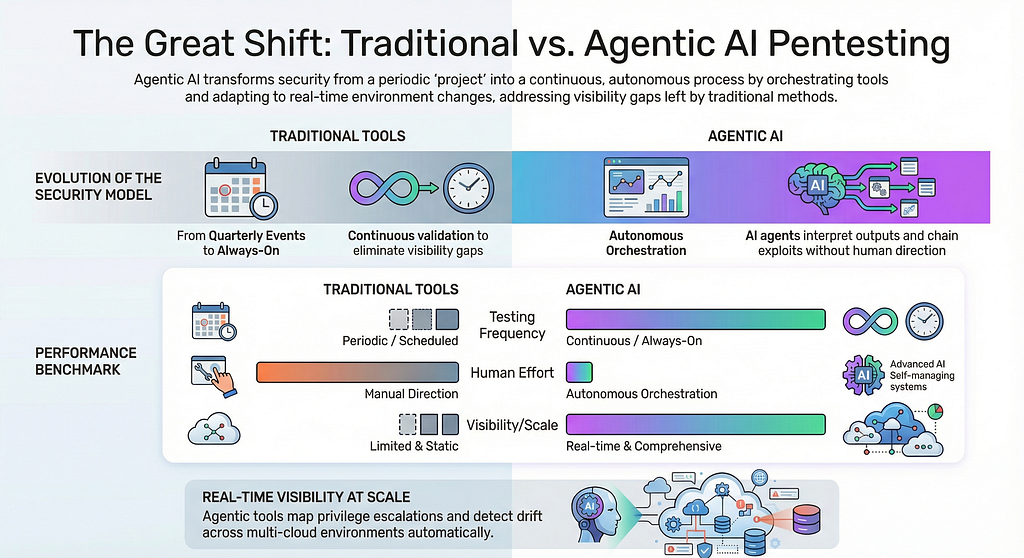
In contrast, AI-driven platforms such as Pentera, XBOW, and CalypsoAI extend these capabilities through autonomous orchestration. They interpret scanner outputs contextually, chain multi-stage exploit paths, and dynamically adjust testing scope as new assets are provisioned. Instead of requiring analysts to manually triage findings, these systems apply machine learning models to distinguish exploitable risk from noise, integrate directly into CI/CD pipelines, and sustain continuous validation at scale. This transition moves penetration testing from discrete quarterly exercises to persistent, always-on assurance — an operational necessity within India’s rapidly expanding cloud ecosystems.
AI Tools Transforming Cloud Pentesting
Cloud-focused penetration testing introduces challenges such as ephemeral workloads, multi-cloud fragmentation, and complex IAM hierarchies — domains where AI-driven systems demonstrate clear operational advantages. Platforms like Pentera and XBOW address these complexities by automatically mapping privilege escalation paths, identifying configuration drift across AWS, Azure, and GCP, and simulating lateral movement within hybrid infrastructures. Solutions such as Wiz and Orca Security, enhanced through agentic reasoning layers, correlate IAM misconfigurations with externally exposed assets, enabling prioritization based on potential blast radius rather than isolated vulnerability metrics.
These platforms integrate directly into cloud-native deployment pipelines, scanning containers and serverless functions at the point of release while continuously ingesting intelligence from global threat feeds. For Indian organizations operating under DPDP-driven localization mandates, such systems proactively detect cross-border exposure risks and policy deviations. Even open-source tools like ScoutSuite gain expanded utility when orchestrated by AI agents, transforming static configuration audits into adaptive, continuously validated security controls that align with DevOps-driven velocity.
While traditional tools such as Burp Suite, Nessus, and Metasploit remain foundational within security operations, they often require significant manual configuration and sustained analyst oversight. Autonomous agents enhance these legacy capabilities by autonomously interpreting outputs, determining subsequent testing paths, and executing iterative assessments at scale. This orchestration reduces repetitive workload, enabling security professionals to concentrate on complex business logic vulnerabilities, architectural weaknesses, and higher-order risk analysis rather than routine scanning operations.
Revolutionizing Incident Response and Compliance
Agentic AI demonstrates its most tangible impact within incident response operations. In the event of a security breach, these systems can autonomously initiate forensic data collection, isolate compromised workloads, revoke exposed credentials, and generate regulator-ready documentation aligned with authorities such as CERT-In. Processes that previously required hours — or even days — of cross-team coordination can now be executed within minutes, significantly reducing operational disruption while ensuring adherence to strict regulatory reporting timelines.
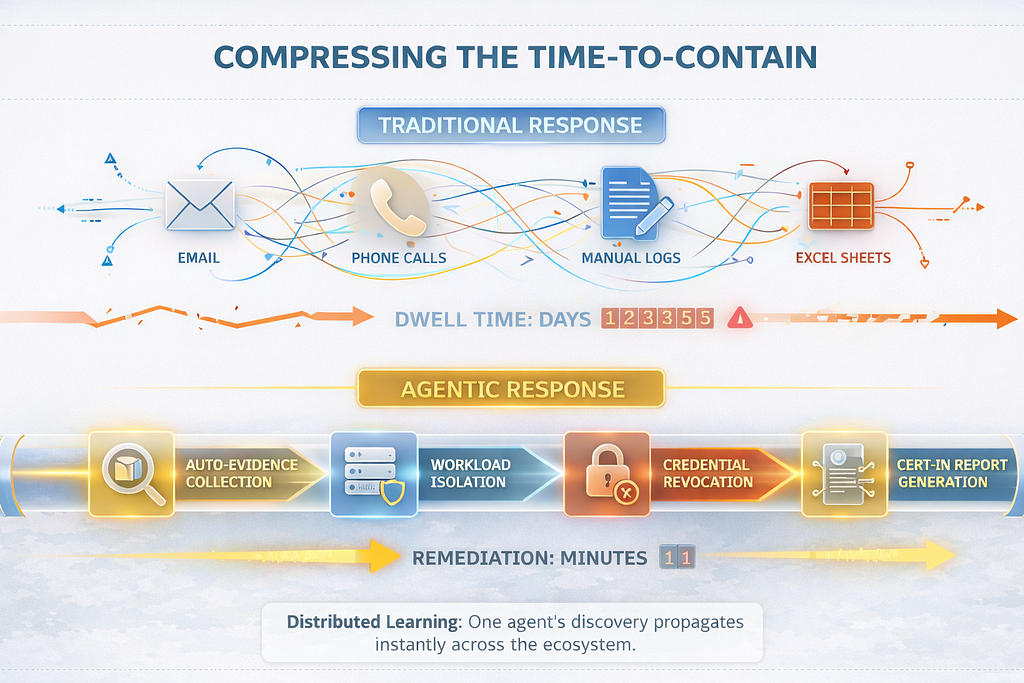
Beyond immediate containment, the intelligence generated during an incident can continuously enhance defensive posture. When an autonomous agent detects a novel attack vector or data exfiltration pattern, that contextual insight can be disseminated across the broader infrastructure in near real time. This distributed learning mechanism enables defense controls to evolve dynamically, strengthening resilience without waiting for manual policy updates or retrospective analysis.
At scale, incident response automation represents a form of collective defense architecture. Autonomous agents share threat intelligence, remediation strategies, and behavioral indicators across environments more rapidly than traditional human-operated Security Operations Centres. The result is accelerated containment, reduced attacker dwell time, and minimized blast radius. Nevertheless, such automation must operate within clearly defined governance boundaries. Comprehensive logging, traceable decision records, and active human oversight remain essential to ensure that automated remediation actions can be reviewed, validated, or reversed to prevent unintended operational consequences.
A Glimpse of Real-world Application
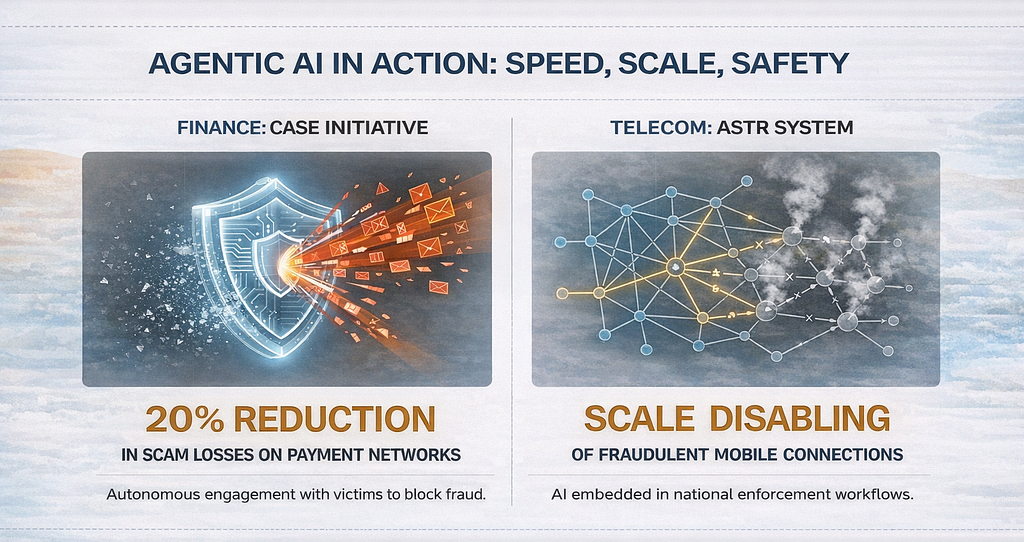
A practical illustration of this trajectory emerged in August 2025, when Indian researchers introduced CASE (Conversational Agent for Scam Elucidation), an AI-driven system designed to address fraud within the country’s rapidly expanding digital payments ecosystem. Built on agentic AI principles, CASE engaged directly with potential scam victims, analyzed contextual responses in real time, and transmitted structured intelligence to enforcement mechanisms to interrupt and block fraudulent transactions. Within weeks of deployment, the system contributed to a reported reduction of more than 20 percent in scam-related losses across a major national payment network.
Although CASE was not developed as a conventional cybersecurity platform, it embodied the core characteristics of agentic systems: autonomous execution, traceable decision logic, audit-aligned workflows, and outcome-driven operation. Its performance demonstrated how intent-based AI architectures can operate reliably in high-volume, time-sensitive, and high-stakes environments. These same attributes — speed, contextual reasoning, and structured accountability — directly parallel the operational demands of modern cloud security infrastructures.
Beyond the financial sector, similar agentic AI principles are being operationalized across other critical domains, reflecting a broader national shift toward autonomous, enforcement-aligned security architectures. Other emerging Indian AI-driven initiatives, such as ASTR (AI System for Telecom Risk), demonstrate how autonomous systems can identify and disable large volumes of fraudulent mobile connections while embedding AI directly into enforcement and public safety workflows. These programs illustrate how agentic capabilities are being institutionalized at scale, signaling a growing national commitment to AI-powered cyber defense mechanisms that combine automation with regulatory accountability.
Building Trustworthy Agentic Systems
Designing an AI system capable of operating autonomously in security-critical environments requires more than advanced algorithms — it demands a clearly defined governance and control framework. A reliable architecture depends on continuous telemetry, ensuring real-time visibility across cloud infrastructure layers. It must also incorporate machine-readable compliance policies that specify permissible actions, data retention limits, transfer restrictions, and the conditions under which automated remediation can be executed.
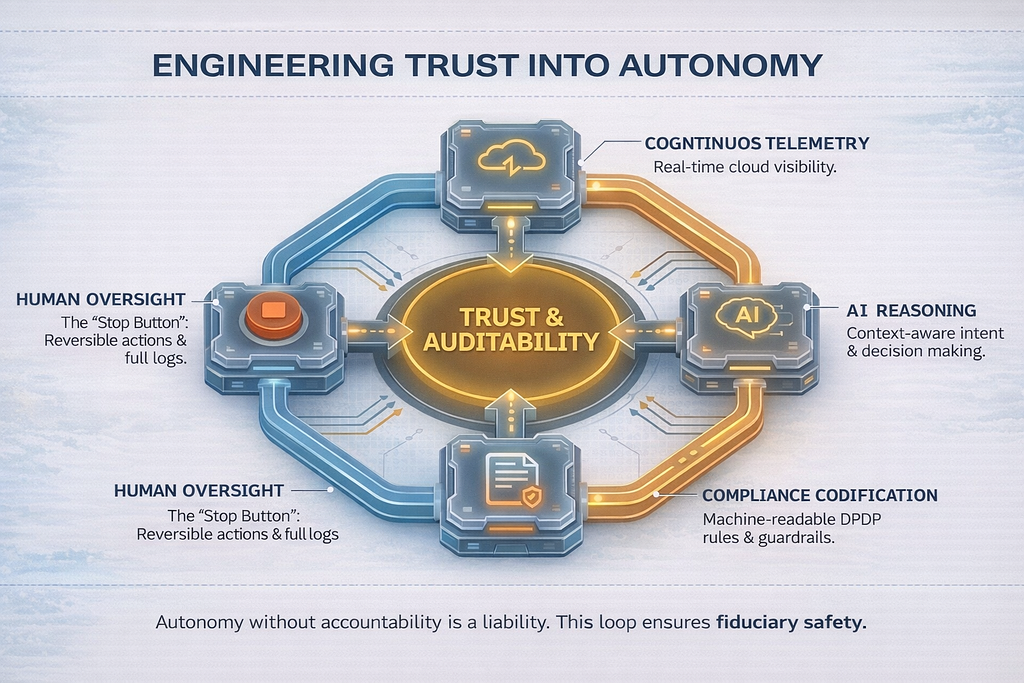
Human oversight remains equally essential. Every automated action must be logged, time-stamped, and explainable, with clear audit trails available for review. Human operators must retain authority to intervene, pause, or override system decisions when necessary. Without such controls, even sophisticated agentic AI systems risk misinterpreting operational signals — such as removing essential audit logs during data cleanup or isolating active production workloads in response to a false threat signal.
This balance between operational autonomy and structured accountability defines trustworthy agentic design, ensuring that AI-driven security mechanisms remain aligned with organizational objectives and regulatory boundaries.
Agentic AI’s governance framework also includes machine-readable compliance codifications that enable AI systems to enforce data retention and transfer policies automatically. Such codifications ensure that agents operate strictly within the legal and fiduciary guardrails relevant in Indian and global jurisdictions, preventing missteps that could lead to fines or reputational harm.
Risks and Responsible Adoption
No transformative technology is without risk, and agentic AI is no exception. Systems that are poorly architected or inadequately governed can quickly become operational liabilities. They may misinterpret priorities, trigger irreversible remediation steps, or become vulnerable to adversarial manipulation. Techniques such as data poisoning or adversarial prompting could potentially distort model behavior, causing AI-driven defenses to overlook genuine threats or generate misleading assessments.
For this reason, governance, transparency, and explainability must be embedded by design rather than treated as secondary controls. Every automated action should generate a verifiable reasoning trail that records why the action was initiated, how it was executed, and under what conditions it can be reversed. Such traceability not only strengthens internal trust but also aligns with audit defensibility and regulatory compliance expectations.
Organizations deploying agentic AI must incorporate adversarial resilience mechanisms, continuous validation testing, and strict model governance controls to reduce the risk of manipulation. Robust monitoring and periodic evaluation of model behavior are essential to ensure that autonomous decision-making remains consistent, reliable, and aligned with defined risk boundaries.
The Human–Machine Partnership
Agentic AI does not replace human expertise; it redefines its role. While machines deliver speed, scalability, and analytical precision, human professionals contribute contextual judgment, ethical reasoning, and strategic oversight. Together, they establish a hybrid defense architecture that balances operational agility with accountable decision-making.
Organizations that adopt this integrated model are better positioned to identify and contain threats efficiently, maintain alignment with India’s evolving regulatory landscape, and demonstrate measurable resilience against sophisticated adversaries. Those that delay adaptation risk extended response times, regulatory exposure, and reputational damage in an increasingly scrutinized environment.
This collaborative framework allows AI systems to manage high-volume, repetitive, and time-sensitive security operations, enabling human experts to concentrate on complex logic flaws, governance strategy, and nuanced risk assessment.
India’s Path Toward Agentic Cybersecurity
India is actively building the foundation for this transition toward autonomous security models. Government-backed initiatives such as ASTR (AI System for Telecom Risk), which leverages AI to identify and disable large volumes of fraudulent mobile connections, illustrate how automation is being operationalized within national enforcement mechanisms. Programs like the CyberGuard AI Hackathon under the India’s AI initiative further encourage innovation in AI-driven cybercrime prevention and incident response.
Simultaneously, advisories from CERT-In addressing emerging risks such as deepfake-enabled fraud reflect growing institutional awareness of AI-driven threat vectors and the need for counter-AI defenses. Indian cybersecurity startups are increasingly integrating machine learning into phishing detection, automated forensic workflows, and anomaly monitoring systems, progressively shifting from manual oversight models to adaptive, self-learning architectures.
Supported by strategic policy initiatives such as NITI Aayog’s National Strategy for Artificial Intelligence, India is clearly moving toward an autonomous future. However, this transition moves organizations from reactive security to anticipatory intelligence — a realignment critical for digital trust. As we navigate the mandates of DPDP and evolving RBI/SEBI norms, Agentic AI is no longer just a technical upgrade; it is the new foundation for continuous assurance. The question for leaders is no longer if we should automate, but how fast we can transition to an AI-driven resilience model.
What do you think about Agentic AI adoption in your organization?
Agentic AI: Redefining Cloud Security in India was originally published in Towards AI on Medium, where people are continuing the conversation by highlighting and responding to this story.
