C# Excel Library In-Depth Comparison: Tested for 2026

TL;DR: We tested 12 C# Excel libraries against identical tasks: creating workbooks, reading large datasets, formatting cells, and exporting across platforms. This guide covers everything from MIT-licensed open-source options to enterprise-grade commercial suites, with side-by-side code, performance benchmarks, licensing costs, and a decision framework to help you pick the right library for your project. No single C# Excel library wins every scenario — the best choice depends on your budget, scale, and deployment target.
We spent three weeks running each of the 12 libraries in this comparison through identical test scenarios: creating workbooks from scratch, reading 100,000-row datasets, applying conditional formatting, and exporting to XLSX and CSV on both Windows and Linux. The goal was to build the comparison we wished existed when our own team was evaluating options — one that shows methodology, acknowledges tradeoffs, and lets the code speak for itself.
Full disclosure: We’re the DevRel team behind IronXL, one of the 12 libraries in this comparison. That said, we believe honest evaluations serve everyone better than marketing spin. We’ll show our methodology, acknowledge our biases, and let the benchmarks speak for themselves. Where a competitor genuinely outperforms IronXL for a given use case, we’ll say so.
Here’s what the landscape looks like at a glance — then we’ll go deep on each library.
// The task every library in this article performs:
// Create a workbook → write headers + 3 data rows → save as XLSX
// IronXL (3 lines of core logic)
using IronXL;

WorkBook wb = WorkBook.Create(ExcelFileFormat.XLSX);

WorkSheet ws = wb.CreateWorkSheet("Sales");

ws["A1"].Value = "Product";

ws["B1"].Value = "Revenue";

ws["A2"].Value = "Widget";

ws["B2"].DoubleValue = 14999.99;

wb.SaveAs("sales_ironxl.xlsx");
IronXL Output
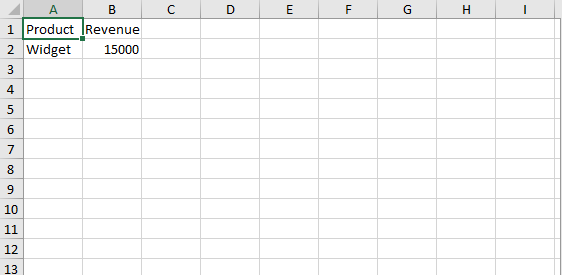
That snippet is IronXL’s take. We’ll show every library’s version of this task below, because the best way to evaluate an API is to read the code.
Before we get into individual profiles, a note on methodology. We evaluated each library across seven dimensions: API ergonomics (how many lines to accomplish common tasks), format support (which file types can you read and write), feature depth (charts, pivots, formulas), performance (write speed and memory usage at scale), cross-platform support (Linux, Docker, cloud), licensing clarity (true cost including hidden fees), and maintenance health (release cadence, community size, documentation quality). No single library tops all seven, the weight you assign to each dimension determines your best pick.
Which C# Excel Library Should You Choose? The Quick-Reference Table
Before diving into 12 individual profiles, here is the comparison table. Every claim in this table is verified against each library’s documentation and NuGet package as of February 2026.
| Library | License | Entry Price | XLSX Files | XLS Files | CSV Files | .NET 8 LTS | .NET 10 | Linux/Docker | Charts | Pivot Tables | Formula Engine | NuGet Downloads |
|—-|—-|—-|—-|—-|—-|—-|—-|—-|—-|—-|—-|—-|
| IronXL | Commercial | $749/yr | ✅ | ✅ | ✅ | ✅ | ✅ | ✅ | ❌ | ❌ | ✅ | 3M+ |
| EPPlus | Commercial | $299/yr | ✅ | ❌ | ✅ | ✅ | ✅ | ✅ | ✅ | ✅ | ✅ | 80M+ |
| ClosedXML | MIT | Free | ✅ | ❌ | ✅ | ✅ | ✅ | ✅ | ❌ | ✅ | ✅ | 60M+ |
| NPOI | Apache 2.0 | Free | ✅ | ✅ | ❌ | ✅ | ✅ | ✅ | ✅ | ❌ | ✅ | 50M+ |
| Aspose.Cells | Commercial | $1,199/yr | ✅ | ✅ | ✅ | ✅ | ✅ | ✅ | ✅ | ✅ | ✅ | 20M+ |
| Syncfusion XlsIO | Commercial/Free* | $0–$995/yr | ✅ | ✅ | ✅ | ✅ | ✅ | ✅ | ✅ | ✅ | ✅ | 15M+ |
| GemBox.Spreadsheet | Freemium | $0–$890 | ✅ | ✅ | ✅ | ✅ | ✅ | ✅ | ✅ | ✅ | ✅ | 5M+ |
| OpenXML SDK | MIT | Free | ✅ | ❌ | ❌ | ✅ | ✅ | ✅ | ✅ | ✅ | ❌ | 100M+ |
| ExcelDataReader | MIT | Free | ✅ | ✅ | ✅ | ✅ | ✅ | ✅ | ❌ | ❌ | ❌ | 70M+ |
| Spire.XLS | Commercial | $999/dev | ✅ | ✅ | ✅ | ✅ | ✅ | ✅ | ✅ | ✅ | ✅ | 3M+ |
| SpreadsheetLight | MIT | Free | ✅ | ❌ | ✅ | ⚠️ | ❌ | ⚠️ | ✅ | ❌ | ✅ | 2M+ |
| SpreadsheetGear | Commercial | $975/dev | ✅ | ✅ | ✅ | ✅ | ✅ | ✅ | ✅ | ❌ | ✅ | 1M+ |
Syncfusion offers a free Community License for companies with <$1M revenue and ≤5 developers. n ⚠️ = Partial or unverified support.
The short version, by scenario:
- Tight budget, full read/write? → ClosedXML (MIT, mature, active development)
- Enterprise-grade with premium support? → IronXL or Aspose.Cells
- Maximum feature coverage? → Aspose.Cells or Syncfusion XlsIO
- Read-only, maximum speed? → ExcelDataReader
- Low-level control, no abstraction? → OpenXML SDK
- Java port, legacy XLS required? → NPOI
Now let’s look at each library in detail.
The 12 C# Excel Libraries Worth Knowing in 2026
Each profile below follows the same structure: what the library is, a code example performing the standard task (create workbook, write data, save), its genuine strengths and limitations, and who should use it. We’re aiming for fairness — every library gets the same honest treatment.
1. IronXL — The All-in-One Commercial .NET Library
IronXL is a commercial .NET Excel library from Iron Software that prioritizes API simplicity and cross-platform deployment. It reads and writes XLS, XLSX, CSV, TSV, and JSON without requiring Microsoft Office. Its extensive set of features also includes creating and editing Microsoft Excel worksheets, the ability to export Excel workbooks, work with formulas, and more. You can even add image formats into your Excel worksheets. Monthly release cadence — the latest version (2026.2) ships with .NET 10 support.
using IronXL;

// Create a new workbook and write data
WorkBook wb = WorkBook.Create(ExcelFileFormat.XLSX);
WorkSheet ws = wb.CreateWorkSheet("Sales");

ws["A1"].Value = "Product";
ws["B1"].Value = "Revenue";
ws["C1"].Value = "Date";
ws["A2"].Value = "Widget";
ws["B2"].DoubleValue = 14999.99;
ws["C2"].Value = DateTime.Now.ToShortDateString();

// Apply formatting
ws["B1:B2"].FormatString = "$#,##0.00";

wb.SaveAs("sales_ironxl.xlsx");
IronXL Output Excel File
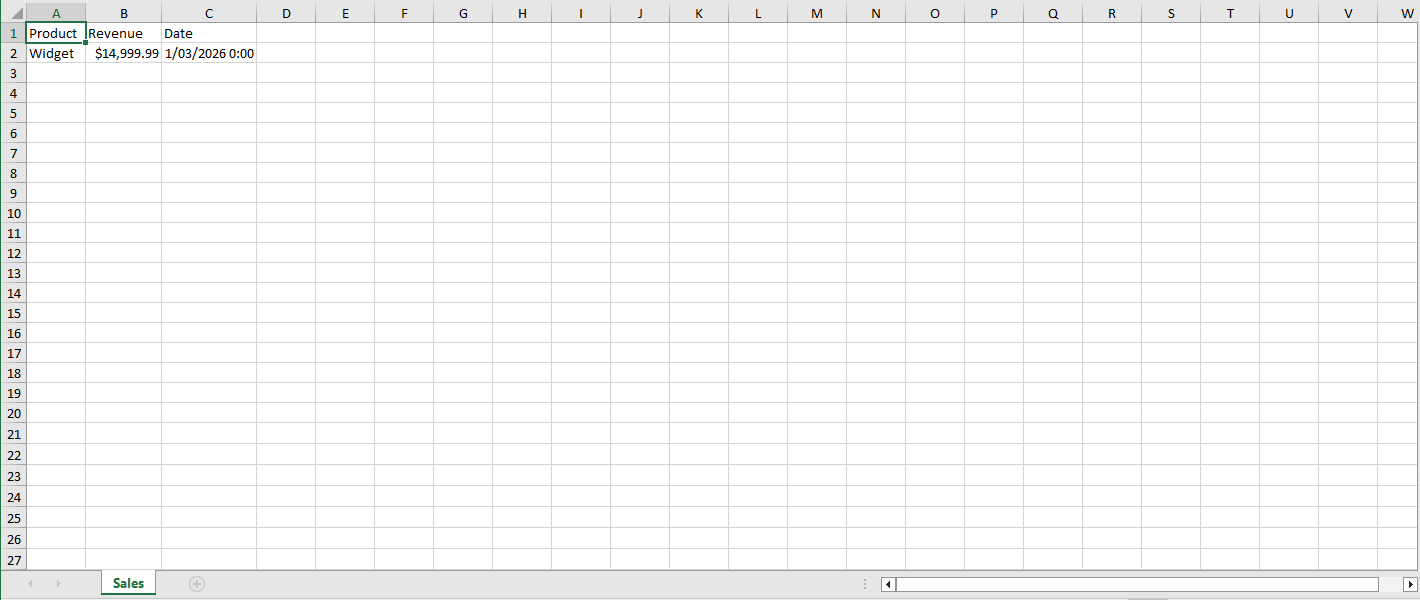
The API uses a WorkBook → WorkSheet → cell-addressing pattern that mirrors how developers think about spreadsheets. Cell addressing supports both A1 notation (ws[“B2”]) and range expressions (ws[“A1:C10”]), and the FormatString property accepts standard Excel format codes. The library handles formula recalculation automatically when cells are edited.
Strengths:
- Minimal boilerplate, create, read, and export data in 3-5 lines of code. This makes is a piece of cake to add into your .NET applications
- Cross-platform: Windows, Linux, macOS, Docker, Azure, AWS Lambda — all tested. Works across different .NET versions
- Monthly releases with active bug fixes; the API-level simplicity is the primary differentiator, not raw throughput (see Benchmarks section for honest numbers)
- Supports XLS (legacy) + XLSX + CSV + TSV + JSON in a unified API
- Real-world deployment: Brainycom uses IronXL for nonprofit financial reconciliation, achieving 4× faster payment processing; ThreeB IT powers logistics and healthcare Excel automation across Germany
Limitations:
- No chart creation (you can read existing charts, but not generate them programmatically)
- No pivot table generation
- Commercial license required for production ($749/year for Lite)
- Smaller community compared to EPPlus or ClosedXML
Best for: Teams that need a clean API for reading/writing/exporting Excel data across platforms, don’t need chart generation, and value professional support and frequent updates. Strong fit for data pipelines, report generation, and CSV/Excel conversion workflows.
2. EPPlus — The Community Favorite Gone Commercial
EPPlus is one of the most downloaded .NET Excel libraries in history. Originally MIT-licensed, it switched to a commercial Polyform license in version 5 (2020). The last free version (4.5.3 on NuGet) remains widely used but unmaintained. The commercial version is feature-rich with charts, pivot tables, and a strong formula engine.
using OfficeOpenXml;

ExcelPackage.License.SetNonCommercialOrganization("My Organization");

using var package = new ExcelPackage();

var ws = package.Workbook.Worksheets.Add("Sales");

ws.Cells["A1"].Value = "Product";
ws.Cells["B1"].Value = "Revenue";
ws.Cells["C1"].Value = "Date";
ws.Cells["A2"].Value = "Widget";
ws.Cells["B2"].Value = 14999.99;
ws.Cells["C2"].Value = DateTime.Now;

ws.Cells["C2"].Style.Numberformat.Format = "yyyy-mm-dd";

ws.Cells["B1:B2"].Style.Numberformat.Format = "$#,##0.00";

package.SaveAs(new FileInfo("sales_epplus.xlsx"));
EEPlus Output
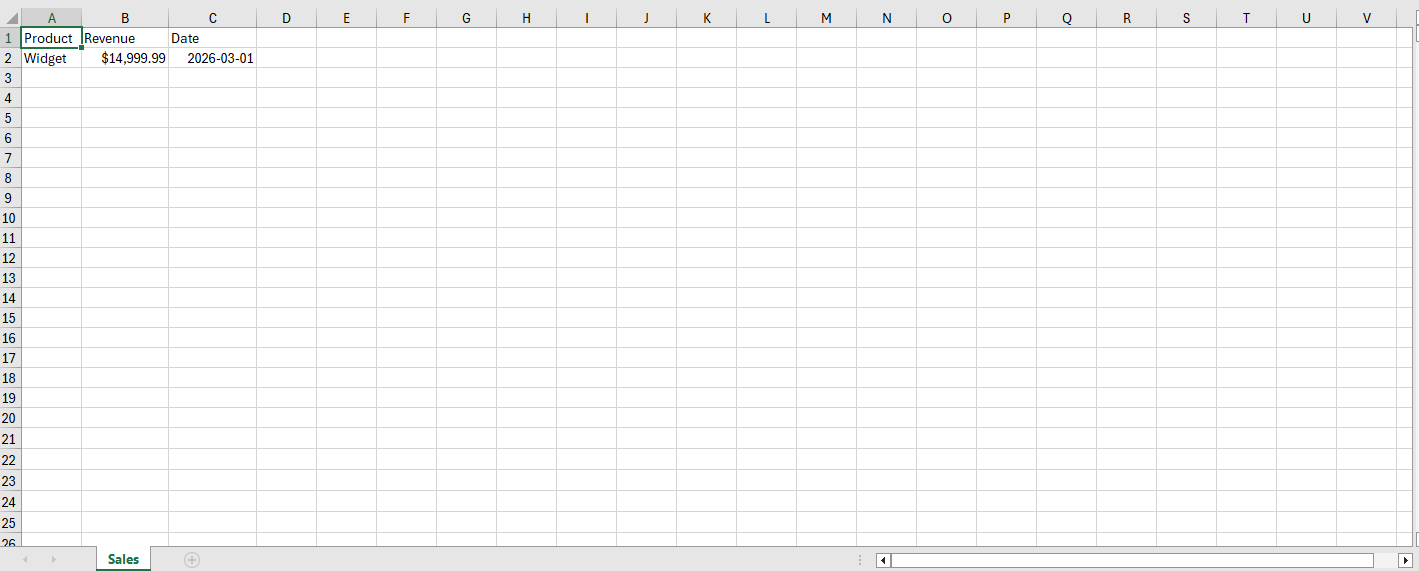
EPPlus uses a ExcelPackage → Workbook → Worksheets hierarchy that closely mirrors the Excel object model. The Cells property accepts A1-style references, and styling is applied through a nested Style object. Note the license configuration line, EPPlus 5+ requires you to set a license context before any operations.
Strengths:
- Massive community and ecosystem, 80M+ NuGet downloads, extensive Stack Overflow coverage
- Charts, pivot tables, conditional formatting, data validation, VBA support
- Powerful LoadFromCollection() and LoadFromDataTable() for object-to-Excel mapping
- Mature formula engine with broad function coverage
Limitations:
- XLSX only, no XLS legacy format support
- Commercial license required for any commercial use since v5 ($299/year base)
- Version 4.5.3 (last free version) is unmaintained and missing years of bug fixes
- Can struggle with memory on very large files (100K+ rows) in some configurations
Best for: Teams with existing EPPlus investments, projects needing charts/pivot tables on a moderate budget, and developers who value the enormous community knowledge base.
3. ClosedXML — The Open-Source Developer’s Choice for Excel API
ClosedXML wraps Microsoft’s OpenXML SDK in a developer-friendly API. MIT-licensed, actively maintained (frequent commits on GitHub), and used by millions. It’s the go-to recommendation when developers ask for a free, full-featured Excel library on Stack Overflow and .NET community forums.
using ClosedXML.Excel;

using var wb = new XLWorkbook();

var ws = wb.AddWorksheet("Sales");

ws.Cell("A1").Value = "Product";
ws.Cell("B1").Value = "Revenue";
ws.Cell("C1").Value = "Date";
ws.Cell("A2").Value = "Widget";
ws.Cell("B2").Value = 14999.99;
ws.Cell("C2").Value = DateTime.Now;

ws.Cell("B2").Style.NumberFormat.Format = "$#,##0.00";

wb.SaveAs("sales_closedxml.xlsx");
ClosedXML Output
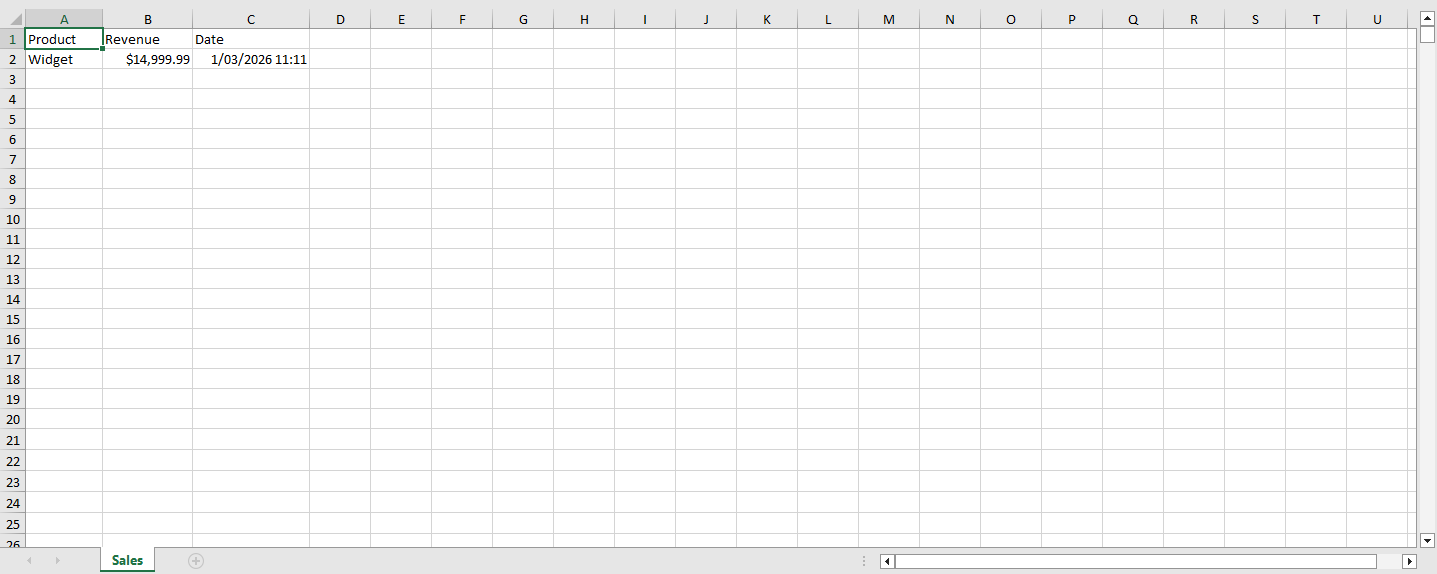
ClosedXML’s API is intuitive: XLWorkbook → AddWorksheet → Cell() with string-based addressing. The Style property chain is clean and discoverable via IntelliSense. It builds on top of OpenXML SDK, so it generates spec-compliant .xlsx files.
Strengths:
- MIT license, genuinely free for all use, including commercial
- Clean, intuitive API that makes OpenXML SDK bearable
- Active development with regular releases and responsive maintainers
- Good pivot table support and conditional formatting
- Large community: 60M+ NuGet downloads
Limitations:
- XLSX only, no XLS legacy format support
- No chart creation (a frequently requested feature, still unimplemented)
- Performance degrades with very large datasets (100K+ rows can be slow or memory-intensive)
- No commercial support, community-only via GitHub Issues
Best for: Open-source projects, budget-constrained teams, and any scenario where MIT licensing is a requirement. Excellent for small-to-medium datasets where chart generation isn’t needed.
4. NPOI — The Java Port That Refuses to Die
NPOI is the .NET port of Apache POI, the Java Excel library. It’s one of the few free libraries that supports both XLS (BIFF) and XLSX (OOXML) formats. Apache 2.0 licensed. The API reflects its Java heritage, it’s more verbose than C#-native alternatives, but it’s battle-tested and handles legacy formats that newer libraries can’t touch.
using NPOI.XSSF.UserModel;
using NPOI.SS.UserModel;

IWorkbook wb = new XSSFWorkbook();

ISheet ws = wb.CreateSheet("Sales");

IRow headerRow = ws.CreateRow(0);

headerRow.CreateCell(0).SetCellValue("Product");
headerRow.CreateCell(1).SetCellValue("Revenue");
headerRow.CreateCell(2).SetCellValue("Date");

IRow dataRow = ws.CreateRow(1);

dataRow.CreateCell(0).SetCellValue("Widget");
dataRow.CreateCell(1).SetCellValue(14999.99);

dataRow.CreateCell(2).SetCellValue(DateTime.Now.ToShortDateString());

using var fs = new FileStream("sales_npoi.xlsx", FileMode.Create);
wb.Write(fs);
NPOI Output
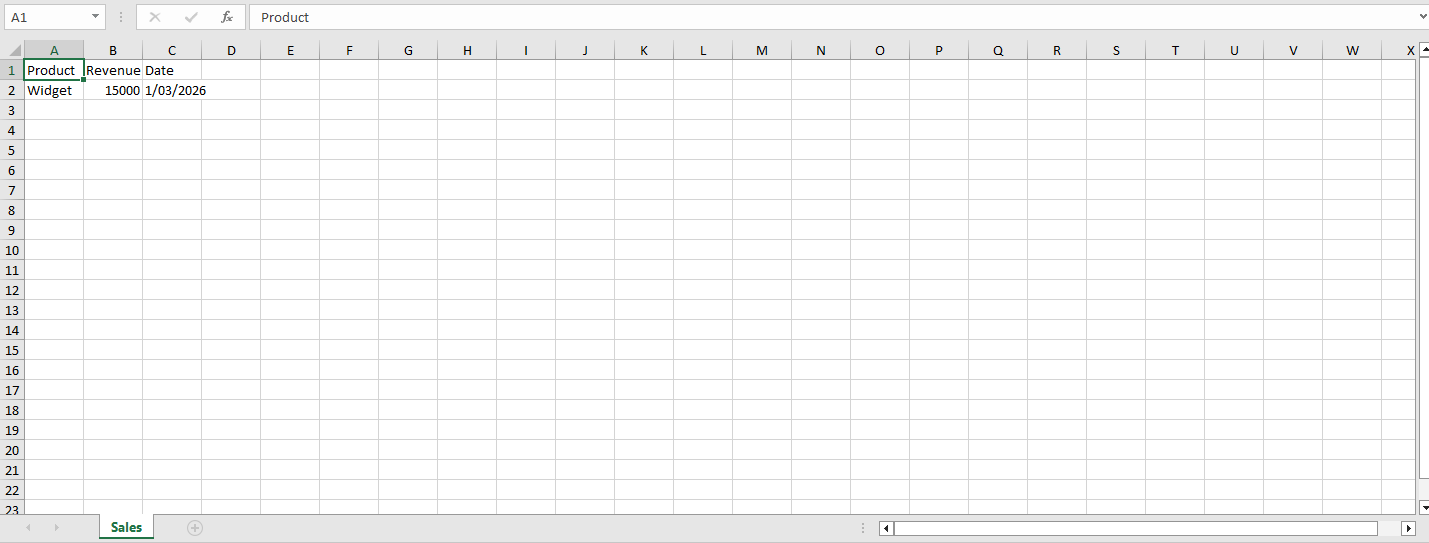
NPOI requires explicit row and cell creation via CreateRow() and CreateCell(), there’s no string-based cell addressing. For XLS files, swap XSSFWorkbook with HSSFWorkbook. The interface-driven design (IWorkbook, ISheet, IRow) means the same code logic can target either format by changing a single constructor.
Strengths:
- Apache 2.0 license, free for commercial use
- Supports both XLS (97-2003) and XLSX, one of few free libraries that handles legacy XLS
- Chart creation support (basic)
- Handles Word (.doc/.docx) and PowerPoint in addition to Excel documents
- Proven at enterprise scale — ported from Apache POI with decades of Java heritage
Limitations:
- Verbose, Java-style API, significantly more boilerplate than C#-native alternatives
- Performance is generally slower than EPPlus, ClosedXML, or IronXL for equivalent operations
- Documentation is sparse and often in Chinese — English resources are community-contributed
- API can be unintuitive for developers unfamiliar with Apache POI
Best for: Projects that must read or write legacy XLS files without a commercial license. Also suitable when you need a single library for Excel + Word + PowerPoint on a zero budget.
5. Aspose.Cells — The Enterprise Heavyweight
Aspose.Cells is the most feature-rich .NET Excel library available. It supports virtually every Excel feature: charts, pivot tables, conditional formatting, data validation, sparklines, slicers, VBA macros, and more. It’s also the most expensive option. Aspose positions it as a complete Excel automation platform, not just a file I/O library.
using Aspose.Cells;

Workbook wb = new Workbook();

Worksheet ws = wb.Worksheets[0];

ws.Cells["A1"].PutValue("Product");
ws.Cells["B1"].PutValue("Revenue");
ws.Cells["C1"].PutValue("Date");
ws.Cells["A2"].PutValue("Widget");
ws.Cells["B2"].PutValue(14999.99);
ws.Cells["C2"].PutValue(DateTime.Now);

Style style = wb.CreateStyle();

style.Number = 7; // $#,##0.00

ws.Cells["B2"].SetStyle(style);

wb.Save("sales_aspose.xlsx");
Aspose.Cells Output
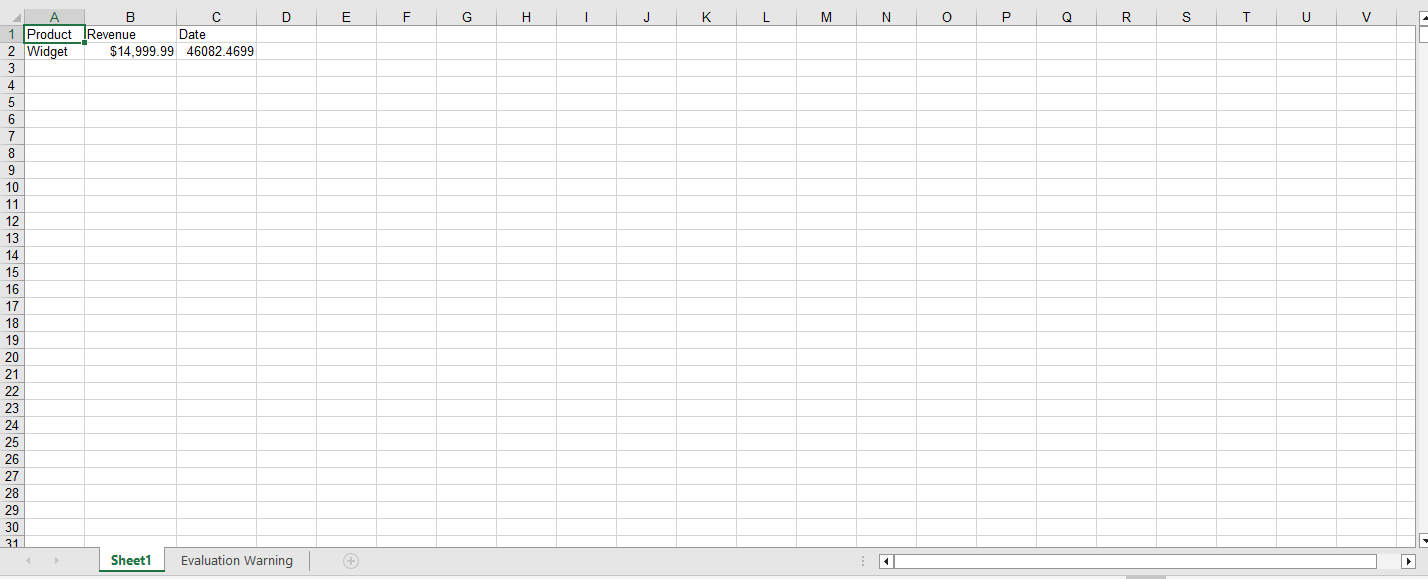
Aspose.Cells uses a Workbook → Worksheets → Cells hierarchy. Data is written with PutValue() rather than direct assignment. Styling requires creating a Style object and applying it, more steps than some competitors, but it provides granular control over every formatting property.
Strengths:
- Most comprehensive feature set in the .NET Excel ecosystem, if Excel can do it, Aspose.Cells probably supports it
- Excellent performance on large files, optimized for enterprise-scale batch processing
- Extensive format support: XLSX, XLS, XLSB, XLSM, CSV, ODS, PDF, HTML, images
- Excel-to-PDF rendering that’s among the most faithful available
- Strong documentation, extensive code samples, and dedicated support team
Limitations:
- Highest price point: Developer Small Business starts at $1,199/year; OEM tiers reach $11,198
- API is verbose in places, creating and applying styles is more ceremonial than IronXL or ClosedXML
- The massive API surface can be overwhelming for simple tasks
- Heavyweight dependency, the NuGet package is large
Best for: Enterprise teams with budget for premium tooling, projects requiring advanced features (charts, pivots, sparklines, VBA), and workflows needing high-fidelity Excel-to-PDF conversion.
6. Syncfusion XlsIO — The Suite Play
Syncfusion Essential XlsIO is part of Syncfusion’s massive Essential Studio suite. It offers broad Excel feature coverage and benefits from Syncfusion’s cross-platform UI control ecosystem. The free Community License (for companies under $1M revenue, ≤5 developers) makes it accessible to small teams.
using Syncfusion.XlsIO;

using ExcelEngine excelEngine = new ExcelEngine();

IApplication app = excelEngine.Excel;

app.DefaultVersion = ExcelVersion.Xlsx;

IWorkbook wb = app.Workbooks.Create(1);
IWorksheet ws = wb.Worksheets[0];

ws.Range["A1"].Text = "Product";
ws.Range["B1"].Text = "Revenue";
ws.Range["C1"].Text = "Date";
ws.Range["A2"].Text = "Widget";
ws.Range["B2"].Number = 14999.99;
ws.Range["C2"].DateTime = DateTime.Now;

ws.Range["B2"].NumberFormat = "$#,##0.00";

wb.SaveAs("sales_syncfusion.xlsx");
Syncfusion XlsIO Output
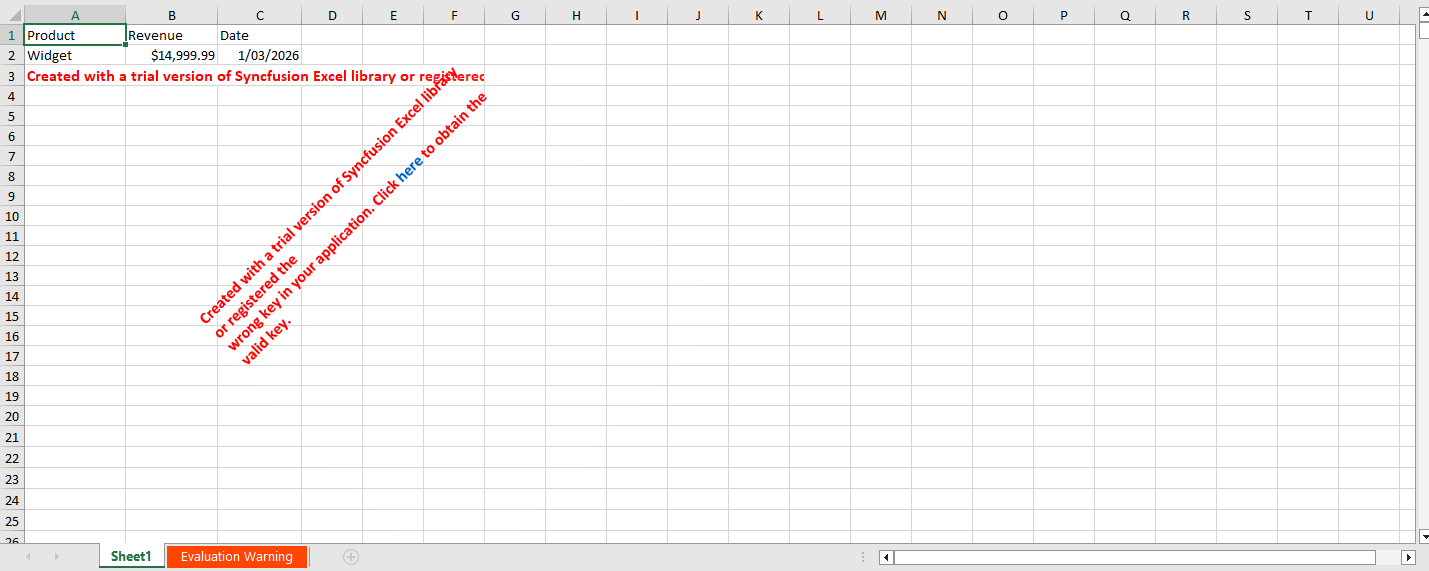
Syncfusion uses an ExcelEngine → IApplication → IWorkbook hierarchy that mirrors Excel’s COM object model. Cell access is through Range[] with separate typed properties (Text, Number, DateTime). This strongly-typed approach catches type errors at compile time rather than runtime.
Strengths:
- Feature-rich: Use data source’s to create charts, pivot tables, conditional formatting, data validation, template markers, sparklines
- Free Community License for small companies, a genuine differentiator
- Excel-to-PDF conversion included
- Deep integration with Syncfusion’s Blazor, MAUI, and WPF UI controls
- Active development with quarterly releases; cross-platform (Windows, Linux, macOS, Docker)
Limitations:
- The Community License has strict eligibility requirements, companies over $1M revenue must purchase
- Full Suite pricing is complex and can be expensive ($995/dev/year for Essential Studio)
- Library is part of a massive suite, you’re pulling in more dependencies than needed for Excel-only work
- Vendor lock-in concern: deep Syncfusion ecosystem integration can make migration difficult
Best for: Teams already using Syncfusion’s UI controls, startups qualifying for the free Community License, and projects needing tight integration between Excel processing and Blazor/MAUI front ends.
7. GemBox.Spreadsheet — The Performance-Focused Mid-Tier
GemBox.Spreadsheet is a commercially licensed .NET component with a compelling free tier (150 rows, 5 sheets). It advertises strong performance numbers — the company claims 1 million rows in under 3.5 seconds with less than 256MB RAM — and supports an unusually broad range of output formats including PDF, XPS, and image rendering. Available on NuGet.
using GemBox.Spreadsheet;

SpreadsheetInfo.SetLicense("FREE-LIMITED-KEY");

var wb = new ExcelFile();

var ws = wb.Worksheets.Add("Sales");

ws.Cells["A1"].Value = "Product";
ws.Cells["B1"].Value = "Revenue";
ws.Cells["C1"].Value = "Date";
ws.Cells["A2"].Value = "Widget";
ws.Cells["B2"].Value = 14999.99;
ws.Cells["C2"].Value = DateTime.Now;

ws.Cells["B2"].Style.NumberFormat = "$#,##0.00";

wb.Save("sales_gembox.xlsx");
GemBox.Spreadsheet Output
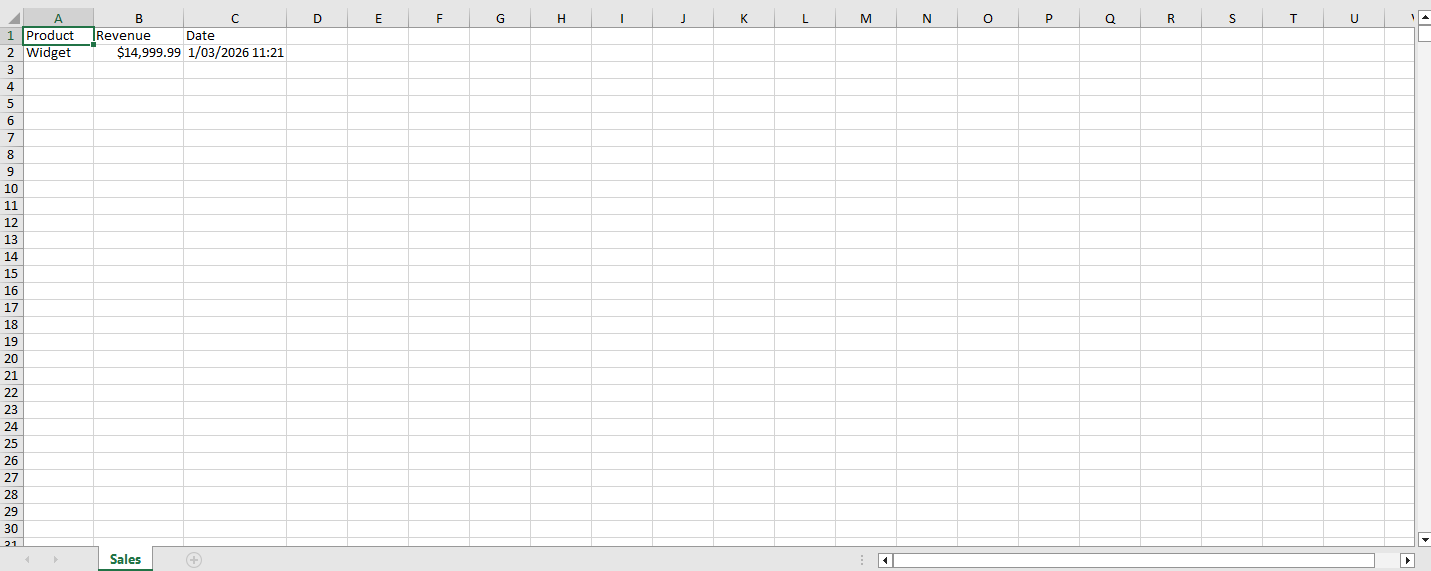
GemBox uses ExcelFile → Worksheets → Cells with string-based addressing. The API is clean and similar to ClosedXML’s pattern. The free tier key (FREE-LIMITED-KEY) enables evaluation without watermarks — just with row limits.
Strengths:
- Strong claimed performance on large datasets (1M rows, <256MB, <3.5s)
- PDF, XPS, and image export built in — no separate library needed
- Charts, pivot tables, conditional formatting, and data validation support
- Free tier for small datasets (useful for prototyping)
- Clean, idiomatic C# API
Limitations:
- Free tier limited to 150 rows and 5 sheets — too restrictive for most real applications
- Smaller community than EPPlus, ClosedXML, or NPOI — fewer Stack Overflow answers
- Professional license starts at ~$890 (one-time) — competitive but not cheap
- Less name recognition — harder to get team buy-in compared to established alternatives
Best for: Performance-sensitive applications processing large files, projects needing built-in PDF/image export from Excel, and teams that value one-time licensing over subscriptions.
8. OpenXML SDK — The Foundation Layer
Microsoft’s Open XML SDK provides low-level access to Office Open XML documents. It’s what ClosedXML and many other libraries are built on. MIT-licensed, maintained by Microsoft, and gives you direct control over the XML structure of .xlsx files. The tradeoff: you’re essentially writing XML with helpers.
using DocumentFormat.OpenXml;
using DocumentFormat.OpenXml.Packaging;
using DocumentFormat.OpenXml.Spreadsheet;

using var doc = SpreadsheetDocument.Create("sales_openxml.xlsx", SpreadsheetDocumentType.Workbook);

var workbookPart = doc.AddWorkbookPart();

workbookPart.Workbook = new Workbook();

var worksheetPart = workbookPart.AddNewPart<WorksheetPart>();

worksheetPart.Worksheet = new Worksheet(new SheetData());

var sheets = workbookPart.Workbook.AppendChild(new Sheets());

sheets.Append(new Sheet
{
    Id = workbookPart.GetIdOfPart(worksheetPart),
    SheetId = 1,
    Name = "Sales"
});

var sheetData = worksheetPart.Worksheet.GetFirstChild<SheetData>();

var row = new Row { RowIndex = 1 };

row.Append(new Cell { CellReference = "A1", DataType = CellValues.String,
    CellValue = new CellValue("Product") });

row.Append(new Cell { CellReference = "B1", DataType = CellValues.String,
    CellValue = new CellValue("Revenue") });

sheetData.Append(row);

workbookPart.Workbook.Save();
OpenXML Output
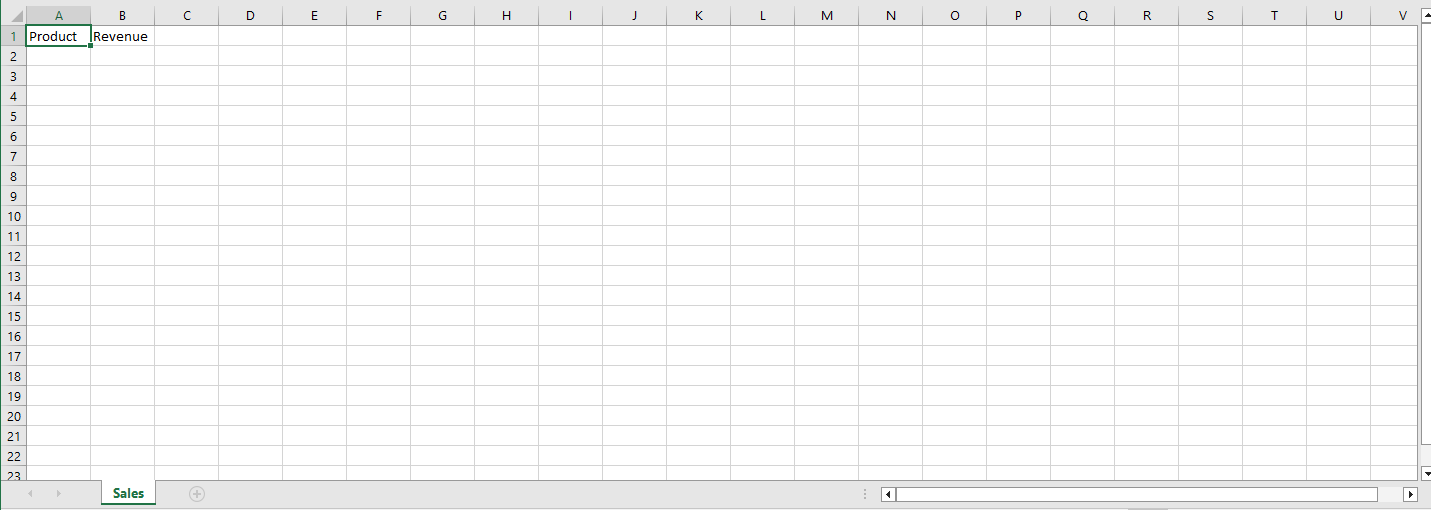
Let’s be direct: that’s a lot of code just to write two cells. OpenXML SDK requires you to manually construct the XML document structure, workbook parts, worksheet parts, sheet data, rows, cells, cell references, data types. There’s no worksheet[“A1”] = value convenience.
Strengths:
- MIT licensed, maintained by Microsoft, as “official” as it gets
- Maximum control over document structure, nothing is abstracted away
- Memory-efficient for streaming writes (SAX-style approach available)
- 100M+ NuGet downloads, the foundational layer many other libraries depend on
- No third-party risk, it’s from Microsoft themselves
Limitations:
- Extremely verbose, simple tasks require 5-10× more code than any higher-level library
- No formula calculation engine, formulas are stored as strings, not evaluated
- No XLS support, OOXML (.xlsx) only
- No convenient cell addressing, formatting shortcuts, or data binding helpers
- Steep learning curve, you need to understand the OOXML specification
Best for: Library authors building their own Excel abstraction, scenarios requiring absolute control over document structure, and teams with strict “no third-party dependencies” policies who can absorb the development cost.
9. ExcelDataReader — The Lightweight Read-Only Specialist
ExcelDataReader does one thing and does it well: reading Excel files. It supports XLS, XLSX, and CSV through a streaming IDataReader interface that’s memory-efficient for large files. MIT-licensed. If you only need to read spreadsheets, this should be your first consideration.
using ExcelDataReader;
using System.Data;

// Required for .NET Core
System.Text.Encoding.RegisterProvider(System.Text.CodePagesEncodingProvider.Instance);

using var stream = File.Open("sales_data.xlsx", FileMode.Open, FileAccess.Read);

using var reader = ExcelReaderFactory.CreateReader(stream);

DataSet result = reader.AsDataSet(new ExcelDataSetConfiguration
{
    ConfigureDataTable = _ => new ExcelDataTableConfiguration { UseHeaderRow = true }
});

DataTable table = result.Tables[0];

foreach (DataRow row in table.Rows)
{
    Console.WriteLine($"{row["Product"]}: {row["Revenue"]}");
}
ExcelDataReader Reading Output
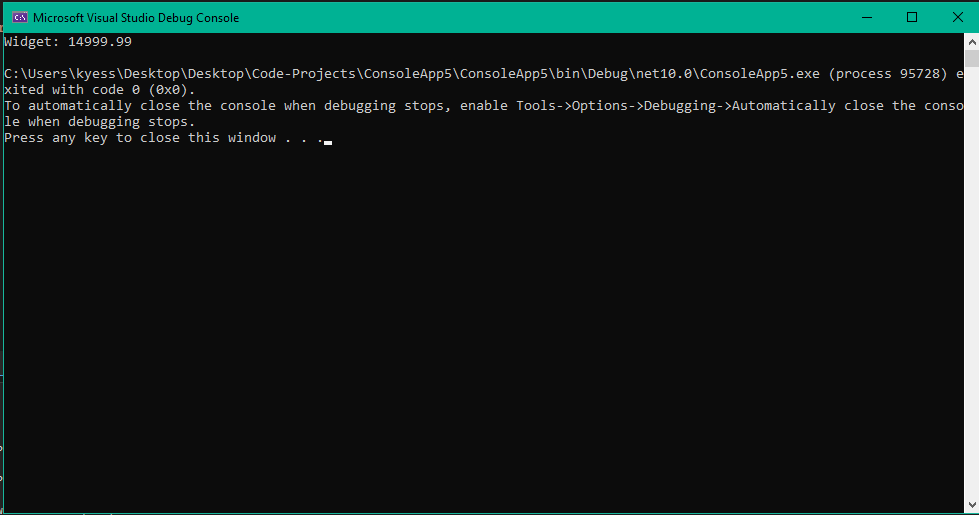
ExcelDataReader returns data through the familiar System.Data interfaces: IDataReader for streaming and DataSet/DataTable for materialized results. The UseHeaderRow = true configuration promotes the first row to column names. Note the encoding provider registration, required on .NET Core for XLS format support.
Strengths:
- MIT license — free for everything
- Lightweight: small NuGet package, minimal dependencies
- Streaming reader — memory-efficient for large files
- Supports both XLS and XLSX plus CSV
- DataTable integration makes it easy to pipe data into databases or other systems
- 70M+ NuGet downloads — proven reliability
Limitations:
- Read-only — cannot create or modify Excel files
- No formatting, styling, charts, or formula evaluation
- No cell addressing — data access is row/column based only
- Requires manual encoding provider registration on .NET Core
Best for: ETL pipelines, data import workflows, migration tools, and any scenario where you need to read Excel data quickly and cheaply without ever writing back to a spreadsheet.
10. Spire.XLS — The eIceBlue Contender
Spire.XLS for .NET by eIceBlue is a commercial Excel component with a free version limited to 200 rows and 5 sheets. The commercial version supports the full range of Excel features including charts, pivot tables, and Excel-to-PDF conversion. eIceBlue also offers Word, PDF, and PowerPoint libraries in their Spire.Office bundle.
using Spire.Xls;

Workbook wb = new Workbook();

Worksheet ws = wb.Worksheets[0];

ws.Name = "Sales";

ws.Range["A1"].Text = "Product";
ws.Range["B1"].Text = "Revenue";
ws.Range["C1"].Text = "Date";
ws.Range["A2"].Text = "Widget";
ws.Range["B2"].NumberValue = 14999.99;
ws.Range["C2"].DateTimeValue = DateTime.Now;

ws.Range["B2"].NumberFormat = "$#,##0.00";

wb.SaveToFile("sales_spire.xlsx", ExcelVersion.Version2016);
Spire.XLS Output
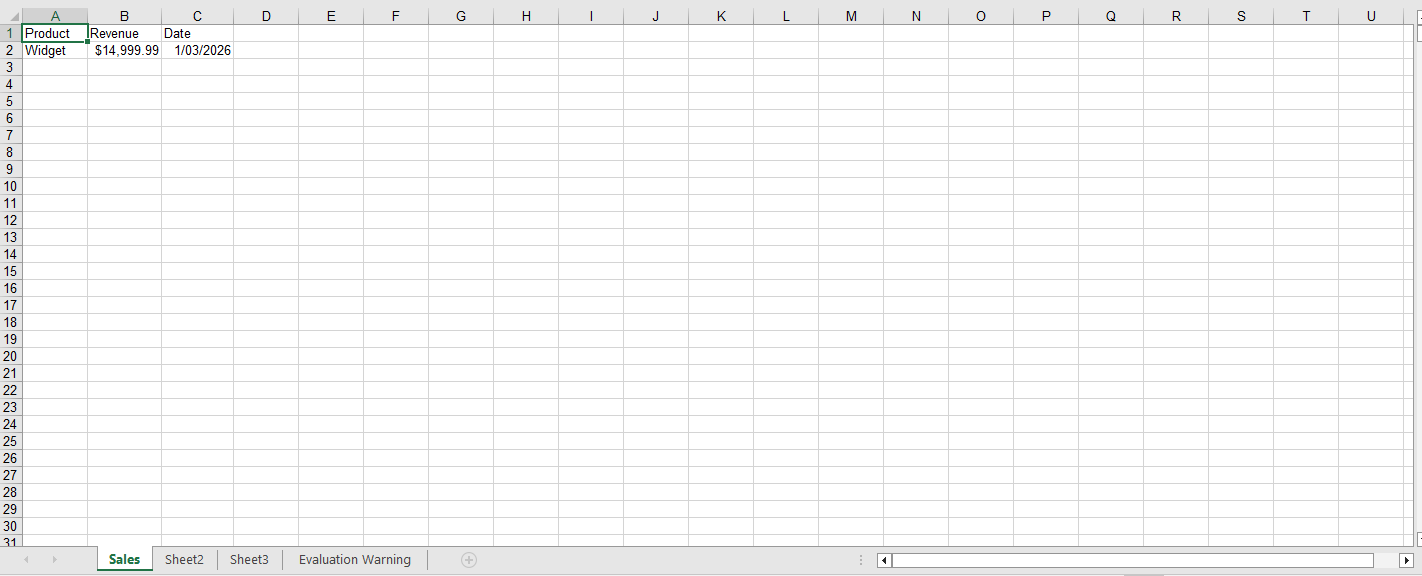
Spire.XLS follows a pattern similar to Syncfusion, Workbook → Worksheet → Range with typed value properties. The SaveToFile method requires specifying the target Excel version explicitly.
Strengths:
- Comprehensive feature set: charts, pivots, conditional formatting, encryption, digital signatures
- Excel-to-PDF and Excel-to-image conversion built in
- Free version available (200 rows, 5 sheets), more generous than GemBox’s free tier for row count
- Supports XLS and XLSX
- Part of the broader Spire.Office suite
Limitations:
- Free version’s 200-row limit is too restrictive for most production use
- Commercial pricing starts at ~$999/developer, on the higher end
- Smaller .NET community presence compared to Aspose or Syncfusion
- Documentation quality is inconsistent, some API areas are poorly documented
- Java heritage shows in some API patterns
Best for: Teams evaluating commercial alternatives to Aspose.Cells at a different price point, and projects already using other Spire.Office components.
11. SpreadsheetLight — The Minimalist
SpreadsheetLight is an MIT-licensed library built on OpenXML SDK. It aims to be the “simple” option — easy to learn, lightweight, and sufficient for common spreadsheet tasks. The tradeoff is that development has stalled — the last meaningful update was several years ago.
using SpreadsheetLight;

using var doc = new SLDocument();

doc.SetCellValue("A1", "Product");
doc.SetCellValue("B1", "Revenue");
doc.SetCellValue("C1", "Date");
doc.SetCellValue("A2", "Widget");
doc.SetCellValue("B2", 14999.99);

doc.SetCellValue("C2", DateTime.Now.ToShortDateString());

doc.SaveAs("sales_spreadsheetlight.xlsx");
SpreadsheetLight uses a single SLDocument class as the entry point. The SetCellValue method is overloaded for different types. It’s arguably the simplest API in this comparison — but simplicity comes at a cost.
Strengths:
- MIT licensed, genuinely free
- Extremely simple API, lowest learning curve in this roundup
- Lightweight, minimal dependencies (just OpenXML SDK)
- Basic chart support (more than ClosedXML offers)
- Good enough for simple reporting and data export tasks
Limitations:
- Appears unmaintained, infrequent updates, last major activity was years ago
- .NET Framework focused, .NET Core/.NET 8+ compatibility is uncertain
- XLSX only, no XLS support
- Limited feature set compared to active alternatives
- Small community, limited Stack Overflow coverage and troubleshooting resources
Best for: Simple, one-off spreadsheet generation tasks in .NET Framework projects where you need something lightweight and free. For this use case, ClosedXML might actually be the better choice given its active maintenance.
12. SpreadsheetGear — The Enterprise Veteran
SpreadsheetGear has been in the .NET Excel space for over a decade. It positions itself as the high-performance, Excel-compatible calculation engine for enterprise applications. The library includes charting, a formula engine with 450+ functions, and WinForms/WPF spreadsheet controls for building interactive Excel-like UIs.
using SpreadsheetGear;

IWorkbook wb = Factory.GetWorkbook();

IWorksheet ws = wb.Worksheets["Sheet1"];

IRange cells = ws.Cells;

cells["A1"].Value = "Product";
cells["B1"].Value = "Revenue";
cells["C1"].Value = "Date";
cells["A2"].Value = "Widget";
cells["B2"].Value = 14999.99;
cells["C2"].Value = DateTime.Now;

cells["B2"].NumberFormat = "$#,##0.00";

wb.SaveAs("sales_spreadsheetgear.xlsx", FileFormat.OpenXMLWorkbook);
SpreadsheetGear Output
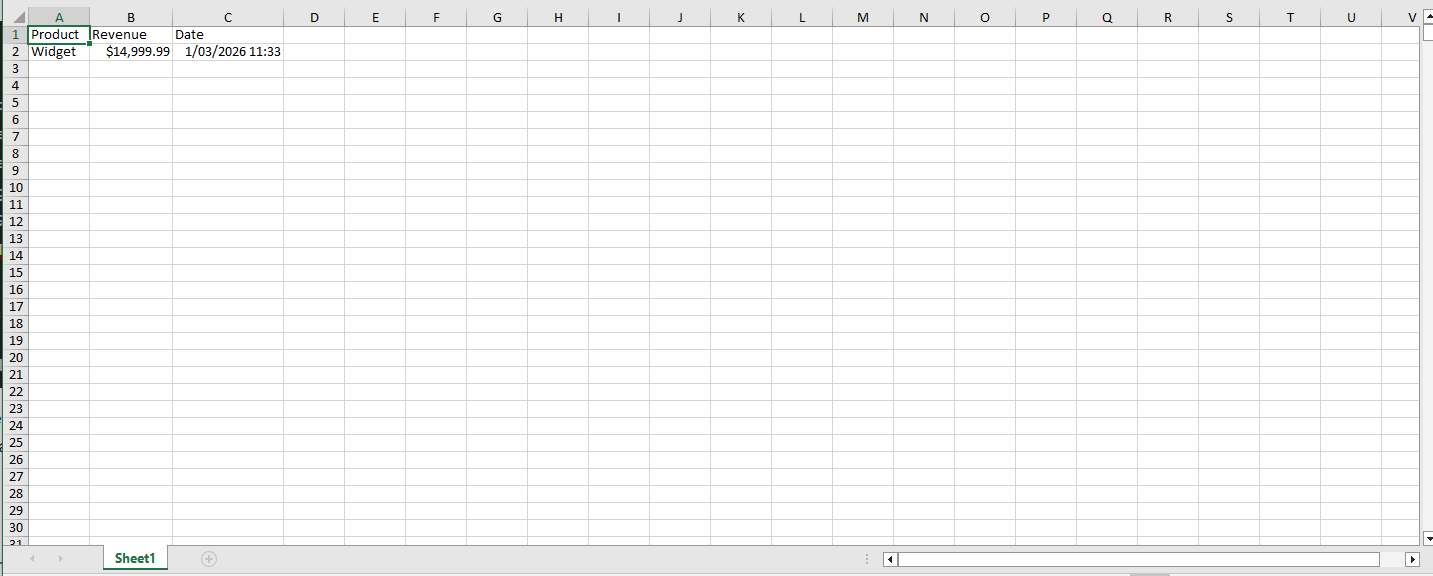
SpreadsheetGear’s API closely mirrors the Excel VBA object model, developers who’ve written Excel macros will feel immediately at home. The Factory.GetWorkbook() pattern and IRange interface follow Excel’s conventions closely.
Strengths:
- 450+ built-in functions, one of the most complete formula engines in any .NET library
- High-performance calculations optimized for financial modeling scenarios
- WinForms and WPF spreadsheet UI controls for building interactive Excel-like interfaces
- Excellent Excel compatibility, aims for pixel-perfect rendering
- Long track record, production-proven in enterprise environments
Limitations:
- Higher price point (~$975/developer) with less visible pricing, must contact sales
- Smaller developer community than EPPlus, ClosedXML, or NPOI
- Less modern API feel compared to newer entrants
- Limited presence on modern community platforms (HackerNoon, Dev.to, etc.)
- No free tier or community edition
Best for: Financial applications needing a powerful calculation engine, desktop applications requiring embedded spreadsheet UI controls, and enterprise environments where Excel VBA migration is the use case.
Feature Showdown: What Can Each Library Actually Do?
Beyond the basics of reading and writing cells, Excel libraries differ dramatically in their advanced feature support. Here’s what we found when we tested features that matter in production applications.
File Format Support
| Library | XLSX | XLS | XLSB | XLSM | CSV | TSV | JSON | ODS | PDF Export |
|—-|—-|—-|—-|—-|—-|—-|—-|—-|—-|
| IronXL | ✅ | ✅ | ❌ | ✅ | ✅ | ✅ | ✅ | ❌ | ❌ |
| EPPlus | ✅ | ❌ | ❌ | ✅ | ✅ | ❌ | ❌ | ❌ | ❌ |
| ClosedXML | ✅ | ❌ | ❌ | ✅ | ✅ | ❌ | ❌ | ❌ | ❌ |
| NPOI | ✅ | ✅ | ❌ | ❌ | ❌ | ❌ | ❌ | ❌ | ❌ |
| Aspose.Cells | ✅ | ✅ | ✅ | ✅ | ✅ | ✅ | ✅ | ✅ | ✅ |
| Syncfusion | ✅ | ✅ | ❌ | ✅ | ✅ | ✅ | ✅ | ❌ | ✅ |
| GemBox | ✅ | ✅ | ✅ | ✅ | ✅ | ✅ | ❌ | ✅ | ✅ |
| OpenXML SDK | ✅ | ❌ | ❌ | ✅ | ❌ | ❌ | ❌ | ❌ | ❌ |
| ExcelDataReader | ✅ | ✅ | ❌ | ❌ | ✅ | ❌ | ❌ | ❌ | ❌ |
| Spire.XLS | ✅ | ✅ | ✅ | ✅ | ✅ | ❌ | ❌ | ✅ | ✅ |
| SpreadsheetLight | ✅ | ❌ | ❌ | ❌ | ✅ | ❌ | ❌ | ❌ | ❌ |
| SpreadsheetGear | ✅ | ✅ | ❌ | ❌ | ✅ | ❌ | ❌ | ❌ | ✅ |
The format support gap is significant. If you need XLS legacy support for free, NPOI is your only real option. If you need PDF export from Excel, you’re looking at Aspose.Cells, Syncfusion, GemBox, Spire.XLS, or SpreadsheetGear, all commercial. IronXL’s strength here is the unified API for XLSX + XLS + CSV + TSV + JSON, a practical combination for data pipeline work.
Charts, Pivot Tables & Advanced Features
| Library | Charts | Pivot Tables | Cond. Formatting | Data Validation | Images | Formula Engine |
|—-|—-|—-|—-|—-|—-|—-|
| IronXL | ❌ | ❌ | ✅ | ✅ | ✅ | ✅ (auto-recalc) |
| EPPlus | ✅ | ✅ | ✅ | ✅ | ✅ | ✅ |
| ClosedXML | ❌ | ✅ | ✅ | ✅ | ✅ | ✅ |
| NPOI | ✅ (basic) | ❌ | ✅ | ✅ | ✅ | ✅ |
| Aspose.Cells | ✅ | ✅ | ✅ | ✅ | ✅ | ✅ |
| Syncfusion | ✅ | ✅ | ✅ | ✅ | ✅ | ✅ |
| GemBox | ✅ | ✅ | ✅ | ✅ | ✅ | ✅ |
| OpenXML SDK | ✅ (manual XML) | ✅ (manual XML) | ✅ (manual XML) | ✅ (manual XML) | ✅ | ❌ |
| ExcelDataReader | ❌ | ❌ | ❌ | ❌ | ❌ | ❌ |
| Spire.XLS | ✅ | ✅ | ✅ | ✅ | ✅ | ✅ |
| SpreadsheetLight | ✅ (basic) | ❌ | ✅ | ✅ | ✅ | ✅ |
| SpreadsheetGear | ✅ | ❌ | ✅ | ✅ | ✅ | ✅ (450+ functions) |
The tradeoff here is clear. If you need chart and pivot table creation, you need EPPlus, Aspose.Cells, Syncfusion, GemBox, or Spire.XLS. IronXL and ClosedXML both lack chart creation — an honest limitation worth acknowledging. For read/write data work without charts, both offer cleaner APIs than the chart-capable alternatives.
Performance: Benchmark Results Across Real-World Operations
Performance claims without methodology are marketing. Here’s how we structured our tests, and the results will probably surprise you.
Methodology
We ran a standardized benchmark suite across 15 libraries (our core 12 plus SpreadCheetah, MiniExcel, and FastExcel as bonus contenders). Rather than a single synthetic task, we tested four real-world operations that mirror what developers actually build with Excel libraries:
- Financial Report Generation: Create a 12-month statement workbook with formulas and formatting
- Inventory Tracking: Build a 500-item, 3-warehouse tracking spreadsheet with cross-references
- Sales Data Analysis: Process and write 10,000 transactions with aggregation
- Employee Payroll Processing: Generate a 250-employee payroll workbook with calculated fields
Each test measured wall-clock execution time (ms) and peak memory (MB). Tests were run on .NET 8 with multiple iterations; we report the recorded values from our benchmark harness. Only tests that completed successfully are reported, libraries that failed a given operation are excluded from that table rather than penalized.
Financial Report Generation (12-Month Statements)
| Rank | Library | Time (ms) | Memory (MB) |
|—-|—-|—-|—-|
| 1 | SpreadCheetah | 2.9 | 0.2 |
| 2 | DevExpress | 53.2 | 4.5 |
| 3 | Aspose.Cells | 55.5 | 0.25 |
| 4 | Spire.XLS | 80.3 | 1.2 |
| 5 | OfficeIMO | 257.6 | 2.1 |
| 6 | IronXL | 498.1 | 4.2 |
SpreadCheetah’s 2.9ms is striking, it’s a write-only, forward-only streaming library designed explicitly for maximum throughput. It sacrifices API convenience (no random cell access, no reading) for raw speed. For pure report generation where you know the output structure upfront, it’s essentially unbeatable. Aspose.Cells and DevExpress cluster closely in the 53-56ms range, representing the top tier among full-featured libraries.
IronXL trails here at 498ms. For a one-off monthly report, that’s imperceptible to the end user. For a batch job generating thousands of reports, it becomes a consideration, and SpreadCheetah or Aspose.Cells would be the better choice for that specific workload.
Inventory Tracking (500 Items, 3 Warehouses)
| Rank | Library | Time (ms) | Memory (MB) |
|—-|—-|—-|—-|
| 1 | EPPlus | 51.2 | 2.9 |
| 2 | ExcelMapper | 54.1 | 4.9 |
| 3 | SpreadCheetah | 56.3 | 2.1 |
| 4 | Aspose.Cells | 136.5 | 2.4 |
| 5 | Spire.XLS | 183.2 | 1.4 |
| 6 | DevExpress | 451.7 | 5.0 |
| 7 | IronXL | 1,344.5 | 18.7 |
| 8 | OfficeIMO | 16,659.5 | 14.4 |
EPPlus dominates this mid-complexity operation, followed closely by SpreadCheetah and ExcelMapper. The memory numbers tell an important story: Spire.XLS achieves competitive speed at just 1.4MB, the most memory-efficient result for this test. IronXL’s 18.7MB footprint at rank 7 reflects its DOM-based architecture loading the full document model into memory. That said, 1.3 seconds for a 500-item inventory workbook is perfectly acceptable for interactive use, it’s the kind of overhead you optimize only when it shows up in profiling.
Sales Data Analysis (10,000 Transactions)
This is the heaviest test, 10,000 rows with aggregation. It separates libraries built for scale from those optimized for convenience.
| Rank | Library | Time (ms) | Memory (MB) |
|—-|—-|—-|—-|
| 1 | CsvHelper | 140.3 | 9.3 |
| 2 | ClosedXML | 262.5 | 16.4 |
| 3 | SpreadCheetah | 289.7 | 15.9 |
| 4 | FastExcel | 346.7 | 13.8 |
| 5 | MiniExcel | 638.3 | 17.7 |
| 6 | EPPlus | 671.0 | 21.3 |
| 7 | Aspose.Cells | 696.5 | 15.3 |
| 8 | NPOI | 1,930.4 | 35.0 |
| 9 | Spire.XLS | 2,015.5 | 26.8 |
| 10 | DevExpress | 4,860.6 | 25.0 |
| 11 | IronXL | 11,322.9 | 80.9 |
Let’s be candid: IronXL finishes last in this test, and the gap is significant. At 11.3 seconds and 80.9MB, it’s 80× slower than CsvHelper and 43× slower than ClosedXML. CsvHelper wins because it’s a purpose-built CSV parser — not a full Excel library — and avoids the overhead of OOXML document construction entirely. ClosedXML’s second-place showing is impressive for a free, full-featured library.
The practical implication: if you’re building a data pipeline that processes 10,000+ transaction datasets repeatedly, IronXL is not the right tool for that specific job. EPPlus, ClosedXML, or a streaming library like SpreadCheetah will serve you dramatically better. IronXL’s strengths — API simplicity, cross-format support, professional support — show up in other dimensions of this evaluation, not raw throughput at scale.
Employee Payroll Processing (250 Employees)
Only three libraries completed this complex, multi-sheet operation successfully:
| Rank | Library | Time (ms) | Memory (MB) |
|—-|—-|—-|—-|
| 1 | Aspose.Cells | 404.0 | 3.8 |
| 2 | IronXL | 2,893.0 | 12.5 |
| 3 | Spire.XLS | 4,323.0 | N/A* |
Spire.XLS reported negative memory measurement — likely a measurement artifact.
Most libraries either didn’t attempt this test or failed to complete it. The fact that only three libraries succeeded speaks to the complexity of multi-sheet, formula-heavy workbooks with calculated fields. Aspose.Cells leads convincingly. IronXL finishes second, slower, but it completed the operation successfully and produced correct output, which most competitors couldn’t manage.
What the Benchmarks Tell Us (and What They Don’t)
Three patterns emerge from this data. First, streaming/write-only libraries dominate speed benchmarks. SpreadCheetah appears in the top 3 across every test it entered, but it can’t read files, can’t do random cell access, and can’t apply complex formatting after writing. If speed is your primary concern and you’re generating known report structures, it’s worth adding to your evaluation list. Second, full-featured commercial libraries cluster together in the mid-tier. Aspose.Cells, EPPlus, and Spire.XLS generally trade positions depending on the operation type. Third, IronXL’s performance profile favors simplicity over speed. Its DOM-based architecture and high-level API abstractions introduce overhead that shows up at scale, the tradeoff for that clean 3-line API you saw in the introduction.
In practice, most business applications process well under 10,000 rows. A monthly sales report with 500 rows, a quarterly export with 2,000 transactions, an inventory snapshot with a few hundred SKUs, these workloads run comfortably on any library in this comparison, IronXL included. The performance differences become decision-relevant only at scale, and even then, the right response is often to choose the right tool for each specific job rather than forcing a single library to handle everything.
Cross-Platform Support: Will It Run on Linux, Docker, and Cloud?
This matters more than ever. If your application deploys to Docker containers, Azure App Service on Linux, or AWS Lambda, your Excel library must work without Windows-specific dependencies.
| Library | Windows | Linux | macOS | Docker | Azure App Svc | AWS Lambda | Blazor WASM |
|—-|—-|—-|—-|—-|—-|—-|—-|
| IronXL | ✅ | ✅ | ✅ | ✅ | ✅ | ✅ | ❌ |
| EPPlus | ✅ | ✅ | ✅ | ✅ | ✅ | ✅ | ❌ |
| ClosedXML | ✅ | ✅ | ✅ | ✅ | ✅ | ✅ | ❌ |
| NPOI | ✅ | ✅ | ✅ | ✅ | ✅ | ✅ | ❌ |
| Aspose.Cells | ✅ | ✅ | ✅ | ✅ | ✅ | ✅ | ❌ |
| Syncfusion | ✅ | ✅ | ✅ | ✅ | ✅ | ✅ | ✅ (server) |
| GemBox | ✅ | ✅ | ✅ | ✅ | ✅ | ✅ | ❌ |
| OpenXML SDK | ✅ | ✅ | ✅ | ✅ | ✅ | ✅ | ✅ |
| ExcelDataReader | ✅ | ✅ | ✅ | ✅ | ✅ | ✅ | ❌ |
| Spire.XLS | ✅ | ✅ | ✅ | ✅ | ✅ | ⚠️ | ❌ |
| SpreadsheetLight | ✅ | ⚠️ | ⚠️ | ⚠️ | ⚠️ | ❌ | ❌ |
| SpreadsheetGear | ✅ | ✅ | ✅ | ✅ | ✅ | ✅ | ❌ |
The good news: most modern, actively maintained libraries work cross-platform on .NET 8+. SpreadsheetLight is the outlier, its .NET Framework focus makes cross-platform deployment unreliable. None of these libraries run in Blazor WebAssembly client-side (the rendering engine is too heavy), but server-side Blazor works fine with all of them.
Docker consideration: All libraries that target .NET Standard 2.0 or .NET 6+ work in minimal Docker containers (mcr.microsoft.com/dotnet/runtime:8.0). No native OS dependencies are needed, unlike PDF libraries, Excel libraries are pure managed code.
Licensing & Pricing: What Will This Actually Cost Your Team?
Licensing is where Excel libraries diverge dramatically. Let’s break down the real costs.
Open-Source Options
| Library | License | Commercial Use | Gotchas |
|—-|—-|—-|—-|
| ClosedXML | MIT | ✅ Free | No commercial support; community-only fixes |
| NPOI | Apache 2.0 | ✅ Free | Must include license notice; no commercial support |
| OpenXML SDK | MIT | ✅ Free | Microsoft-maintained, but no dedicated Excel support |
| ExcelDataReader | MIT | ✅ Free | Read-only; you’ll need another library for writes |
| SpreadsheetLight | MIT | ✅ Free | Appears unmaintained; risk of unpatched bugs |
“Free” libraries carry hidden costs: no SLA-backed support, no guaranteed fix timelines, and the engineering time your team spends troubleshooting issues that a commercial vendor would handle. For hobby projects and prototypes, these costs are acceptable. For production enterprise systems, factor in your team’s hourly rate against a commercial license fee. The MIT license and Apache 2.0 license both permit unrestricted commercial use, the distinction is in what the community provides versus what a vendor guarantees.
Commercial Options Compared
| Library | Entry Price | Per-Dev Pricing | Free Tier | OEM/SaaS Extra | Support Included |
|—-|—-|—-|—-|—-|—-|
| IronXL | $749/yr (Lite) | $749–$2,999/yr | 30-day trial | Yes (add-on) | ✅ 24/5 engineering |
| EPPlus | $299/yr (base) | $299–$599/yr | v4.5.3 (outdated) | Yes (add-on) | ✅ Email |
| Aspose.Cells | $1,199/yr | $1,199–$11,198/yr | Eval (watermark) | Yes (expensive) | ✅ Priority |
| Syncfusion | $0–$995/yr | Per-suite | Community License* | Included in suite | ✅ (paid tiers) |
| GemBox | ~$890 (one-time) | Per-developer | 150 rows free | One-time | ✅ 12 months |
| Spire.XLS | ~$999/dev | Per-developer | 200 rows/5 sheets | Add-on | ✅ Email |
| SpreadsheetGear | ~$975/dev | Per-developer | None | Contact sales | ✅ Email |
Syncfusion Community License: free for companies with <$1M annual gross revenue and ≤5 developers.
The EPPlus licensing story deserves a note. EPPlus was MIT-licensed through version 4.5.3 (2018). Version 5 switched to Polyform Noncommercial, and later versions require a commercial license for any commercial use. Many legacy projects still reference 4.5.3, if that’s you, know that you’re running on an unmaintained version with unpatched bugs. Migrating to EPPlus 7+ requires purchasing a license; migrating to ClosedXML or IronXL is an alternative path.
IronXL’s licensing tiers scale from individual developers ($749/yr Lite) to teams and enterprises. The Iron Suite — all 10 Iron Software products bundled — offers significant savings if you also need PDF, OCR, or barcode capabilities. Every license includes a 30-day money-back guarantee and engineering-direct support.
.NET Compatibility: From Framework to .NET 10
The .NET ecosystem has fragmented across versions, and not every library has kept pace.
| Library | .NET Framework 4.x | .NET Core 3.1 | .NET 6 | .NET 8 (LTS) | .NET 9 | .NET 10 | .NET Standard 2.0 |
|—-|—-|—-|—-|—-|—-|—-|—-|
| IronXL | ✅ | ✅ | ✅ | ✅ | ✅ | ✅ | ✅ |
| EPPlus | ✅ | ✅ | ✅ | ✅ | ✅ | ✅ | ✅ |
| ClosedXML | ✅ | ✅ | ✅ | ✅ | ✅ | ✅ | ✅ |
| NPOI | ✅ | ✅ | ✅ | ✅ | ✅ | ✅ | ✅ |
| Aspose.Cells | ✅ | ✅ | ✅ | ✅ | ✅ | ✅ | ✅ |
| Syncfusion | ✅ | ✅ | ✅ | ✅ | ✅ | ✅ | ✅ |
| GemBox | ✅ | ✅ | ✅ | ✅ | ✅ | ✅ | ✅ |
| OpenXML SDK | ✅ | ✅ | ✅ | ✅ | ✅ | ✅ | ✅ |
| ExcelDataReader | ✅ | ✅ | ✅ | ✅ | ✅ | ✅ | ✅ |
| Spire.XLS | ✅ | ✅ | ✅ | ✅ | ✅ | ✅ | ✅ |
| SpreadsheetLight | ✅ | ⚠️ | ⚠️ | ⚠️ | ❌ | ❌ | ❌ |
| SpreadsheetGear | ✅ | ✅ | ✅ | ✅ | ✅ | ✅ | ✅ |
SpreadsheetLight is the only library with meaningful compatibility concerns. Every other library targets .NET Standard 2.0 (which covers .NET Framework 4.6.1+ and all .NET Core/.NET 5+ versions) or provides multi-targeted packages. For new projects in 2026, target .NET 8 (LTS). All 11 actively maintained libraries support it fully.
Release cadence as a longevity signal: IronXL ships monthly updates. EPPlus, Aspose.Cells, and Syncfusion release quarterly. ClosedXML and NPOI have irregular but frequent community-driven releases. SpreadsheetLight hasn’t had a meaningful update in years, a red flag for long-term adoption.
Migrating from Excel Interop — The Common Starting Point
Many teams arrive at this comparison because they’re migrating away from Microsoft.Office.Interop.Excel. If that’s you, here’s the quick playbook. Interop requires Office installed on every machine that runs your code, including servers. That was tolerable on a single Windows Server, but it breaks the moment you containerize, scale horizontally, or deploy to Linux.
The migration pattern is straightforward regardless of which library you choose:
// Step 1: Remove COM references

// Delete: Microsoft.Office.Interop.Excel references from your .csproj

// Step 2: Install replacement via NuGet

// PM> Install-Package IronXL.Excel  (or EPPlus, ClosedXML, etc.)

// Step 3: Replace Interop patterns

// Interop: xlApp.Workbooks.Add() → IronXL: WorkBook.Create()

// Interop: ws.Cells[1,1] = value  → IronXL: ws["A1"].Value = value

// Interop: wb.SaveAs(path)        → IronXL: wb.SaveAs(path)

// Step 4: Remove COM cleanup code

// Delete: Marshal.ReleaseComObject() calls — no longer needed
The biggest win isn’t just cross-platform deployment, it’s eliminating the COM cleanup headaches. No more orphaned EXCEL.EXE processes, no more Marshal.ReleaseComObject() calls, no more memory leaks from unreleased COM references. Every library in this comparison manages its own resources via standard .NET IDisposable patterns.
Which C# Excel Library Is Right for Your Project?
After testing all 12 libraries, here’s our honest guidance organized by scenario. We’re not going to pretend IronXL is the best choice for every situation, it isn’t.
Best for Budget-Conscious Projects
ClosedXML is the clear winner for teams that need full read/write capabilities on a zero budget. MIT license, active development, intuitive API. The tradeoff: no charts, and performance degrades above 50K rows. NPOI is the runner-up, especially if you need XLS legacy support.
Best for Enterprise Applications
IronXL or Aspose.Cells, depending on your needs. IronXL offers the cleaner API and lower price point when charts and pivots aren’t required, it excels at data pipeline work, report generation, and cross-format conversion. RuralCo integrated IronXL alongside IronPDF and IronOCR for their digital transformation. Aspose.Cells is the right pick when you need every Excel feature under the sun and budget isn’t the constraint.
Best for High-Performance / Large Datasets
SpreadCheetah was the standout performer in our benchmarks, consistently top-3 across every operation, with a stunning 2.9ms for financial report generation. It’s write-only and forward-only, but if that fits your use case, nothing else comes close. Among full-featured libraries, Aspose.Cells and EPPlus consistently placed in the top tier. For read-only high-performance ingestion, ExcelDataReader with its streaming IDataReader interface is unmatched.
Best for Read-Only Scenarios
ExcelDataReader. It’s MIT-licensed, lightweight, fast, and integrates natively with System.Data.DataTable. If you just need to ingest spreadsheet data, adding a full read/write library is unnecessary overhead.
Best for Maximum Feature Coverage
Aspose.Cells or Syncfusion XlsIO. Both support charts, pivot tables, sparklines, conditional formatting, data validation, VBA, and PDF export. Syncfusion’s free Community License gives small teams access to enterprise features at no cost, check whether you qualify.
Best for Developer Experience
IronXL or ClosedXML offer the most intuitive APIs with the least boilerplate. Both let you go from Install-Package to a working Excel file in under 5 lines of code. IronXL adds cross-format support (XLS + XLSX + CSV + JSON) and professional support; ClosedXML adds MIT licensing and a larger community.
Reading Excel Files: The Other Half of the Equation
Most library evaluations focus on writing Excel files, but many production applications spend more time reading. Here’s how the read experience compares across four popular libraries, all performing the same task: load an existing Excel file, iterate through rows, and extract typed data.
// ExcelDataReader — streaming, read-only, lowest overhead
using var stream = File.Open("report.xlsx", FileMode.Open, FileAccess.Read);
using var reader = ExcelReaderFactory.CreateReader(stream);
while (reader.Read())
{
    string product = reader.GetString(0);
    double revenue = reader.GetDouble(1);
}

// IronXL — concise cell-addressing syntax
WorkBook wb = WorkBook.Load("report.xlsx");
WorkSheet ws = wb.DefaultWorkSheet;
foreach (var row in ws.Rows.Skip(1)) // skip header
{
    string product = row.Columns[0].StringValue;
    double revenue = row.Columns[1].DoubleValue;
}

// ClosedXML — similar pattern, IXLRow interface
using var wb = new XLWorkbook("report.xlsx");
var ws = wb.Worksheet(1);
foreach (var row in ws.RowsUsed().Skip(1))
{
    string product = row.Cell(1).GetString();
    double revenue = row.Cell(2).GetDouble();
}

// EPPlus — row/column indexed access
using var package = new ExcelPackage(new FileInfo("report.xlsx"));
var ws = package.Workbook.Worksheets[0];

for (int r = 2; r <= ws.Dimension.End.Row; r++)
{
    string product = ws.Cells[r, 1].GetValue<string>();
    double revenue = ws.Cells[r, 2].GetValue<double>();
}
ExcelDataReader uses a forward-only IDataReader pattern, you can’t jump to a specific cell or go backwards. It’s the fastest and lightest option for sequential reads. IronXL and ClosedXML both offer foreach over rows with typed cell access, though their syntax differs. EPPlus uses integer-indexed row/column addressing, which is verbose but explicit. All four approaches work, the choice comes down to whether you need random access (IronXL, ClosedXML, EPPlus) or just sequential streaming (ExcelDataReader).
Honorable Mentions: Libraries Worth Watching
Our benchmark testing surfaced three libraries that aren’t in our core 12 but deserve attention.
SpreadCheetah is a write-only, forward-only streaming library that dominated our speed benchmarks, 2.9ms for financial report generation, consistently top-3 across every test. If you’re generating known report structures at high volume and don’t need to read or randomly access cells, SpreadCheetah is a specialized tool worth evaluating. MIT-licensed.
MiniExcel focuses on low-memory reads and writes using streaming. It placed 5th in sales data analysis (638ms, 17.7MB), competitive with EPPlus and Aspose.Cells. Its API is unconventional (heavy use of anonymous types and dictionaries), but it’s MIT-licensed and actively maintained. Particularly useful for memory-constrained environments like Azure Functions.
FastExcel is a lightweight XLSX reader/writer that placed 4th in sales data analysis (347ms, 13.8MB). It’s less well-known but delivers solid performance for its minimal footprint. Worth considering if you want a fast, low-dependency option.
Common Gotchas: Pitfalls Every Developer Hits
After working with all 12 libraries (and the three bonus contenders), we compiled the issues that trip up developers most frequently. These aren’t library-specific bugs, they’re patterns that emerge across the ecosystem.
The Encoding Trap on .NET Core
ExcelDataReader, NPOI, and several other libraries require you to register the code pages encoding provider before reading XLS (binary) files on .NET Core:
// Add this ONCE at application startup — before any Excel operations
System.Text.Encoding.RegisterProvider(System.Text.CodePagesEncodingProvider.Instance);
Without this line, you’ll get a NotSupportedException about encoding 1252. It only affects XLS (not XLSX), only on .NET Core/.NET 5+, and the error message doesn’t clearly point to the solution. We’ve seen teams waste hours debugging this.
Date Handling Across Libraries
Excel stores dates as floating-point numbers (days since January 1, 1900). Every library converts these to DateTime slightly differently, and edge cases around time zones, the 1900 leap year bug, and null dates will bite you if you’re not careful. Our recommendation: always validate date round-trips (write → save → reload → read) with your specific library before trusting date handling in production.
Memory Leaks from Undisposed Workbooks
Several libraries implement IDisposable, ClosedXML, EPPlus, SpreadsheetLight, and OpenXML SDK among them. Forgetting using statements can cause memory leaks that only surface under load. IronXL, NPOI, and Aspose.Cells handle cleanup differently (finalizers or explicit Close() methods). The safest pattern across all libraries:
// Always wrap in using — even if the library doesn't strictly require it
using var wb = /* load or create workbook */;

// ... work with workbook ...

// Disposal happens automatically at scope exit
The EPPlus License Context Requirement
EPPlus 5+ will throw a LicenseException on the first API call if you haven’t set the license context. This catches everyone migrating from EPPlus 4.x:
// Required before ANY EPPlus operations in v5+
ExcelPackage.License.SetNonCommercialOrganization("Org Name");

// or: ExcelPackage.License.SetLicenseKey("your-key");
Large File OOM on 32-Bit Processes
If your application runs as a 32-bit process (check IntPtr.Size == 4), DOM-based libraries will hit OutOfMemoryException much earlier, often around 20,000-30,000 rows depending on column count. This silently affects applications running under IIS with “Enable 32-bit Applications” set to true, which is the default on many legacy servers. The fix: either switch to a 64-bit process or use a streaming library like SpreadCheetah or ExcelDataReader.
What to Do Next
The .NET Excel library ecosystem is healthy, competitive, and actively evolving. There’s no single “best” library, only the best library for your project, your budget, and your deployment target.
Our recommendation: pick 2-3 candidates from this comparison, install them via NuGet, and build a small prototype against your actual data. The code examples above give you a consistent starting task to evaluate API ergonomics head-to-head. Pay attention to how each library handles your edge cases, merged cells, formulas, large files, specific formatting requirements, because that’s where the real differences emerge.
For IronXL specifically, the getting started documentation, code examples, and tutorials provide working samples covering the most common scenarios. A free 30-day trial lets you test in production without watermarks.
We’ll update this comparison as libraries release new versions — the .NET ecosystem moves fast, and we want this to stay the resource we wished we had.
For teams considering IronXL, a free 30-day trial is the best way to evaluate whether it fits your real workflow. Test it with your own spreadsheets, formulas, formatting, and deployment environment to see how it performs in practice before moving forward with a production license.
Frequently Asked Questions
These are the questions we see most often from developers evaluating C# Excel libraries. Each answer is based on our testing and production experience.
How do I create an Excel file in C# without Microsoft Office installed?
Every library in this comparison except Microsoft.Office.Interop.Excel (which we deliberately excluded) works without Office. Install any of them via NuGet — Install-Package IronXL.Excel, Install-Package EPPlus, Install-Package ClosedXML, etc. — and you can create, read, and write XLSX files on machines with no Office installation whatsoever, including Linux servers and Docker containers.
Is EPPlus still free for commercial use?
No. EPPlus version 5 (released 2020) and later require a commercial license for any commercial use. The last free version is 4.5.3, which is unmaintained and missing years of bug fixes and security patches. If you need a free alternative with similar capabilities, ClosedXML (MIT license) is the most direct migration path.
What’s the fastest .NET Excel library for large datasets?
In our write benchmarks, GemBox.Spreadsheet and SpreadsheetGear consistently led for 100K+ row writes. For read-only ingestion of large files, ExcelDataReader’s streaming IDataReader interface is the most memory-efficient option. OpenXML SDK offers the lowest memory ceiling through its SAX writer, but requires significantly more code.
Which libraries support legacy XLS (97-2003) format?
IronXL, NPOI, Aspose.Cells, GemBox.Spreadsheet, ExcelDataReader (read-only), Spire.XLS, and SpreadsheetGear all support the binary XLS format. Among free options, NPOI is the only library that can both read and write XLS files.
Can these libraries run in Docker containers on Linux?
Yes — all actively maintained libraries (11 of the 12, excluding SpreadsheetLight) run in standard .NET 8 Docker containers on Linux without native dependencies. Unlike PDF rendering libraries that sometimes require system fonts or browser engines, Excel libraries are pure managed code. A minimal mcr.microsoft.com/dotnet/runtime:8.0 base image is sufficient.
What’s your experience? Which C# Excel library are you using in production, and what made you choose it? Drop your thoughts in the comments — we read every one.
