The Death of the Consensus Computer Science Syllabus and the Rise of Innovation-First Learning

Why Traditional CS Learning is Breaking
The clash between traditional education and rapidly advancing technology is no longer just a gap; it is now a complete break. For decades, schools have relied on slow cycles: years of theory, then controlled practice, all based on a syllabus that takes years to approve. In a world where AI brings new breakthroughs every week, waiting for consensus means falling behind.
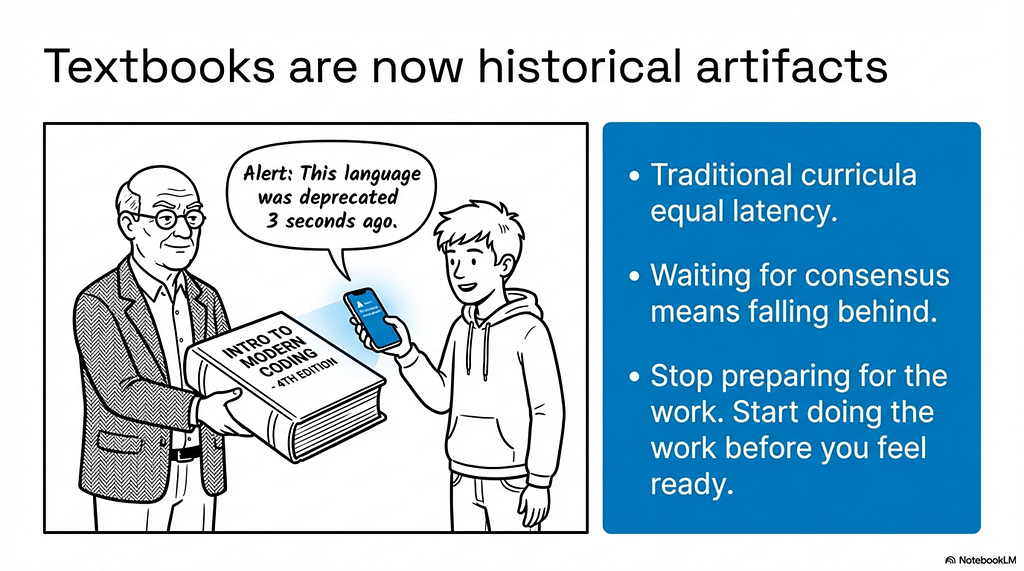
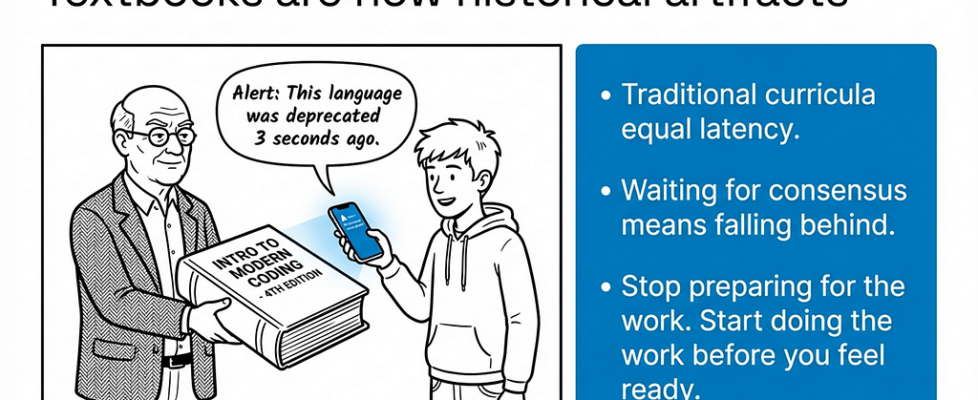
Traditional curricula are effectively “latency” in a high-speed world. By the time a textbook is printed, the tools it describes are often historical artifacts. Innovation-First Learning is no longer a pedagogical choice; it is the only survival strategy for the cognitive age. It demands that we stop preparing for the work and start doing it before we feel “ready.”
Takeaway 1: Building is the New Prerequisite
Many traditional educators say you must master the basics before using advanced tools. This limits creativity. Innovation-First Learning suggests we flip this approach. By starting with new concepts and tools right away, students can begin creating.
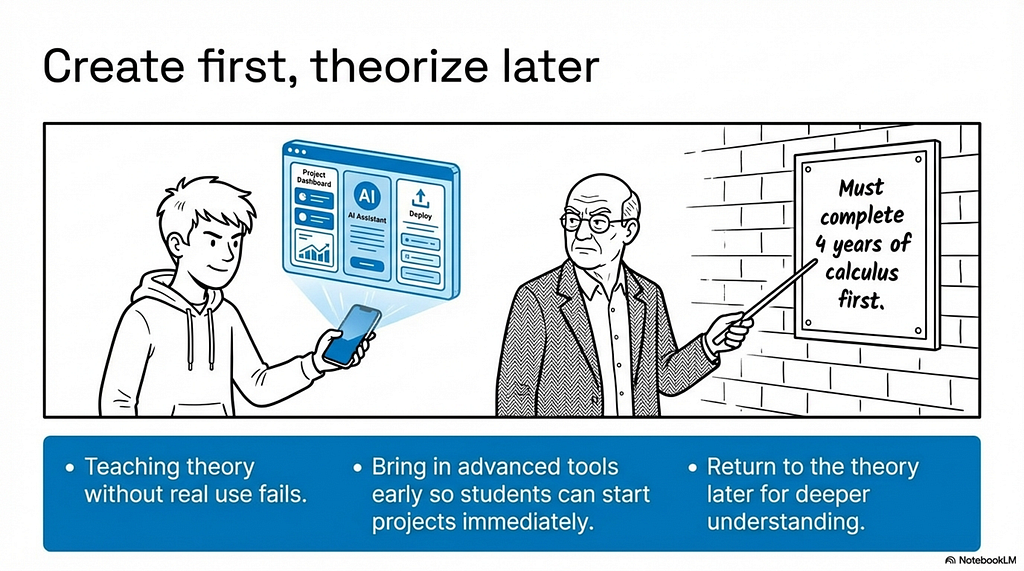
This approach is not only about keeping students interested; it helps them learn better. Teaching theory first, without real use, is not effective because students have nothing to connect the ideas to. By starting with building, we give them a practical way to learn as they go. Later, when we return to the theory, students understand it more deeply because they see why it matters.
Learn by building. Bring in advanced tools and ideas early so students can start projects right away. Later, return to these topics for a deeper understanding.
Takeaway 2: The End of “Theory vs. Practice”
We need to remove the divide between theory and practical coding. In this new approach, coding is just as important as theory. If you cannot show, test, or challenge a concept with code, it is not useful.

When theory and code are combined, learning becomes a cycle in which ideas are put into practice. This keeps concepts from staying abstract and unused. We do not just talk about innovation; we teach how to do it. By making code the main way to think and work, every idea learned becomes a tool for solving real problems right away.
Takeaway 3: Let AI Handle the Standard; Humans Must Innovate
Today’s learners need to separate routine tasks from truly new ideas. Machines now handle repetitive work. This means that real innovation is the only thing that counts for people. If a task can be performed by AI, it should no longer be a learning goal.
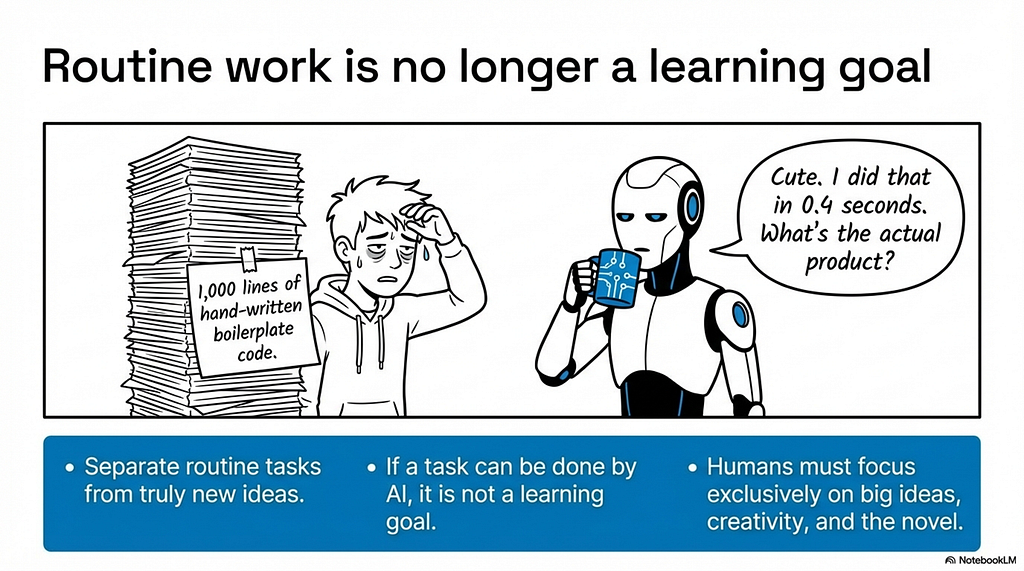
To stay relevant, we must focus on the newest tools and ideas, not old lessons. The aim is to create something new. By letting AI handle routine work, people are free to focus on big ideas, creativity, and always pushing for something new.
Takeaway 4: Radical Ownership in the Age of Reuse
With so many libraries, frameworks, and AI helpers available, work is now more about intent than just doing tasks. We urge students to learn a wide range of practical skills instead of focusing deeply on just one thing. Use existing tools and let AI handle the details, but always keep control of the purpose behind your work.
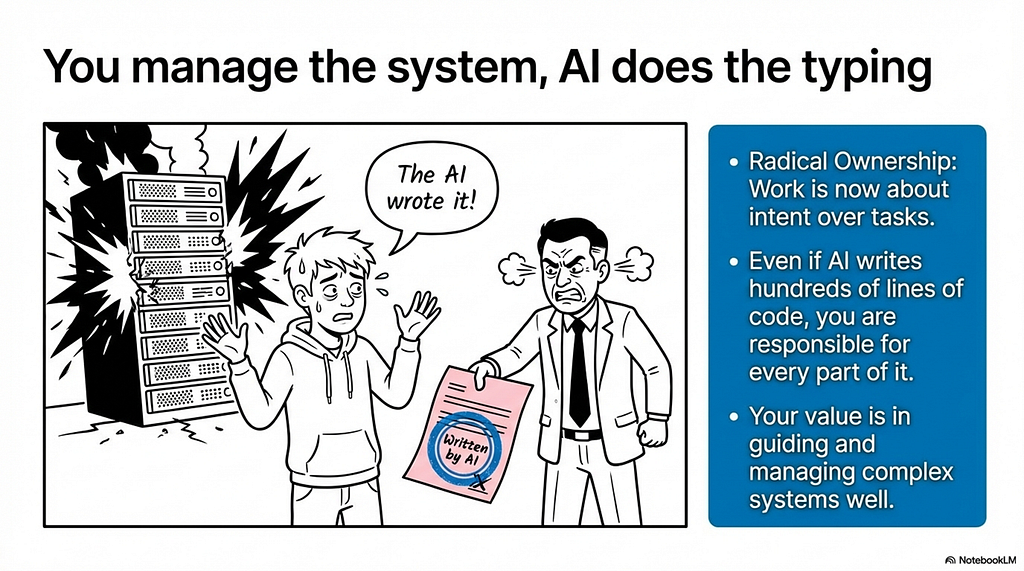
This is what we call radical ownership. Even if AI writes hundreds of lines of code for you, you are still responsible for every part of it. You let AI do the work, but you make the key decisions. Today, your value is not in writing everything yourself, but in guiding and managing complex systems well.
Takeaway 5: Storytelling as a Technical Skill
Innovation matters only if you can share it. Here, storytelling is not just a soft skill; it is a key technical skill. As we move into a world run by natural language tools, being able to explain complex ideas clearly is the most important skill.
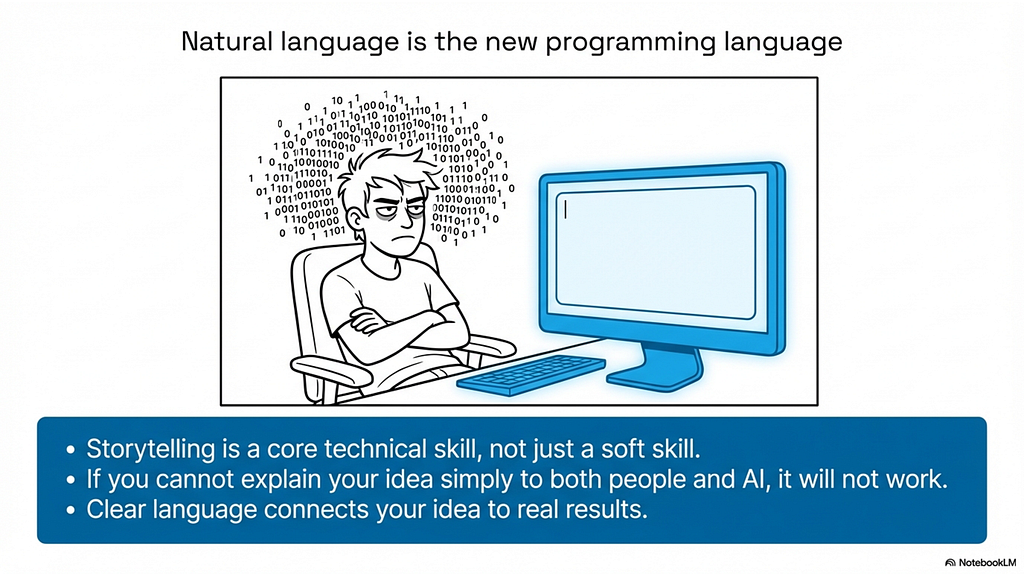
We are not only talking to people anymore; we are also giving instructions to the world. If you cannot explain your idea in a way that both people and AI can use, your idea will not work. Clear language connects your idea to real results.
Tell your story clearly. Teach students to explain their ideas and innovations in simple words, so both people and AI can understand and use them.
Takeaway 6: Tangible Proof over Test Scores
Standardized tests no longer matter. In a world with generative AI, letter grades mean little. The real proof of skill is what you can actually make. Every learner should finish with a real project, a working example, and a presentation that shows they can deliver results.

Moving from tests to real projects works best with ongoing feedback. Projects should improve through regular review and updates to meet real-world standards. A portfolio with finished, working projects is the best proof that someone has mastered their skills and can work at the highest level.
Conclusion: The Future of the Craft
At its core, Innovation-First Learning is about enjoying the process of creating. It is exciting to make complex ideas simple and to build things that really work. We are heading toward a future where ideas can quickly become real products.

The real question now is not whether you can follow a syllabus. Instead, ask yourself: Are you learning to do tasks that AI will soon take over, or are you at risk of becoming outdated? The answer is clear: You must innovate, or you risk being replaced by automation.
About the author
Sasha Apartsin (PhD) is an AI scientist and faculty member at the Holon Institute of Technology. His research focuses on deep generative models, synthetic data generation for training and evaluation, and anomaly detection, with applications in NLP, computer vision, and robotics. He brings over three decades of industry experience across roles from developer and architect to VP/Head of AI, including leadership positions in AI for public safety, finance, document management, and vehicle telematics, and has founded and co-founded startups and innovation initiatives. www.apartsin.com
The Death of the Consensus Computer Science Syllabus and the Rise of Innovation-First Learning was originally published in Towards AI on Medium, where people are continuing the conversation by highlighting and responding to this story.
