Top 5 AI Trends from Google and Why We’re All Becoming “AI Shepherds.”

Top 5 AI Trends from Google and Why We’re All Becoming “AI Shepherds.” A 2026 Report Breakdown With My Experience
In Google’s new “AI Agent Trends 2026” report, the term “LLM” moves into the background. The new main character is Agentic AI.
I went through all 50 pages of the report so you don’t have to. In short:

Spoiler:
Google believes the era of “chatbots” is over.
We’re entering the era of digital assembly lines, where people no longer write code or text themselves — they conduct an ensemble of AI agents.
Below is a breakdown of 5 key trends, an analysis of the new MCP protocol, and my personal experience trying to build this kind of “orchestrator” in a pet project.
Google makes an important distinction that is essential to understanding the report:
- Instruction-based (how it works now): you tell the machine step by step what to do. Write a function, send an email, draw a cat.
- Intent-based (how it may work in 2026): you tell the machine what outcome you want to achieve. For example: “Organize the logistics for a product return” or “Find a vulnerability in the new release.”
The machine builds the plan itself (Chain of Thought), selects the tools itself, and fixes its own errors. Humans are only needed to approve the strategy.
Surprising, right?
Trend 1: Agents for Every Employee (Not Replacements, but “JARVISes”)
Google’s core thesis: we are moving from the role of creator to the role of orchestrator.
In this new model, an employee does not handle every task personally. Instead, they delegate work to a group of specialized agents. Their function is to set the goal, define the strategy, choose the right agentic tools, and verify the result.
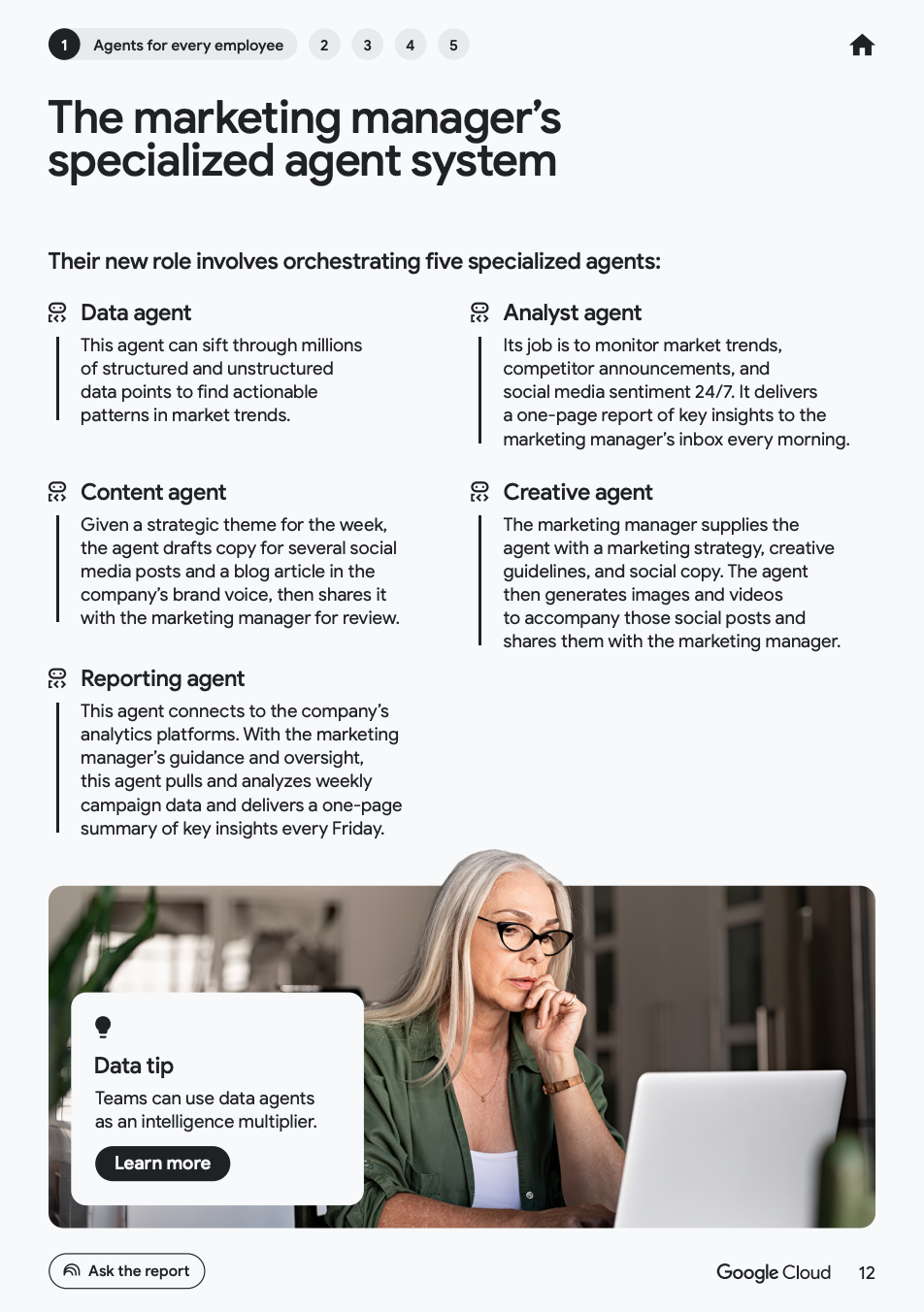
Imagine you are a marketer. Instead of writing posts yourself and manually checking analytics, you have 5 specialized agents working for you:
- Data Agent: parses trends 24/7
- Content Agent: writes drafts
- Creative Agent: generates images
Google’s research shows that 52% of executives at companies already using generative AI are deploying agents into production, and nearly half of them use agents for customer support and marketing.
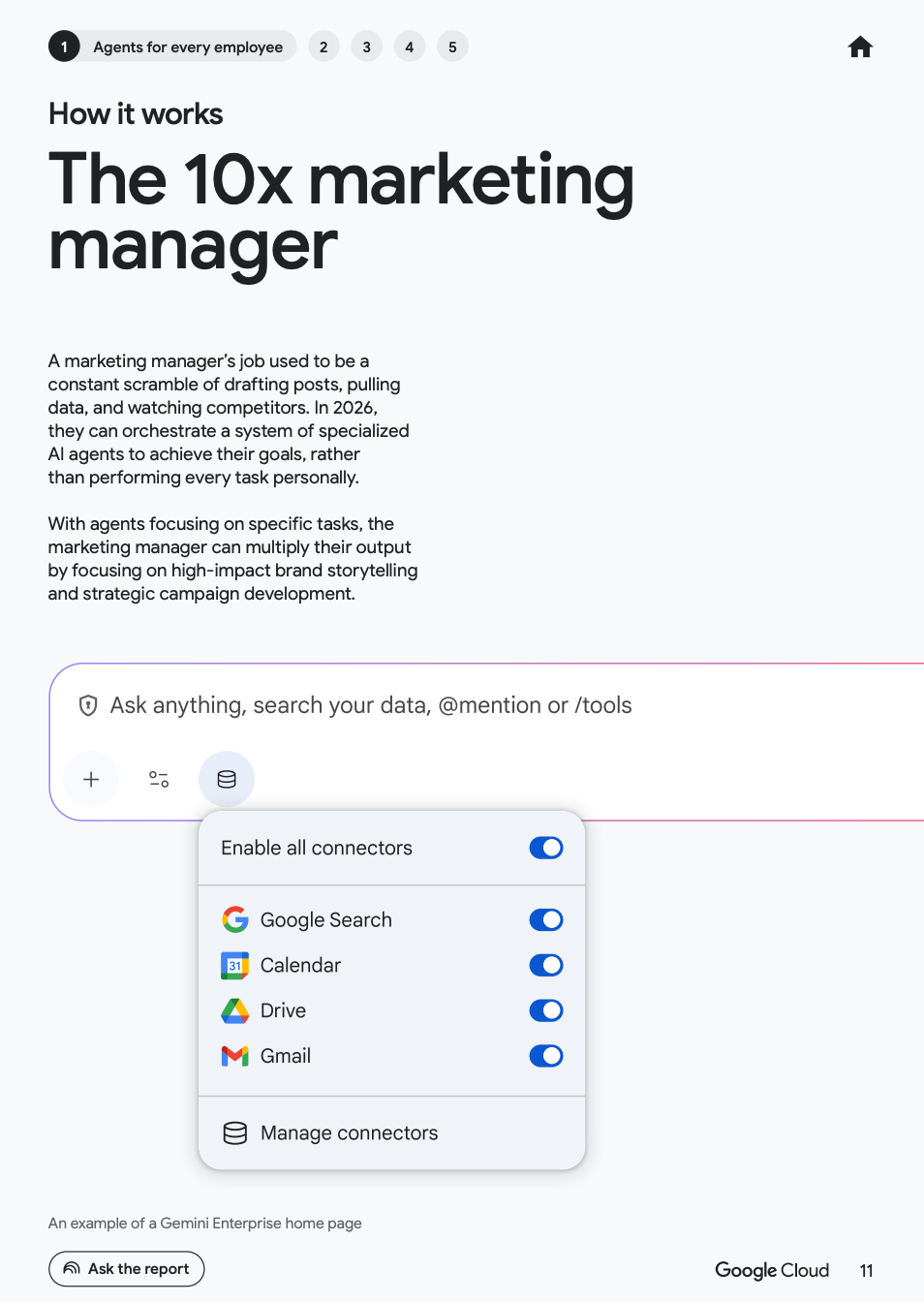
To illustrate how this works, the report gives the example of a “10× marketer.” This marketer is supported by five agents: one gathers market data, another monitors social media and news, a third writes copy, a fourth creates images and videos, and a fifth generates reports.
What Should Businesses Do?
- Identify routine tasks that are better delegated to agents: report drafting, information retrieval, and initial data analysis.
- Prepare employees for coordinator roles: teach them how to frame tasks and validate outputs, rather than copy-pasting data.
- Provide access to context: according to the report, an agent becomes significantly more effective when it is grounded in internal knowledge bases and systems — the report explicitly highlights this as a core requirement.
Trend 2: Agent-to-Agent (A2A) and the Death of APIs as We Know Them
Google predicts that agents will start communicating with each other directly, without a human in the loop. To enable this, it is promoting the Agent2Agent (A2A) standard.
An example from the report: a network monitoring agent detects an outage → it automatically contacts a support agent → the support agent automatically sends notifications to customers.
This is the “digital assembly line” in action.
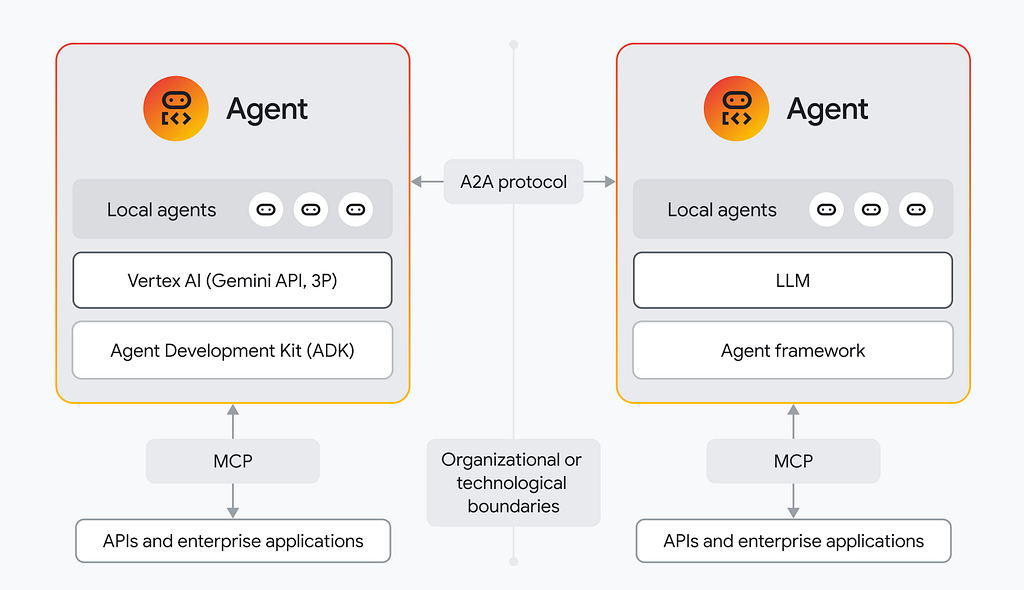
To access data, agents need the Model Context Protocol (MCP) — a standardized bidirectional channel for connecting to databases and external tools.
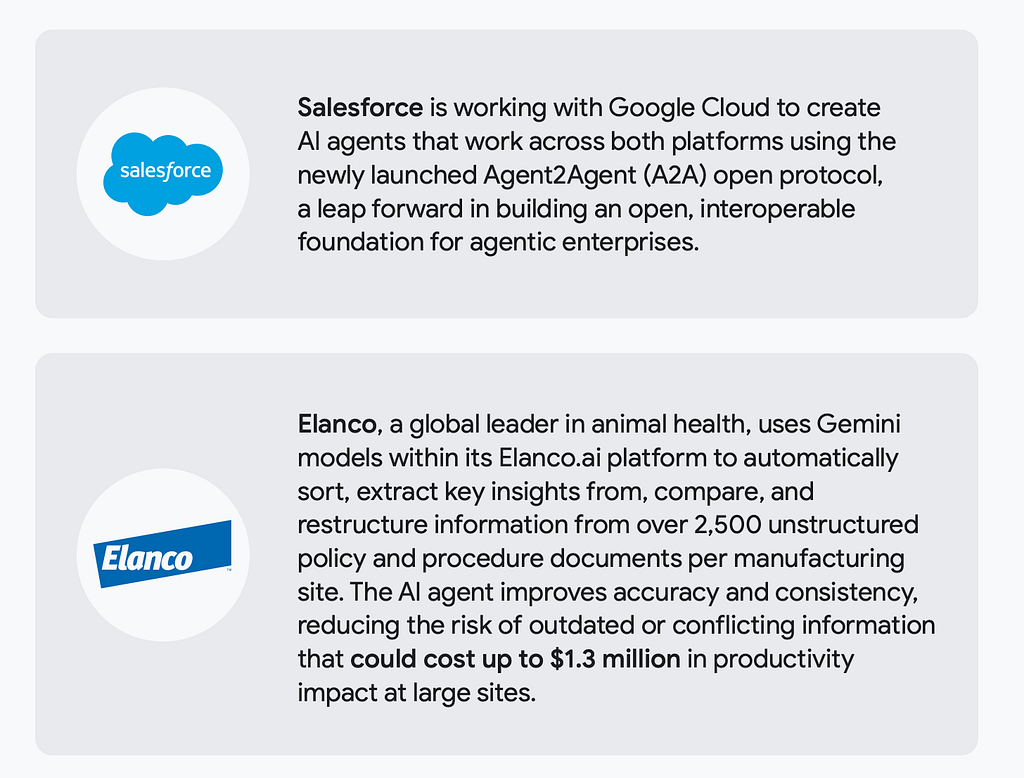
Organizations implementing these systems are already seeing results: 88% of early adopters report positive ROI for at least one use case. Salesforce and Google are building interoperable agents using the A2A protocol, while Elanco uses Gemini to process thousands of documents — reducing the risk of errors and improving productivity.
How Do You Start?
- Pilot agent chains on a single end-to-end process for example, automated invoicing or incident handling.
- Track open standards — A2A and MCP help avoid vendor lock-in and speed up integration between in-house and third-party solutions.
- Design security upfront if an agent can trigger a payment automatically, you need clear authorization checks and defined accountability when something goes wrong.
Trend 3: Customer Service a Concierge Instead of a Script
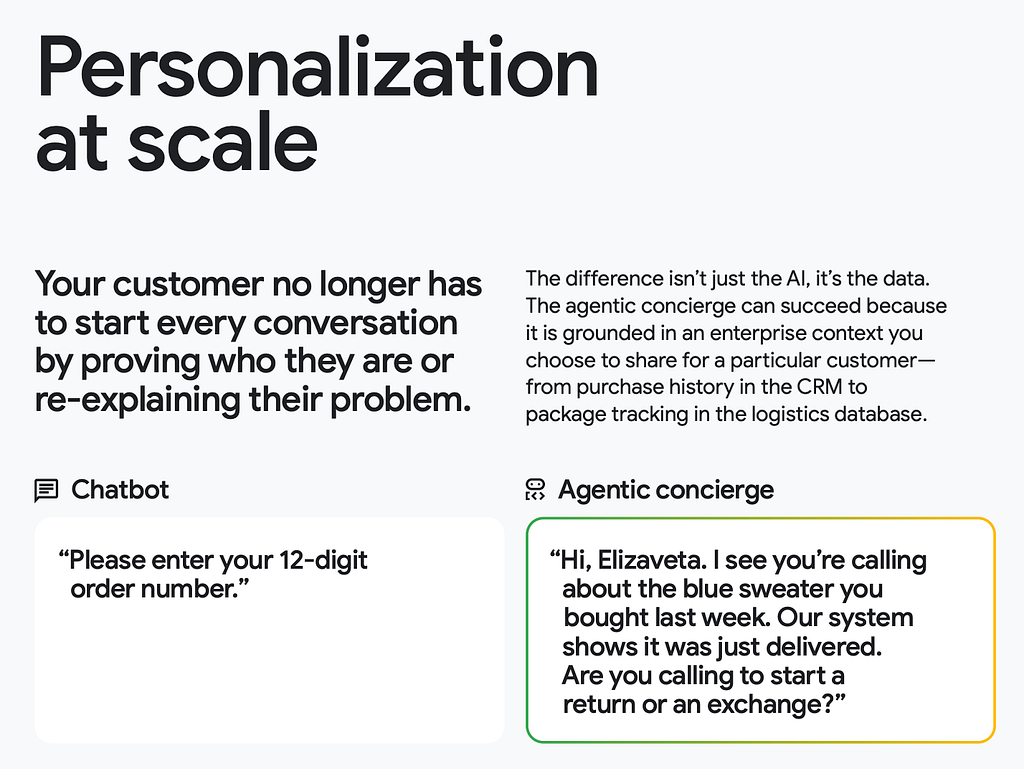
We all hate chatbots that say, “I didn’t understand that — transferring you to an agent.” Google’s 2026 trend is the opposite — the Grounded Concierge.
The key difference is grounding.
A grounded agent does not just generate text — it is anchored in the company’s real data: purchase history, logistics, CRM records, and service context. That means it doesn’t need to ask ten follow-up questions. It can address the customer by name, see what they bought, and even resolve standard issues on its own.
The report notes that 49% of companies with agents are already deploying them in customer support and customer service roles.
Example from the Report
A customer wants to buy a jacket, but it is out of stock.
Agent in 2025:
“This item is unavailable. Subscribe for restock notifications.”
Agent in 2026:
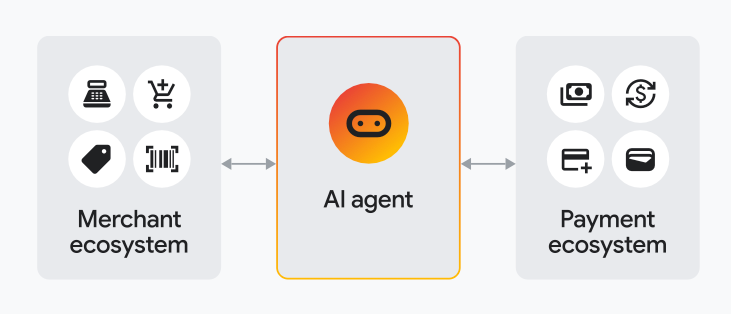
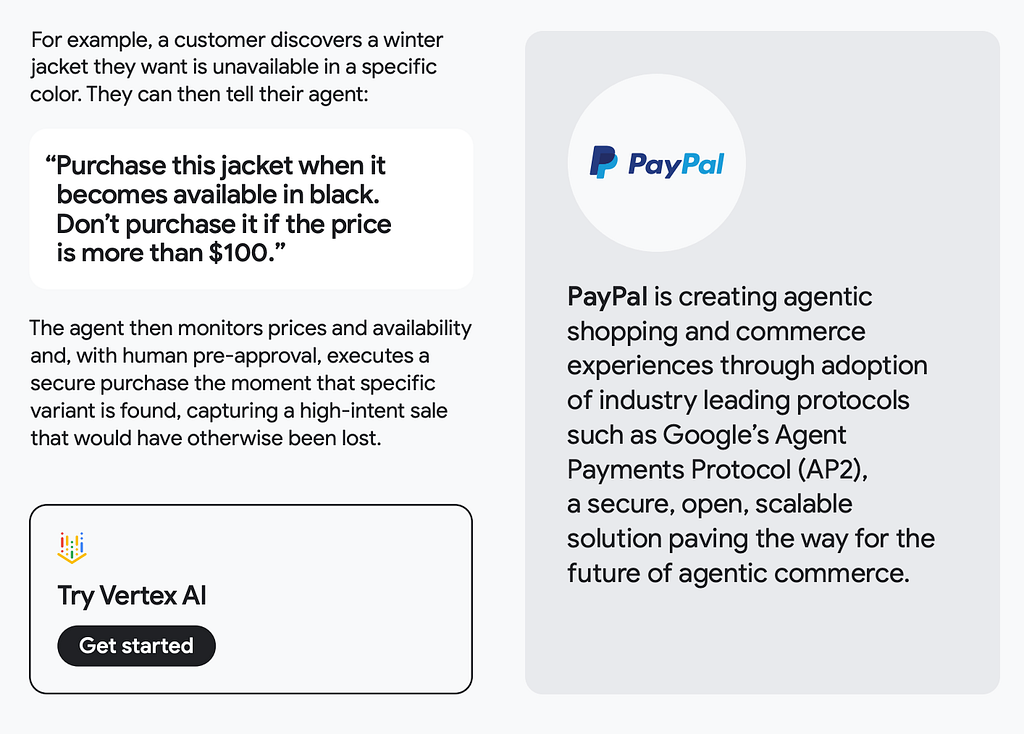
The customer says: “Buy this jacket when it becomes available in black, but only if it costs no more than $100” -> The agent stores the intent, monitors inventory, and completes the transaction through a protocol once the conditions are met.
Systems like this are not limited to retail. In manufacturing, they can help managers improve shift performance, and in healthcare, they can support predictive treatment models and help prevent complications.
How to Apply This
- Build a unified customer data map an agent cannot personalize interactions if your CRM, logistics, and billing systems are fragmented.
- Learn how to hand off to a human even the smartest agent should be able to make a smart handoff, summarize the situation and pass control to a human specialist when the conversation goes beyond a standard scenario.
- Design for transparency and consent users should understand that a program is acting on their behalf and be able to step in easily.
Trend 4: Cybersecurity — Agents vs Agents
This is the most alarming and at the same time the most hopeful trend.
Hackers are already using AI for attacks. Google’s answer: a semi-autonomous SOC (Security Operations Center).
In a modern SOC, analysts are drowning in an endless stream of incidents, and 82% of them worry they may miss a real threat. AI agents can help: they do not just select prebuilt playbooks — they can analyze context and adapt the plan as new data comes in. Already, 46% of organizations that have adopted agents are using them in cybersecurity.
Instead of an analyst manually sorting through 1,000 alerts per day, the system works as a cycle:
- Detection Agent: spots an anomaly.
- Investigation Agent: checks logs and correlates IPs.
- Response Agent: isolates the server.
- Human: receives the report and approves the next actions.

Interestingly, Google also mentions CodeMender and the Specular platform agents focused on offensive security: they can proactively search for zero-day vulnerabilities in code and suggest patches before release.
What Matters Most
- Build a semi-autonomous loop the agent monitors, escalates, and investigates, while humans make the key decisions.
- Continuously update models with fresh data and expert knowledge otherwise, agents will miss new attack patterns.
- Prepare the team for role shifts analysts should move toward threat hunting and strategy, instead of spending their time buried in alerts.
Trend 5: Talent Is Everything (Upskilling)
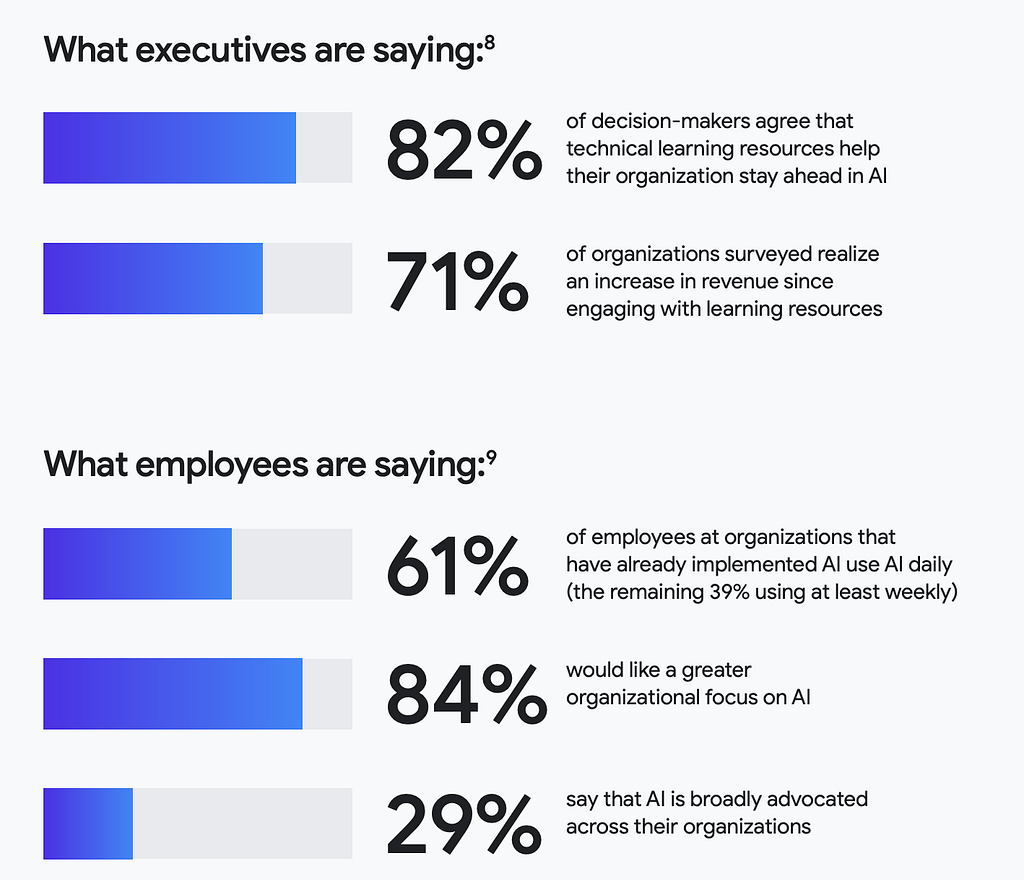
This is probably the most sobering slide in the report.
In technology, the half-life of professional skills (the time it takes for your knowledge to become half obsolete) has shrunk to 2 years.
That makes learning the most important resource.
Google/Ipsos research shows that:
- 82% of executives consider technical training a key factor in staying ahead of competitors,
- 71% of companies reported revenue growth after investing in training,
- and 84% of employees want more focus on AI.
Google states this directly: the adoption of agents will be constrained not by technology, but by people.
New roles will emerge that barely exist in today’s job market:
- Agent Orchestrator (the very “shepherd” of agents)
- Chief of Staff for AI
If you do not learn how to manage agents now, your qualification may be effectively reset within four years.
To prepare employees for the role of agent orchestrator, the report proposes five pillars:
- Define goals and metrics — for example, by 2026, 100% of employees should regularly use agents in their work.
- Assign a sponsor, a driver, and a technical expert — leadership provides support, the internal champion motivates the team, and the engineer turns ideas into real outcomes.
- Build a knowledge-sharing culture — hackathons, field days, gamification, and regular communication help sustain interest and surface best practices.
- Integrate agents into daily workflows — embed documentation updates and learning into the Definition of Done, and run regular reviews.
- Prioritize security and ethics — train employees to recognize social engineering and avoid sharing confidential data.
My Experience Or How I Tried to Delegate My Life to a Telegram Agent
Inspired by the topic, I decided to build a personal assistant in Telegram.
The idea was simple: I send it a voice note or a text like, “Message Ivan, let’s discuss the project on Thursday after lunch, and book a meeting room,” and the agent goes to Google Calendar, checks email, and creates the event on its own.
On paper, it sounds like a “one-evening project” with LangChain.
In reality:
- Time zone issues -> the analyst agent correctly extracted “after lunch,” but passed only “14:00” to the planning agent. As a result, the meeting ended up in the calendar sometimes in UTC, sometimes in the server’s local time.
I only fixed it by introducing strict JSON protocols — exactly the kind of thing Google talks about (Trend 2).
- Hallucinations with “Names” -> if I have five contacts named Alex, the agent didn’t ask for clarification. It just picked the first one it found and tried to send the invite.
Conclusion
What I mostly realized is this: for now, we are not really conductors — we are more like AI babysitters.
You spend 80% of your time not on strategy, but on making sure the agent doesn’t behave like a superintelligent yet extremely inattentive intern.
If you enjoyed this article, I’d be grateful for your support
I’m a Product Manager with an engineering background (ex SWE), focused on building, scaling and growing products. I’m especially interested in new technologies, particularly AI/ML, and how they can be applied in real workflows.
Email: akzhankalimatov@gmail.com
✅ Connect with me on LinkedIn, X (Twitter)
✅ Press and hold the 👏 to give up to 50 claps for this article
Top 5 AI Trends from Google and Why We’re All Becoming “AI Shepherds.” was originally published in Towards AI on Medium, where people are continuing the conversation by highlighting and responding to this story.
