Travel in AI’s Token-Toll Intelligence Linguistic Road

The Cognitive Cost of Language Inequality in Artificial Intelligence
In the architecture of large language models, the AI systems that power tools like Chat-GPT, Claude, Gemini, and others the language is not processed as words, sentences, or ideas. It is processed as tokens.
A token is a fragment of text. In English, a single token is roughly equivalent to three-quarters of a word. Common words like “the,” “is,” and “and” are single tokens. Longer or rarer words may consume two or three tokens. A sentence of twenty words might cost the system approximately fifteen tokens to process. The word ‘programming’ might be one token. The word ‘unforgettable’ might be two. Every token costs money, because AI companies charge you based on how many tokens you send and receive. This seems innocuous, even elegant and a neat compression of language into arithmetic.
But here is where the road begins to slope. Token boundaries are not universal. They are not determined by linguistic logic or cultural equity. They are determined by training data, the vast corpus of text that AI models are trained upon. And that corpus is overwhelmingly, structurally, and consequentially English-first.
The token problem does not only affect human languages. It also affects programming languages. Different coding languages generate very different numbers of tokens when processed by AI and that difference has real consequences for cost, speed, and the quality of AI help you receive.
Languages That Are Cheap for AI
At the efficient end of the spectrum sit, languages like Python, Haskell, and F#. Python is clean, readable, and does a lot with very few lines of code. Haskell and F# are smart about types and they can figure out a lot without you having to spell everything out. These languages cost fewer tokens per task, which means faster responses, lower API bills, and more room in the AI’s working memory to handle complex problems.
Languages That Are Expensive for AI
At the other end sit languages like COBOL, verbose Java configurations, and XML-heavy code. These languages require a lot of repetition and ceremony. In COBOL, for example, you must write out identifiers in full, follow rigid paragraph structures, and repeat yourself often. A simple operation that takes five tokens in Python might take fifty in COBOL.
This matters enormously because COBOL still runs much of the world’s banking and government infrastructure. Developers maintaining those systems are often in developing countries where legacy technology is most common , face the highest AI token costs for work that tends to pay the least. The Token-Toll hits hardest at the bottom.
The Double Penalty: When Your Coding Language and Your Human Language Both Work Against You
Now imagine you are a software developer in Chennai, India. You think naturally in Tamil. You write code in Java for a legacy banking system. You use an AI coding assistant to help you work faster. Sounds like a good setup, right?
But here is what actually happens when you send a message to the AI:
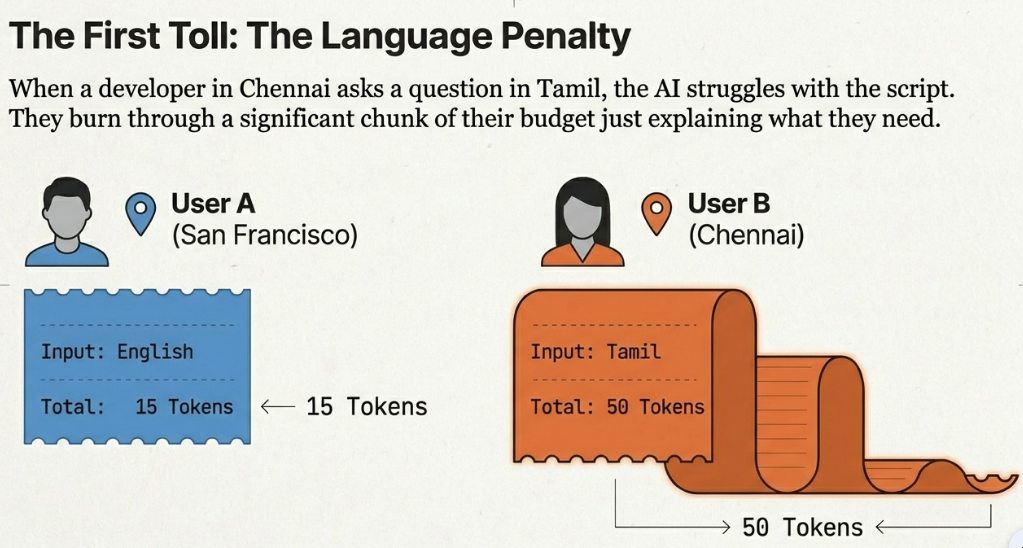
First, you write your question in Tamil. The AI’s tokenizer was mostly trained on English text, so it struggles with Tamil’s script and grammar. Instead of using 10 tokens to understand your question, it uses 40 or 50. You have already used up a chunk of your budget just explaining what you need.
Second, the AI generates Java code in response. Java is a verbose language it needs class declarations, boilerplate getters and setters, exception handling syntax, and many other formal requirements. This eats up even more tokens.
Third, you are now approaching the AI’s context limit which is the maximum amount of information it can hold in its ‘mind’ at one time. Because your tokens ran out faster, the AI starts to forget earlier parts of your conversation. It no longer remembers the architectural decisions you agreed on earlier. It starts producing code that conflicts with what it already generated. You have to start over, splitting your work into smaller pieces and losing the benefit of seeing the whole picture at once.
Meanwhile, your colleague in San Francisco, working in English, using Python never hits these limits. They get smooth, coherent, context-aware help from the same AI, at a fraction of the cost, with none of the fragmentation.
This is the double penalty. One toll for your human language. Another toll for your programming language. And the two multiply each other.
It Is Not Just About Cost — It Is About Quality
The financial side of the Token-Toll is real and measurable. But the quality gap is even more damaging in the long run.
AI coding assistants learn from training data which are billions of lines of code, documentation, Stack Overflow answers, GitHub repositories, and developer blog posts. The vast majority of this data is in English. That means the AI has learned from an enormous library of English coding knowledge and a relatively tiny library of Tamil, Bengali, Swahili, or Arabic coding knowledge.
When you ask the AI a question in English about a well-known Python problem, it has seen thousands of similar questions and answers. Its response is confident, accurate, and nuanced. When you ask the same question in Tamil about a less common library, the AI is working with far less familiarity. Its answer may be technically correct but shallower and less aware of common mistakes, less familiar with local library conventions, less useful overall.
The Real Numbers: What the Token-Toll Actually Costs
Let’s make this concrete. Modern AI coding APIs charge by the token. As of the time of writing, a leading AI API charges around $3 per million input tokens and $15 per million output tokens. These numbers look small until you do the math at scale.
A development team of 20 engineers using an AI coding assistant intensively might send and receive 10 million tokens per month. At standard rates, that is about $30–$150 per month in API costs. Manageable.
But if that same team works in Tamil instead of English, their token consumption for the same workload is 3 to 5 times higher — because Tamil tokenizes so much less efficiently. Their monthly bill becomes $90–$750 for the exact same output. Over a year, that difference is thousands of dollars , a meaningful amount for a startup or a small development company in a country where average developer salaries are a fraction of those in the US.
The AI industry does not publicize this disparity. There are no warning labels on API pricing pages that say ‘prices may be three times higher if you work in Tamil.’ The price is presented as equal for all. But equal prices for unequal token quantities is not equality. It is a structural disadvantage wearing the costume of fairness.
Conclusion: Who Pays, and Who Decides
The Token-Toll is a quiet, invisible tax. It does not announce itself. There is no notification that says ‘you are being charged more because of your language.’ It simply sits inside the architecture of AI systems, silently multiplying the costs and reducing the quality of assistance for millions of developers around the world.
These are not edge cases. There are roughly 27 million software developers worldwide. The majority of them do not speak English as their first language. They live in India, China, Brazil, Nigeria, Indonesia, Egypt, and hundreds of other countries. They build apps, maintain infrastructure, and write code that millions of people depend on every day. They deserve the same quality of AI assistance as their counterparts in San Francisco or London. Right now, they do not get it.
‘Are You Ready to Travel in AI Token-Toll Intelligence Lingual Road, The Cognitive Cost of Language In Equality’ — asks a deceptively simple question. Are you ready to travel? The answer depends entirely on who you are. For English-speaking developers working in Python, the road is smooth and the toll is cheap. For Tamil-speaking developers working in Java or COBOL, the road is rough and the toll is steep.
The question is whether the people with the power to change it will choose to do so — before the gap becomes so wide that catching up feels impossible.
Travel in AI’s Token-Toll Intelligence Linguistic Road was originally published in Towards AI on Medium, where people are continuing the conversation by highlighting and responding to this story.
