Your CPU Is 1,000x Less Efficient Than Physics Allows

How information theory connects to the Second Law of Thermodynamics, and why it may define the ultimate ceiling on AI computation
There is a law more fundamental than Moore’s that governs every computer ever built, and it has nothing to do with transistors. It was written not by engineers but by entropy, and it applies equally to a 1950s vacuum tube and a 2024 NVIDIA H100. The law states, essentially, that forgetting is expensive. Not metaphorically, not in some hand-wavy systems-theory sense, but physically, measurably, unavoidably expensive. Every time a computer erases a bit, it must dump a minimum quantity of heat into the surrounding environment. No material science breakthrough, no architectural cleverness, no cryogenic trick can eliminate this cost. Physics forbids it.
This is the Landauer limit, and for most of computing history it was a curiosity, a theoretical footnote that practitioners could safely ignore because real hardware was so catastrophically inefficient that the gap between actual and theoretical minimum was something like ten orders of magnitude. That gap is closing. Modern 5nm chips dissipate around a thousand times the Landauer floor per switching operation, and projections for the 2030s suggest this ratio could narrow to somewhere between 55 and 60 times the limit. At the same time, AI training workloads are consuming megawatts for months at a stretch. The “just add compute” strategy that has driven a decade of AI progress is quietly developing a thermodynamic ceiling.
Rolf Landauer published his original argument in 1961 while working at IBM. The core claim was both simple and radical: heat generation in computers is not fundamentally caused by electrical resistance or material imperfection. It is caused by the logical structure of computation itself, specifically by operations that destroy information. A NOT gate, which flips a bit, is reversible; given the output, you know the input. A NAND gate, which maps two bits to one, is not. When you lose information, entropy increases in the environment. The universe balances its books in heat.
What followed Landauer’s paper is one of the more underappreciated intellectual threads in the history of physics. It connects Maxwell’s 1867 thought experiment about a demon that could sort molecules, to Shannon’s 1948 measure of information uncertainty, to Boltzmann’s entropy formula from statistical mechanics, to modern quantum experiments on single trapped ions. What emerged from this 150-year arc is not just a limit on computation, but a proof that information is a physical quantity with thermodynamic weight.
Table of Contents
- Logical Irreversibility: The Root of Heat
- The Math: One Formula, Three Centuries of Physics
- Shannon Meets Boltzmann
- Maxwell’s Demon and Bennett’s Resolution
- Stochastic Thermodynamics: When Reality Gets Noisy
- The Speed-Energy Tradeoff
- Experimental Verification: From Theory to Fact
- Quantum Computing and the Heisenberg Connection
- CMOS and the Global Efficiency Gap
- Reversible Computing: A Real Escape Route?
- Error Correction’s Hidden Thermodynamic Cost
- AI Scaling and the Terminal Bound
Logical Irreversibility: The Root of Heat

What Makes an Operation Irreversible
Landauer’s central distinction is between operations that preserve information and operations that destroy it. A logically reversible operation is one where the output uniquely determines the input; run the process backward and you can recover exactly where you started. A NOT gate satisfies this, if the output is 1, the input was 0, no ambiguity. A logically irreversible operation is one where multiple distinct inputs map to the same output, making the original state unrecoverable from the result alone.
The NAND gate is the canonical irreversible operation. It takes two input bits and produces one output bit, which means three distinct input combinations (01, 10, and 11) all produce the same output (0). The identity of the inputs is gone. And “gone” in this context is not a metaphor for lost in memory or overwritten somewhere else. It is gone in the sense that the phase space of the system, the set of distinguishable states available to the information carrier, has been reduced. The Second Law of Thermodynamics requires that any reduction in a system’s informational entropy be compensated by an equivalent increase in the entropy of the environment. That compensating entropy increase is heat. Bit erasure, which resets a memory cell to a fixed state regardless of whether it held a 0 or a 1, is the simplest irreversible operation and the one Landauer analyzed directly.
Why the Transistor Is Not the Root Cause
This reframing matters more than it might seem. The engineering community spent decades treating heat dissipation in processors as a consequence of resistive losses, gate capacitance, and leakage currents. These are real and significant, but they are not fundamental. They can, in principle, be reduced without limit by improving materials and design. The Landauer limit cannot. Even a hypothetical computer made of frictionless components, operating at zero voltage, with zero leakage, would still dissipate heat whenever it performed logically irreversible operations. The heat is not a side effect of imperfect engineering. It is a consequence of the logic itself.
The Math: One Formula, Three Centuries of Physics
Unpacking the Inequality
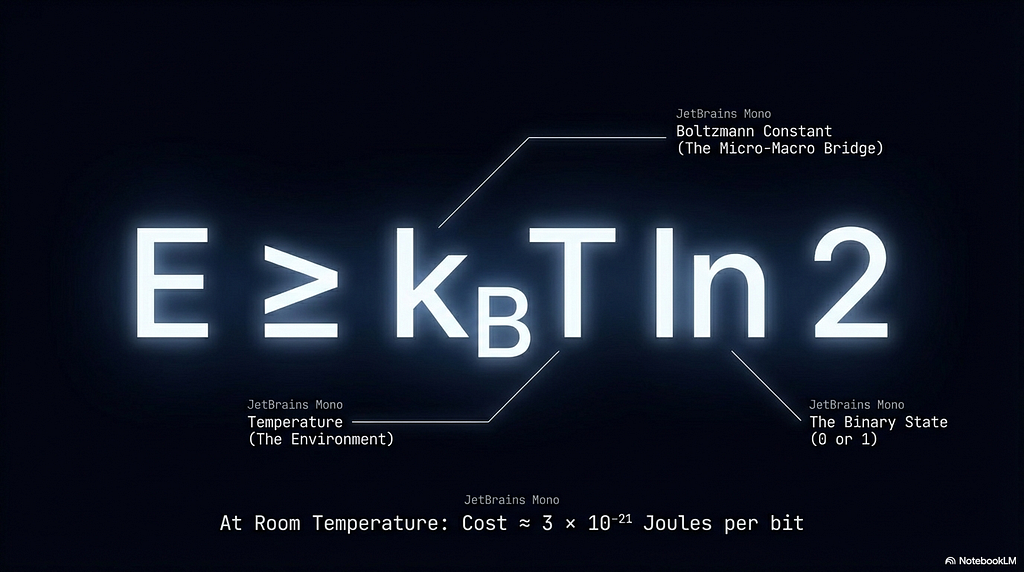
The energy cost of erasing one bit of information is bounded below by the inequality ‘ΔE ≥ k_B T ln 2’. Three symbols, three distinct domains of physics. T is the absolute temperature of the thermal reservoir into which the entropy is expelled, drawn from classical thermodynamics. k_B is the Boltzmann constant (1.38 × 10⁻²³ J/K), the bridge between macroscopic temperature and the microscopic energy scale of individual particles, from statistical mechanics. And ln 2 is the natural logarithm of 2, arising from information theory: erasing one binary bit reduces the number of possible states from two equiprobable options to one certain value, and the information-theoretic cost of that reduction is exactly ln 2.
At room temperature (300 K), this evaluates to approximately 2.87 × 10⁻²¹ joules per bit, or about 0.018 electron-volts. This is not a soft guideline or an engineering benchmark. It is a lower bound enforced by the Second Law of Thermodynamics, applicable to any physical system that stores information in distinguishable states, regardless of the substrate.
What the Formula Reveals
One underappreciated implication of this formula is that the Landauer floor is not fixed. It scales with temperature. Operating a computer at cryogenic temperatures, say 4 Kelvin rather than 300 Kelvin, lowers the minimum dissipation per bit erasure by a factor of 75. This is one reason superconducting computing architectures, which operate near absolute zero, are genuinely interesting from a thermodynamic standpoint, not just for their electrical properties. The temperature variable is something that can, in principle, be engineered.
Maxwell’s Demon and Bennett’s Resolution
The Thought Experiment That Troubled Physics for a Century
In 1867, James Clerk Maxwell proposed a thought experiment that appeared to violate the Second Law of Thermodynamics. A tiny demon sits at a gate between two chambers of gas. The demon observes each molecule approaching the gate and opens it only for fast-moving molecules traveling into the right chamber. Over time, the right chamber fills with fast molecules (hot gas) and the left with slow ones (cold gas), producing a temperature differential that could drive a heat engine. The demon has seemingly reduced the total entropy of the system without performing any work.
Early attempts to rescue the Second Law focused on the demon’s measurements. Surely observing a molecule’s velocity must cost energy? This turned out to be wrong. Landauer himself noted, and Charles Bennett formalized in 1982, that measurement can in principle be performed reversibly. A sufficiently clever demon can record the state of each molecule without dissipating any energy.
The Resolution Lives in Memory, Not Measurement
Bennett’s insight was to ask what happens to the demon’s memory after many sorting cycles. The demon accumulates a record of all its observations: fast molecule, slow molecule, fast, fast, slow… After enough cycles, the demon’s memory is full. To continue operating, the demon must erase its accumulated records. And that erasure, subject to the Landauer bound, generates exactly enough heat to compensate for the entropy reduction achieved by sorting the molecules. The Second Law is rescued not by the cost of observation, but by the cost of forgetting. Every time the demon clears its memory to make room for new measurements, it pays the thermodynamic debt it had deferred.
This resolution is elegant because it makes the accounting explicit. Computation can defer thermodynamic costs by storing intermediate results rather than erasing them. But those costs cannot be avoided permanently. Every bit of information that was ever written and then erased contributes at least k_B T ln 2 of heat to the environment. Memory is a loan from entropy, and entropy always collects.
Stochastic Thermodynamics: When Reality Gets Noisy
The Gap Between Theory and Real Systems
Landauer’s original derivation assumed quasi-static processes, operations performed so slowly that the system remains in thermal equilibrium at every step. This is how you derive clean inequalities in thermodynamics: you take the limit where everything happens infinitely slowly and see what the minimum cost looks like. Real computers do not operate quasi-statically. They operate in nanoseconds, far from equilibrium, in the presence of thermal noise that makes individual bit operations stochastic events.
The modern framework for handling this is stochastic thermodynamics, which extends thermodynamic analysis to individual trajectories of small systems rather than ensemble averages. This framework matters for systems where thermal fluctuations are not negligible, including individual transistors in advanced process nodes, molecular-scale memory elements, and biological information processing.
The Speed-Energy Tradeoff
Parallelism as Thermodynamic Strategy
The quasi-static limit, the regime where the Landauer bound is achievable, requires infinite time. Every departure from quasi-static operation incurs excess dissipation that scales with how far from equilibrium the process is. For serial computation, where each operation must complete before the next begins, this creates a fundamental divergence: the faster you operate, the more energy each operation costs, with no lower bound on the per-operation energy as speed increases.
A 2023 paper in Nature Communications formalized this tradeoff and arrived at a conclusion that reframes how parallelism should be understood. For massively parallel architectures, where many operations occur simultaneously and independently, the energy cost per operation can remain close to the Landauer bound even at finite operating speeds. The reason is that parallel operations collectively move more slowly through their state space relative to the thermal equilibration time, mimicking the quasi-static limit without actually requiring infinite time.
This shifts the interpretation of GPU architectures and parallel computing from pure performance engineering to thermodynamic strategy. The reason that massively parallel hardware is more energy efficient per operation than fast serial processors is not merely about amortizing overhead. It is a consequence of the fundamental physics of non-equilibrium thermodynamics.
Experimental Verification: From Theory to Fact
The 2012 Bérut Experiment
For fifty years after Landauer’s 1961 paper, the limit was theoretical. Measuring the heat released by erasing a single bit requires isolating a system with exactly two distinguishable states, controlling it precisely enough to perform a defined erasure operation, and detecting the resulting heat dissipation at the scale of 10⁻²¹ joules. The technology to do this did not exist until the 2000s.
The first direct verification came in 2012 from Bérut et al., who used a microscopic silica bead suspended in water and held in a double-well optical trap. The two wells represented the 0 and 1 states of a single bit. To perform erasure, the researchers slowly tilted the potential landscape while simultaneously reducing the barrier between the wells, coaxing the bead into one well regardless of its starting position. By tracking the bead’s Brownian motion with high-speed cameras and applying stochastic thermodynamics to calculate the heat exchanged with the water, they showed that the mean dissipated heat converges to the Landauer bound as the erasure is performed more slowly. Faster erasures dissipate more; in the slow limit, the bound is saturated.
From Colloids to Solid State
In 2025, Yan et al. extended verification to a fully quantized system: a single trapped ion whose internal state served as the bit, coupled to a phonon heat bath serving as the thermal reservoir. Both the information carrier and the reservoir were governed by quantum mechanics rather than classical statistics. The experiment confirmed that ‘k_B T ln 2′ remains the minimum dissipation per erasure even in this regime, closing a critical theoretical gap. It ruled out the possibility that quantum coherence or discrete energy levels might provide a loophole allowing sub-Landauer erasure.
Quantum Computing and the Heisenberg Connection
Where the Two Limits Meet
Quantum computation introduces a structural asymmetry relative to classical computing. Unitary quantum gates are reversible by definition; they preserve quantum state information completely and incur no Landauer cost. In principle, an entire quantum algorithm could run without dissipating any heat, provided that measurements and state initializations could be avoided entirely.
In practice, they cannot. Every useful quantum computation requires collapsing qubits to defined states at initialization and extracting classical output through measurement. Both operations are logically irreversible. State preparation collapses an arbitrary superposition to a fixed ground state; measurement collapses a superposition to one of its basis states and discards the others. Each such collapse is an information-destroying event subject to the Landauer bound.
CMOS and the Global Efficiency Gap
How Far We Are
Every standard CMOS logic gate, every NAND and NOR gate in every processor running today, is logically irreversible. When they operate, information is destroyed and heat is released well above the thermodynamic minimum. Modern 5nm chips dissipate approximately 3 × 10⁻¹⁸ joules per switching operation. The Landauer limit at room temperature is approximately 2.87 × 10⁻²¹ joules. The gap is roughly a factor of 1,000.
That gap looks like bad news but it is also encouraging context. Processor switching energy has fallen by fifteen orders of magnitude since the 1940s. The progress has been extraordinary. The question is whether it can continue at the same rate, and the honest answer is that it cannot. The efficiency improvements that CMOS scaling delivered came from shrinking transistors and reducing operating voltages, both of which have diminishing returns as physical limits intrude. Projections for the early 2030s suggest switching energies in the range of 160 to 400 zeptojoules (zJ) per transistor, which would put current hardware roughly 55 to 140 times above the Landauer floor, down from the current factor of roughly 1,000.
The Thermal Wall
Without qualitative changes to computing architecture, this deceleration is expected to harden into a plateau. As switching energies approach the Landauer floor, the energy involved in each operation becomes comparable to the thermal noise in the environment. Transistors that operate near the thermodynamic floor will occasionally switch spontaneously due to thermal fluctuations rather than intentional signals. Error rates increase. Error correction requires additional operations, which dissipate additional heat. The system becomes harder to run reliably even as it becomes thermodynamically efficient. This is the thermal wall, and it is not simply an engineering problem. It is a consequence of thermodynamics itself.
Reversible Computing: A Real Escape Route?
The Theoretical Promise
The Landauer limit applies specifically to logically irreversible operations. Operations that are logically reversible, where inputs can be uniquely recovered from outputs, do not inherently destroy information and therefore do not incur the mandatory heat cost. Reversible logic gates, including the Toffoli gate (a controlled-controlled-NOT) and the Fredkin gate (a controlled-SWAP), are universal for classical computation. Any classical algorithm can be implemented using only these gates. In principle, a computer built entirely from reversible logic could perform computation with zero net energy dissipation.
The practical challenge is that reversible computation is not free, it defers costs rather than eliminating them. Reversible gates are bijective mappings that preserve all input information in their outputs, which means that intermediate computational results accumulate as “garbage” bits alongside the desired output. These garbage bits must eventually be dealt with. If they are simply erased, the Landauer cost is reintroduced at the garbage-collection stage. Truly dissipation-free reversible computation requires running the algorithm backward to “uncompute” the garbage bits, restoring the ancilla registers to their initial state without erasure. This works in principle, doubles the computational time, and creates significant practical overhead.
Why It Has Not Replaced CMOS
To achieve near-zero dissipation, reversible systems must operate adiabatically, changing states slowly enough that the system tracks the evolving potential landscape in quasi-static equilibrium. This is the same requirement as achieving the Landauer bound in erasure operations. Fast adiabatic switching is a contradiction in terms. Current reversible logic prototypes operate orders of magnitude more slowly than CMOS and have not achieved the integration density required for competitive general-purpose computation. Reversible computing is not a near-term replacement for CMOS; it is a long-term architectural alternative whose thermodynamic advantages only become compelling as CMOS approaches its own fundamental limits.
Error Correction’s Hidden Thermodynamic Cost
Reliability Requires Erasure
Reliable computation in the presence of noise requires error correction. This is true for classical systems through Error Correcting Codes (ECC), and it is true for quantum systems through Quantum Error Correction (QEC). Both approaches follow the same basic pattern: measure a syndrome to detect whether an error has occurred, identify the error, and reset the affected bit or qubit to its correct state. The reset step is a logically irreversible operation that dissipates at least ‘k_B T ln 2’ of heat. Error correction is, thermodynamically, a continuous stream of erasure operations.
For classical systems, this cost is manageable. ECC overhead is modest and the required resets are infrequent. For quantum systems, the situation is far more severe. Quantum error correction is extraordinarily expensive relative to the underlying computation because quantum states are fragile and the number of physical qubits required to encode one logical qubit fault-tolerantly is large.
Quantum Error Correction’s Thermodynamic Burden
A fault-tolerant quantum computer capable of running practically useful algorithms at scale, such as breaking contemporary cryptographic protocols, may require on the order of 20 million physical qubits just to maintain a much smaller number of logical qubits. The overhead comes from syndrome measurements and ancilla resets performed continuously to suppress errors as they accumulate. Each ancilla reset is a Landauer erasure. With millions of physical qubits undergoing continuous error correction cycles, the total heat dissipated by syndrome measurement and ancilla reset can dominate the energy budget of the entire machine. The Landauer limit is not an abstraction for fault-tolerant quantum computing. It is a critical engineering constraint that determines whether large-scale quantum systems are thermodynamically viable.
AI Scaling and the Terminal Bound
The Compute Scaling Paradigm and Its Costs
The last decade of AI progress has been built on a simple strategy: more compute, more data, larger models. LLM training runs in 2024 consumed megawatts of power continuously for months. The strategy has worked because the efficiency improvements from algorithmic advances and hardware scaling have roughly kept pace with the increasing demand. But the efficiency improvements from CMOS scaling are decelerating while the appetite for compute continues to grow. The gap between these two trajectories is where the Landauer limit becomes practically relevant.
Conclusion
The Landauer limit is simultaneously a historical artifact and a future constraint. It began as a theoretical observation in 1961, spent decades as a curiosity that practicing engineers could ignore, was experimentally confirmed starting in 2012, and is now emerging as a hard boundary on the most energy-intensive computational workloads humans have ever built. Information is physical. Forgetting has a price. The universe charges that price in heat, and the invoice is denominated in units of ‘k_B’ T ln 2.
What makes the limit genuinely interesting, beyond its role as a constraint, is what it reveals about the relationship between logic and physics. The cost of erasing a bit is not an accident of implementation. It is a consequence of the way that uncertainty, entropy, and the threads of time are woven together in the structure of nature.
References
Academic Research
Landauer, R. (1961). Irreversibility and Heat Generation in the Computing Process. IBM Journal of Research and Development, 5(3), 183–191.
Bérut, A., Arakelyan, A., Petrosyan, A., Ciliberto, S., Dillenschneider, R., & Lutz, E. (2012). Experimental verification of Landauer’s principle linking information and thermodynamics. Nature, 483, 187–189.
Hong, J., Lambson, B., Dhuey, S., & Bokor, J. (2016). Experimental and theoretical analysis of Landauer erasure in nanomagnetic switches of different sizes. Science Advances, 2(3).
Chattopadhyay, P., Misra, A., Pandit, T., & Paul, G. (2025). Landauer Principle and Thermodynamics of Computation. arXiv preprint arXiv:2506.10876v1
Parrondo, J. M. R., Horowitz, J. M., & Sagawa, T. (2015). Thermodynamics of information. Nature Physics, 11, 131–139.
Jaynes, E. T. (1957). Information Theory and Statistical Mechanics. Physical Review, 106(4), 620–630.
Industry Articles & Blog Posts
Nöris, R. F. (2026, January). An Unnoticed Singularity? Reflections on Landauer’s Limit. Medium.
Documentation & Technical Specs
Landauer, R. (1961). Irreversibility and Heat Generation in the Computing Process. Worrydream.com archival copy.
Limits to the Energy Efficiency of CMOS Microprocessors. arXiv:2312.08595.
Fundamental energy cost of finite-time parallelizable computing. Nature Communications (2023). ResearchGate.
THERMODYNAMIC AND INFORMATIONAL BOTTLENECKS OF SCALABLE FAULT-TOLERANT QUANTUM COMPUTATION. ResearchGate.
Enabling Physical AI through Biological Principles. arXiv:2509.24521.
Your CPU Is 1,000x Less Efficient Than Physics Allows was originally published in Towards AI on Medium, where people are continuing the conversation by highlighting and responding to this story.
