Five ways the ABACUS label advances nature-based carbon removal

Five ways the ABACUS label advances nature-based carbon removal
From more-accurate measurement of carbon dioxide removal to greater diversity in restoration design, the ABACUS labels requirements help advance the integrity of restoration projects in the voluntary carbon market.
Sustainability
Kyle Hemes James Mulligan
Dynamic baseline to measure additionality
Historically, restoration carbon projects assume that whatever land use was occurring before a project takes place pasture or agriculture, for example would have continued unaltered without the project intervention. This assumption ignores the myriad ecological, economic, and policy dynamics that could affect carbon removal without assistance from the voluntary carbon market.
In addition to demonstrating that a project would not be viable without carbon credit finance, ABACUS requires a treatment-control approach to measuring additionality, or the carbon removal resulting from the project above and beyond what would have occurred otherwise. This means matching the project treatment area based on historical, satellite-based proxies for biomass to a population of control plots that are followed through time. Each of these controls represents a potential alternate reality for the project in the absence of restoration.
If the control plots regain forest carbon at pace with the project, this indicates that the project may have regained forest carbon on its own, without the intervention. If the control plots remain low-carbon, degraded land, we can be more confident that the projects climate impacts are additional. By treating additionality as dynamic instead of static, were able to obtain a more data-driven estimation of the true impact of restoration.
Carbon projects as engines for agricultural production
Carbon removal cannot come at the expense of food production; in fact, these challenges are inextricably linked. Under some projections, agricultural production will need to double by 2050, even as the least productive pasture and croplands are restored to forest cover. Sustainably intensifying agriculture to increase food production, while sparing land for carbon removal or, better, integrating carbon removal within productive agricultural systems is critical to reconciling these needs.
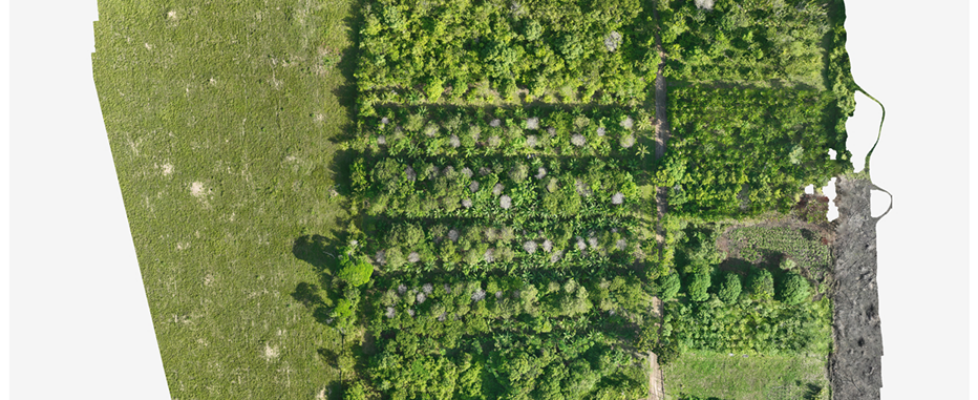
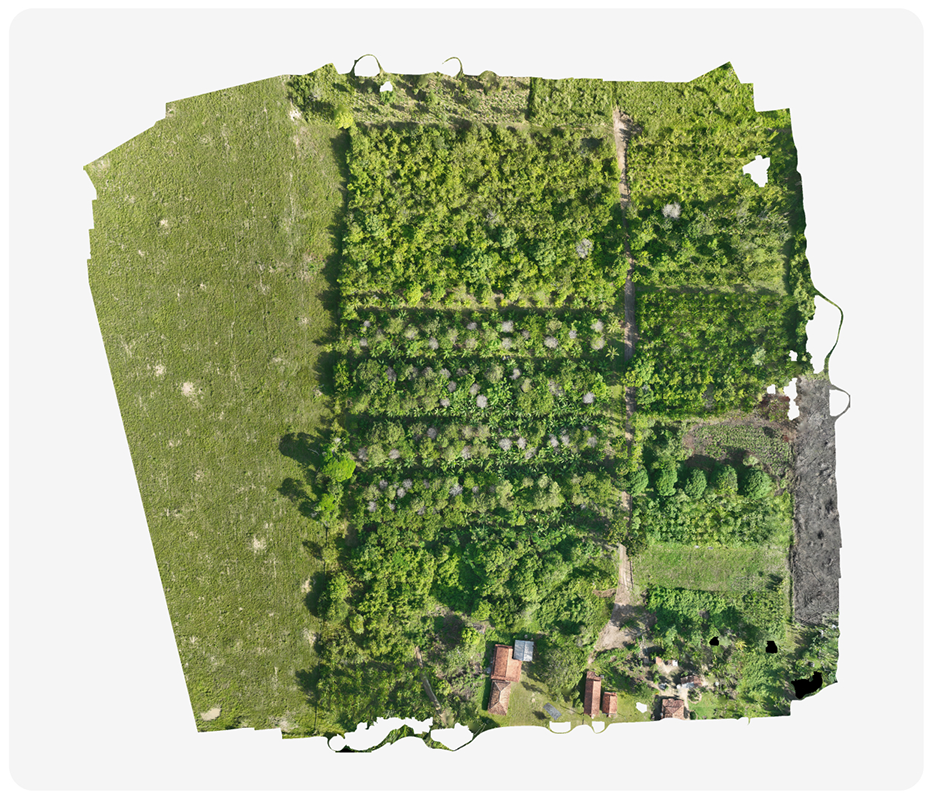
Drone footage of a mature cocoa, coconut, and mahogany agroforestry system, adjacent to a degraded pasture in southeast Par, Brazil.
But the voluntary carbon market is not equipped to tackle this challenge. Carbon removal projects that displace agricultural production often result in indirect land use change and associated emissions, as agricultural markets replace lost production to serve growing demand (leakage).
These crop- and region-specific leakage effects are difficult to quantify reliably. Conventional leakage methodologies impose standardized deductions based on default carbon leakage rates when agricultural production is displaced. This creates a persistent source of uncertainty and risk of over-crediting, and the approach misses an opportunity to build synergies between restoration and agricultural production.
ABACUS instead takes a food-forward approach to leakage accounting. Rather than using an imprecise default value to quantify leakage effects, ABACUS requires projects to eliminate leakage by maintaining or enhancing agricultural production in the project areas and surrounding landscapes. By recognizing the land-sparing effect of enhancing production of different types of commodities, ABACUS encourages projects to co-optimize for carbon and agricultural production and avoids locking regions into specific agricultural products. The working group is engaging partners to create commodity-specific leakage metrics based on land-carbon opportunity costs to estimate, and mitigate, the impacts of leakage.
Abbreviated crediting periods for durability assurance
Carbon stored in ecosystems can be highly durable, but it faces persistent, long-term climate risks such as fire, drought, and land use change, which must be responsibly managed. Nature-based carbon removal should seek effective permanence an actual net greenhouse gas benefit to the atmosphere that is equal to, or greater than, the net benefit represented by the credits. In addition, the removal should ensure that this balance can be maintained indefinitely.
On the other hand, agroforestry and restoration projects can catalyze shifts to land use systems that durably enhance carbon storage even beyond what is credited. This can happen through spillover effects, continued carbon removal after the crediting period, and biophysical cooling feedbacks, among other factors. ABACUS includes several methods that improve the likelihood that nature-based carbon remains durably stored for example, requiring projects to plant ecologically appropriate restoration systems and to create public plans for the longevity of project activities even after the support of carbon revenues.
One of ABACUSs key innovations is to limit the crediting period in an effort to maximize uncredited removals. The ABACUS working group found that revenues from credits generated beyond year 30 are mostly immaterial to investment decisions today, due to their heavy discounts. By shortening the crediting period to 40 years maximum as opposed to as much as 100 years under some voluntary carbon market standards ABACUS will create a source of uncredited carbon removal that can serve as an additional buffer against future reversals.
Additionally, ABACUS proposes that projects will be required to allocate a portion of carbon credits issued late in the crediting period (i.e., years 3140) to a long-term permanence mechanism such as an enhanced buffer pool or insurance product. Achieving increased confidence in the effective permanence of nature-based carbon credits may require stringing together removals or replacing a moderate-durability credit with a high-durability credit, if and when previously credited removals are reversed. Economically, such a construct is currently likely to be cost effective compared to todays high-durability carbon dioxide removal.
Going beyond commercial monoculture plantations
Forest plantations already cover nearly 300 million hectares globally roughly equivalent to the entire area of India. That figure has more than doubled in the last 30 years, without a robust voluntary carbon market, and it is projected to continue growing to provide timber, pulpwood, firewood, and charcoal to increasing populations and a growing economy.
As a first step, ABACUS prohibits most monocultures and requires project developers to use observed or modeled data to demonstrate that planted systems are ecologically appropriate for the landscape. This approach avoids projects seeking to reforest with systems that arent suitable for the locations native biomass potential a function of climate, soil type, water availability, and elevation, among other things. Credit buyers are encouraged to send demand signals that further encourage biodiverse, ecologically sound, and socially beneficial restoration.
Transparency to foster competition on quality
For some aspects of restoration, its challenging to prescribe universally applicable requirements without stifling innovation and local knowledge: every restored ecosystem is unique in its own way. ABACUS introduces multiple requirements for added transparency that will allow buyers, investors, and the public to better assess for themselves the effectiveness of project designs and measurement.
For example, ABACUS projects will need to publish their in-situ inventory measurements, systematically justify their use of allometric or other scaling models, and report on design approaches to avoid measurement or sampling bias. Instead of once every five years or so, ABACUS requires projects to annually map disturbances, to ensure that carbon credited and subsequently reversed is immediately identified. With enhanced transparency, the ABACUS working group hopes to incentivize project developers to compete on quality.
ABACUS doesnt solve all of the challenges of quantifying the complete climate impact of nature-based carbon removal, and it is no replacement for the stakeholder engagement necessary to ensure genuine socio-economic benefits on the ground. Many important improvements remain for future versions of the labels principles and requirements. As we learn, the ABACUS working group will continue to enhance the scientific rigor of and public confidence in ecosystem restoration, catalyzing rural restoration economies and livelihoods and if we succeed helping to enable billions of tons of ecosystem carbon removal across the world.
Research areas: Sustainability
Tags: Climate change , The Climate Pledge
