Architecting Resilience: Why Most Agentic Workflows Are Fragile Demos

Stop building fragile demos. Build resilient, production-grade AI systems.
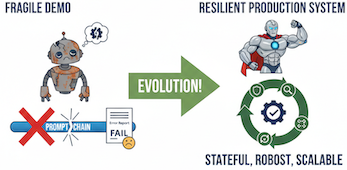
Building an AI agent in a Jupyter notebook is seductive. You chain a few prompts, define a custom tool, hit run, and get back clean JSON. For a moment, it feels like you’ve automated the complex reasoning of a Business Analyst.
But production environments are not notebooks.
In the real world, data is incomplete, APIs timeout, schemas evolve without warning, and models behave non-deterministically across runs. In retail analytics, for example, a hallucinated join between an inventory_live table and a historical_sales table isn’t just a cute bug; it’s a multi-million dollar procurement error waiting to happen.
That’s where most “agentic workflows” collapse. They assume a “happy path” that rarely exists outside of a controlled demo.
If your system cannot gracefully handle a 404 from a tool call, a malformed SQL query, or ambiguous retrieval context, you haven’t built a product. You’ve built a liability.
After over a decade working across analytics systems — from legacy enterprise setups to high-scale e-commerce platforms — one pattern keeps repeating: The difference between a fragile demo and a production AI product is not the intelligence of the model. It’s the resilience of the architecture around it.
1. State Machines over Linear Chains
Most “agentic” implementations today are essentially glorified prompt chains (A → B → C). These are architecturally brittle because they assume forward progress. If step B fails, the entire pipeline crashes.
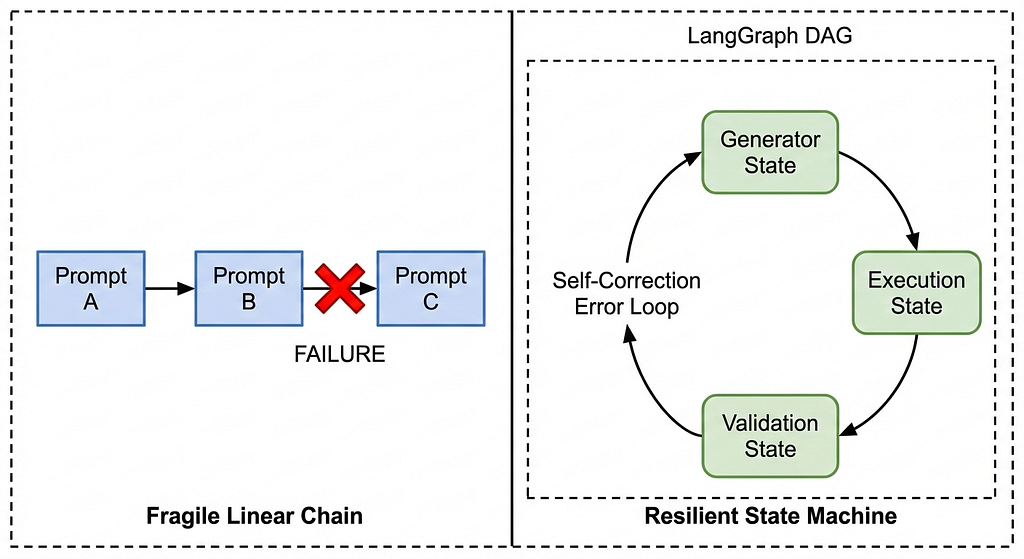
A resilient architecture uses state machines with self-correction loops, not brittle linear chains.
In production, we need Stateful Orchestration. Using frameworks like LangGraph or Temporal, we treat the workflow as a Directed Acyclic Graph (DAG) with cycles.
- The Logic: Each node in the graph represents a specific state (e.g., “SQL Generation,” “Execution,” “Validation”).
- The Failsafe: If the “Execution” state returns a traceback due to a malformed query, the system doesn’t error out. It transitions back to “SQL Generation,” passing the error logs as feedback for self-correction.
This is deterministic orchestration wrapping non-deterministic reasoning. We aren’t hoping the agent is smart; we are forcing the system to be robust.
2. Dual-Layer Guardrails: Schema Enforcement is Mandatory
If your agent’s output is feeding a downstream system or a C-Suite dashboard, natural language is not enough. You need strict Schema Enforcement.

A production-grade system wraps the LLM in a “sandwich” of pre- and post-inference guardrails.
We can rely on Pydantic for structured output validation. If the LLM returns a field that doesn’t match the expected type or range, the system rejects it at the gateway.
The Dual-Layer Strategy:
- Pre-Inference: Using tools like NeMo Guardrails or a specialized SLM (Small Language Model) to redact PII and validate intent. Compliance shouldn’t depend on a probabilistic prompt; it should be a hard-coded check.
- Post-Inference (LLM-as-a-Judge): We use a secondary, faster model (e.g., Llama-3–8B) to perform a Groundedness Check. Does the generated insight actually exist in the retrieved context? If the “Judge” scores the factuality below a 0.8 threshold, the response is discarded.
3. The Unit Economics of Scale: Semantic Routing
One should definitely look at the marginal utility of model parameters. Using a 400B parameter model like GPT-4o to categorize simple customer feedback is a waste of capital.
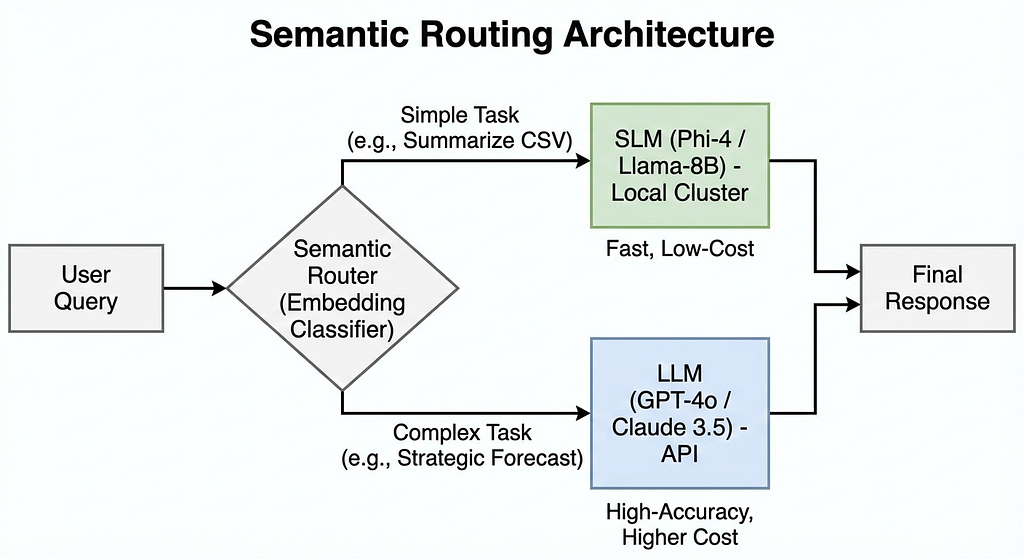
Semantic routing optimizes cost and latency by sending queries to the most appropriate model based on complexity.
We implement Semantic Routing to manage the cost-performance curve:
- The Classifier: A lightweight embedding-based router (like vLLM’s Iris) analyzes the query’s complexity.
- The Route: Simple “Level 1” tasks — summarization or basic SQL — are routed to SLMs (Phi-4 or Llama-8B) running on local clusters.
- The Escalation: Only high-reasoning, “Level 2” tasks — cross-functional forecasting or strategic synthesis — hit the expensive, high-latency frontier models.
This reduces token costs by 40–60% while maintaining enterprise-grade accuracy.
4. Observability: From Logs to Traces
You cannot manage what you cannot measure. In a multi-agent system, a standard log file is useless. We need Distributed Tracing.
By integrating OpenTelemetry or LangSmith, we track the “Life of a Query.” We can see exactly which tool was called, the latency of each reasoning hop, and where the context was lost.
- Circuit Breakers: If the agent gets stuck in a “Reasoning Loop” (hitting the same state 3+ times without progress), a circuit breaker kills the process.
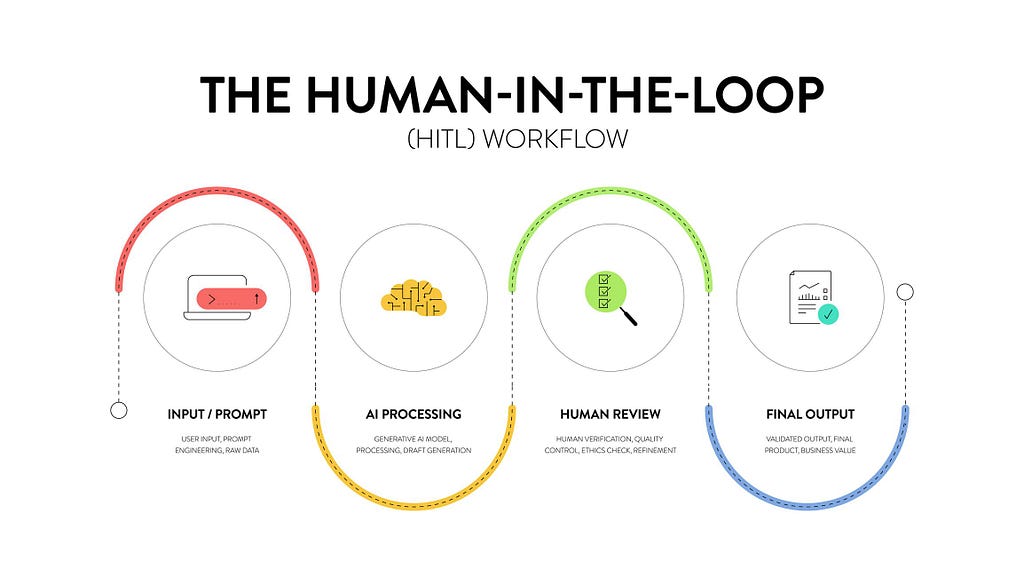
- Human-in-the-Loop (HITL): High-impact decisions (e.g., changing a pricing algorithm) trigger a mandatory human pause. The agent preserves its intermediate state, and a human analyst clicks “Approve” or “Correct” before execution.
The Verdict: The Shift to AI Engineering
The novelty of “talking to your data” has worn off. Stakeholders now demand reliability, auditability, and scale.
Building end-to-end AI products requires us to stop being prompt engineers and start being AI System Architects. The goal isn’t to build an agent that sounds intelligent; the goal is to build a system that behaves predictably under uncertainty.
That is the standard we are setting for 2026.
Transparency Note: This article reflects my perspective after a decade in analytics, but was developed with AI assistance for structural refinement. All technical architectural decisions and conclusions are my own and have been verified against production standards.
Architecting Resilience: Why Most Agentic Workflows Are Fragile Demos was originally published in Towards AI on Medium, where people are continuing the conversation by highlighting and responding to this story.
