
Enterprise AI Automation: A Practical Guide for Large Organizations


Key Takeaways
– Enterprise AI automation is a coordinated system (RPA + ML/LLMs + agents) that manages complex, end-to-end processes, not a single tool but an operating model.
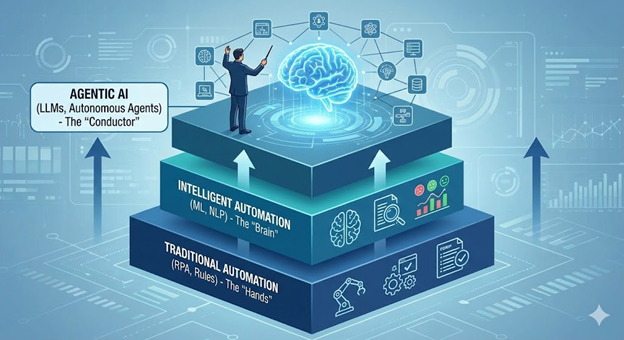
– Three layers define the stack traditional automation (hands), intelligent automation (brain), and agentic AI (conductor), each adds adaptability beyond rule-based logic.
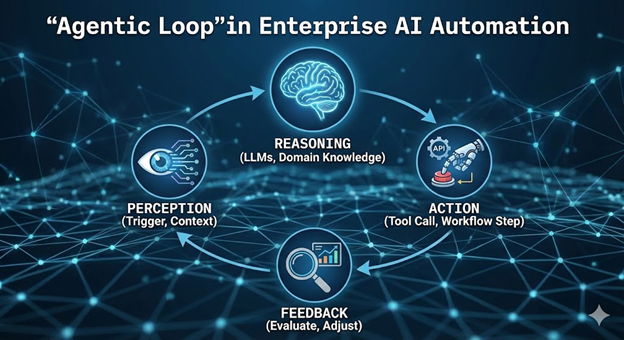
– The agentic loop — perception → reasoning → action → feedback lets systems adapt when steps fail, making AI effective for the “long tail” of variable, decision-heavy work.
– Benefits include 30–50% efficiency gains, faster decisions, on-demand scalability, and measurable cost reduction; early adopters are already in production across finance, healthcare, retail, and manufacturing.
– Risks are real Shadow AI, hallucination, prompt injection, and underestimating ongoing operational cost; governance, validation layers, and human-in-the-loop are non-negotiable for production.
– Getting started means preparation (alignment, data audit), one high-impact pilot, then scale with governance-as-code and cross-functional teams from day one.
For the past decade, enterprises treated automation as a way to speed up repetitive tasks. Robotic Process Automation (RPA) bots copied data between systems, filled out forms, and processed invoices. That model worked well for predictable, rule-based work. But it broke the moment anything deviated from the script, be it an unusual document format, an ambiguous customer request, a process that required judgment.
Enterprise AI automation changes that equation. It combines traditional execution layers (RPA, workflow engines) with cognitive capabilities (machine learning, large language models, AI agents) to manage complex, end-to-end business processes. Rather than following rigid scripts, these systems perceive context, reason through decisions, and take action, then learn from the outcome.
This article explains what enterprise AI automation is, how it works in practice, what benefits and risks it introduces, and how large organizations are putting it into production today.
What Is Enterprise AI Automation?
Enterprise AI automation is a coordinated system of technologies (machine learning, natural language processing, generative AI, and autonomous agents) working together to reduce manual effort across multi-system environments. It is not a single tool. It is an operating model.
The simplest way to understand it is through three layers:
– Traditional Automation (RPA) acts as the “hands.” It executes deterministic tasks such as copying data, filling forms, routing files using structured inputs and if-then logic.
– Intelligent Automation acts as the “brain.” It adds adaptive capabilities such as document understanding, sentiment analysis, and pattern recognition, allowing systems to handle unstructured data.
– Agentic AI acts as the “conductor.” It interprets context, reasons through objectives, and orchestrates both the hands and the brain to achieve outcomes, often across multiple systems and departments.
Each layer builds on the one below it. RPA handles what is predictable. Intelligent automation handles what is variable. Agentic AI handles what requires planning and judgment.
How It Works the Agentic Loop
At the core of modern enterprise AI automation is a pattern called the agentic loop. It works like this:
- Perception. The system receives a trigger, for example a customer email, a flagged transaction, and a support ticket.
- Reasoning. A large language model interprets the intent, evaluates context (using retrieved documents, past interactions, or domain knowledge), and builds a plan.
- Action. The agent selects and calls the appropriate tool, be it an API, a database query, a workflow step, and executes it.
- Feedback. The agent reads the result, evaluates whether the goal was met, and either completes the task or adjusts the plan and loops back.
Unlike traditional automation, this loop is not linear. If a step fails or returns unexpected results, the agent can reason for the failure and try a different approach. This is what makes AI automation effective for the “long tail” of enterprise processes, the complex, variable, decision-heavy work that RPA could never touch.
Multi-agent systems extend this further. Instead of a single agent handling everything, specialized agents collaborate a sourcing agent, a risk assessment agent, and a logistics agent might coordinate on a supply chain decision, each contributing domain-specific reasoning. This shift from AI-as-assistant to AI-as-operating-model is already reshaping how enterprise teams are structured and how work gets assigned.
Why Is Enterprise AI Automation Important for Large Organizations?
Enterprise AI automation is important because it improves operational efficiency, accelerates decision-making, enhances scalability, and reduces costs across departments. By eliminating manual handoffs and enabling continuous execution, organizations can manage growing complexity without proportionally increasing headcount. For large enterprises operating across multiple systems, AI automation shifts workflows from fragmented execution to coordinated intelligence.
The business case for enterprise AI automation rests on four pillars:
Operational Efficiency
Early adopters report 30–50% gains in process efficiency. These gains come not from speeding up individual tasks, but from eliminating handoffs, reducing rework, and allowing systems to operate continuously. A Deloitte survey found that 34% of companies now use AI to “deeply transform” their business operations, and workforce access to sanctioned AI tools grew from under 40% to roughly 60% in the past year.
Decision Speed
AI agents analyze data and surface recommendations in seconds rather than days. In financial services, that means faster fraud detection. In retail, it means real-time inventory adjustments. In healthcare, it means faster claims processing and compliance checks.
Scalability
Human teams scale linearly. AI agents scale on demand. When a spike in customer inquiries hits, an agent-based system handles the load without hiring, training, or scheduling. Research from Zapier shows that 72% of enterprises are now using or testing AI agents, with 84% planning to increase investment in the next 12 months.
Cost Reduction
Automating complex workflows reduces both labor costs and error-related costs. Consider a global automotive manufacturer that deployed an agentic system trained on decades of vehicle knowledge to support field technicians. Diagnoses that previously took days now take under an hour, the system runs 24/7, and the company has saved more than £1M while also uncovering over £10M in procurement inefficiencies through process mining.
Where Are Enterprises Applying AI Automation Today?
Enterprises are deploying AI automation across finance, healthcare, retail, automotive, and manufacturing to manage fraud detection, compliance, claims processing, supply chains, and predictive diagnostics. These systems combine document understanding, retrieval-augmented generation, process mining, and AI agents to transform workflows that previously required manual cross-referencing and decision-heavy oversight.
Enterprise AI automation is already in production across industries:
– Financial services. AI agents handle fraud detection, regulatory compliance, and credit risk analysis. Agentic RAG (retrieval-augmented generation) systems in banking pull context from regulatory databases in real time, flag anomalies, and generate compliance reports. Work that previously required analysts to manually cross-reference dozens of documents.
– Healthcare. Automated workflows handle claims processing, audit analytics, and patient data routing. A billion-dollar pharmaceutical company replaced error-prone manual audit categorization with an ML pipeline that analyzed over 400,000 findings using unsupervised learning delivering explainable, context-driven results that leadership could act on immediately.
– Retail. AI-powered systems manage demand forecasting, personalized recommendations, and supply chain coordination. Denmark’s largest retailer achieved a 40% reduction in technology costs by replacing legacy systems with modern, data-driven platforms making it a transformation that also drove exponential e-commerce growth.
– Automotive and manufacturing. Conversational AI, process mining, and intelligent document processing are reducing downtime and improving compliance across production lines. The automotive case mentioned earlier is a good example the same engagement that deployed agentic diagnostics also used Celonis process mining to optimize purchase-to-pay workflows and automated regulatory document processing with 80% cost savings.
What Are the Risks of Enterprise AI Automation?
Enterprise AI automation introduces risks such as shadow AI usage, hallucinated outputs, prompt injection attacks, and underestimated operational costs. Unlike traditional automation, AI agents can generate incorrect results or drift from intended goals. Production-grade deployments require governance frameworks, validation layers, data controls, and human oversight to ensure safety, compliance, and reliability.
Enterprise AI automation introduces risks that traditional automation does not. Ignoring them is how pilot projects stall.
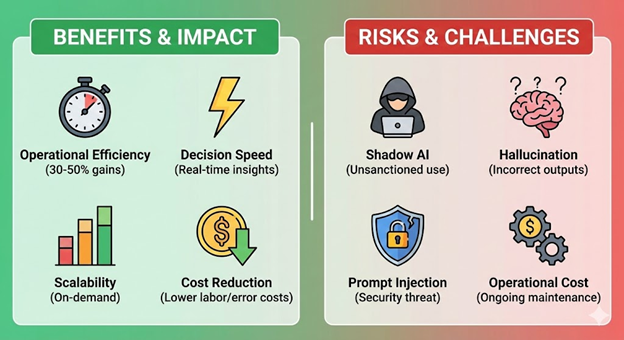
Shadow AI
Up to 60% of employees use unsanctioned AI tools at work, and a third admit to pasting sensitive data into them. This creates invisible attack surfaces where proprietary information leaks to public models and unverified agents inherit user permissions. Enterprises need centralized AI registries and data loss prevention controls.
Hallucination and Goal Drift
AI agents can confidently produce incorrect outputs. In a customer-facing context, that means wrong answers. In a compliance context, it means regulatory exposure. Production-grade systems require validation layers after every tool call, strict step limits to prevent infinite loops, and human-in-the-loop approval for high-stakes actions.
Prompt Injection
This is the SQL injection of the AI era. An agent processing external documents can encounter hidden instructions that hijack its behavior. Defense requires input sandboxing, separate scanning models, and semantic circuit breakers that monitor the agent’s internal state for prohibited patterns.
Underestimating Operational Cost
AI is not a one-time deployment. It requires ongoing evaluation, retraining, quality checks, and orchestration. Many teams overlook these needs and face friction when pilots succeed technically but stall operationally or financially. The real value of AI automation compounds over time, each cycle of data generates better insights, which improve outcomes, which drive adoption, which generates more data but only if the operational investment keeps pace with the technical one.
How Should Large Organizations Get Started?
Large organizations should adopt a phased approach to enterprise AI automation: align leadership around measurable objectives, pilot one high-impact workflow, and then scale using governance-as-code and cross-functional teams. Treating AI automation as an operating model shift rather than a technology experiment ensures sustainable adoption and measurable long-term value.
A phased approach reduces risk and builds organizational confidence:
Stage 1Preparation. Align leadership on business objectives. Audit your data landscape. Identify where AI automation can solve real problems, not where it sounds impressive.
Stage 2Pilot. Select one high-impact, low-risk workflow. Redesign it end-to-end using agentic principles. Measure results against clearly defined metrics. Start with workflows that integrate well with existing systems.
Stage 3Scale. Standardized platforms. Establish a Center of Excellence. Integrate governance-as-code from day one. Build cross-functional teams that include engineering, compliance, and operations.
The most common mistake is treating AI automation as a technology project rather than an operating model shift. The organizations that succeed are the ones that pair technical capability with clear governance, structured workflows, and human oversight. For a deeper dive into architecture patterns and industry-specific implementation detail, the full enterprise AI automation guide covers each stage in depth.
What Is the Future of Enterprise AI Automation?
Enterprise AI automation is shifting from experimental pilots to production operating models. As AI agents mature, organizations that combine governance, structured workflows, and cross-functional ownership will gain competitive advantage. The focus is no longer whether to adopt AI automation, but how quickly enterprises can scale responsibly.
Enterprise AI automation is not about replacing people with machines. It is about redesigning how workflows through an organization, letting AI handle the repetitive reasoning, the data-heavy coordination, and the always-on operational load, while humans focus on judgment, creativity, and the decisions that matter most.
The technology is production ready. The early adopters are already measuring results. The question for every enterprise is no longer whether to invest, but how quickly can they move from pilot to operating model.
If you are exploring what AI agents can do for your workflows, or evaluating how intelligent automation and process transformation fit into your existing stack, the practical next step is the same pick one workflow, redesign it end-to-end, and measure what changes.
Enterprise AI Automation: A Practical Guide for Large Organizations was originally published in Towards AI on Medium, where people are continuing the conversation by highlighting and responding to this story.
