Why AI in CRM Fails Without a Warehouse-First Architecture

Rebuilding CRM as a Probabilistic Control System Instead of a Campaign Engine
When Model Accuracy Is Not Enough
In Part 1 of this series, we explored how a warehouse-first composable CDP restores architectural control to modern CRM systems. In Part 2, we examined the Identity Nexus, addressing semantic fragmentation through embedding-based resolution and governed arbitration.
These layers provide the essential foundation for structural integrity and identity resolution.
Yet across multiple production audits, a deeper pattern consistently emerged:
Many AI initiatives inside CRM environments fail — not because their predictive models are inaccurate, but because the surrounding architecture cannot operationalize them effectively.
Model performance and business performance are not the same variable.
The missing layer is orchestration.
The Illusion of Intelligent CRM
Modern CRM platforms increasingly integrate machine learning features:
Lead scoring
Churn prediction
Intent classification
Customer lifetime value estimation
Offline evaluation often looks strong. Metrics improve. Models separate high-probability users from low-probability ones with statistical clarity.
Despite this architectural rigor, tangible business impact often falls short of expectations.
The reason is subtle but structural.
Most CRM systems remain governed by calendar logic:
Weekly campaign launches
Nightly segment refreshes
Periodic API synchronization
In this design, model evaluation is continuous, but activation is periodic.
If a model detects rising purchase intent at 10:07 AM but outreach occurs two days later, the predictive advantage may have already dissipated.
Customer behavior evolves in real time.
Intent signals fluctuate
Probability is not static
When activation timing does not align with behavioral inflection, AI becomes descriptive rather than operational.
The limiting factor is not intelligence.
It is latency.
Architectural Separation: Prediction vs. Execution
In traditional stacks:
Models are trained and evaluated in analytical environments
CRM platforms control campaign logic
Data moves between systems through connectors or batch exports
This separation creates systemic friction.
Temporal Drift
Prediction and intervention operate on different clocks.
Segment Divergence
Definitions in the warehouse gradually diverge from CRM segments due to synchronization delays.
Control Fragmentation
No unified layer governs both probability evaluation and activation eligibility.
As a result, AI outputs are treated as advisory signals rather than decision triggers.
The model informs
The campaign calendar decides
This structural decoupling limits the operational power of machine learning.
Warehouse-First as a Probabilistic Control Layer
A warehouse-first composable CDP collapses this separation.
Identity resolution, feature engineering, survival modeling, and intent scoring coexist within the same governed environment. Activation logic is no longer embedded solely inside CRM tools. Instead, it is defined where probability is computed.
Beyond simple synchronization, Reverse ETL serves as a projection mechanism for capturing and acting upon behavioral state transitions.
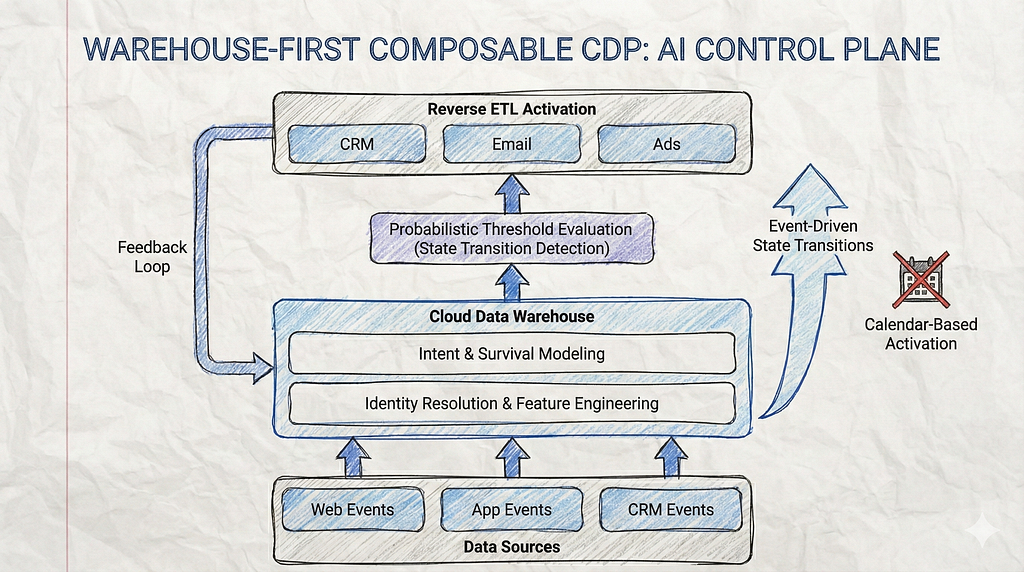
Activation is no longer driven by “Who should we contact this week?”
It is driven by “Has this customer crossed a statistically meaningful threshold?”
This is the conceptual shift from campaign automation to probabilistic orchestration.
When identity is high fidelity, feature pipelines are version-controlled, and activation triggers operate on behavioral deltas rather than static segments, the warehouse becomes an AI control plane.
Execution aligns with modeled state transitions instead of predefined schedules.
Removing Latency Unlocks Impact
By superseding weekly batch updates with delta-driven, probability-aligned orchestration, we achieved a 153% increase in actionable conversions during a controlled production audit.
No changes were made to creative assets.
Channel mix remained constant.
Budget allocation did not increase.
The only variable altered was activation timing.
The uplift did not stem from a better model.
It emerged from removing the delay between prediction and execution.
When AI governs intervention eligibility in real time, its predictive value compounds instead of decaying.
The Real Bottleneck in Applied AI
Organizations often attempt to “add AI” to CRM platforms.
Few redesign the system control logic around probabilistic governance.
Without a warehouse-first architecture:
Models remain siloed in analytical layers
Activation remains periodic and manually defined
Latency erodes predictive advantage before it can be realized
AI in CRM does not fail because the mathematics are flawed.
Failure occurs when the system’s latency exceeds the velocity of behavioral change.
Accuracy without orchestration is inert.
Architecture Defines AI Effectiveness
Across this series, the progression has been structural:
Warehouse-first architecture establishes operational sovereignty.
Identity Nexus ensures semantic coherence.
Probabilistic orchestration determines whether AI influences outcomes.
Composable CDP is not simply a modular tooling choice.
It is an architectural prerequisite for AI effectiveness.
As customer journeys accelerate and signals fragment across channels, competitive advantage will not depend solely on model sophistication.
It will depend on minimizing the distance between prediction and execution.
And that distance is defined by architecture.
The Architectural Mismatch
In traditional stacks:
Models live inside analytics environments or notebooks
CRM tools control activation logic
Data flows through connectors or batch exports
This separation introduces systemic friction:
1. Temporal Drift
Predictions and interventions operate on different clocks.
2. Segment Divergence
Warehouse definitions and CRM segments fall out of sync.
3. Control Fragmentation
No unified governance layer evaluates prediction and execution together.
The result is structural decoupling:
Prediction is continuous
Activation is periodic
The model suggests.
The campaign calendar decides.
Why Warehouse-First Architecture Enables Orchestration
A composable CDP restructures control flow.
Instead of exporting segments to CRM platforms, Reverse ETL serves as a projection mechanism for state transitions.
Activation logic is no longer embedded inside marketing tools.
It is defined in the same environment where probability is computed.
When:
Identity resolution is high fidelity
Feature engineering is version-controlled
Survival and intent models are warehouse-native
Delta detection replaces full-table sync
The warehouse becomes an AI control plane.
Execution aligns with model-evaluated thresholds rather than calendar cadence.
Empirical Signal: Removing Latency
In a controlled production audit, we isolated activation timing as the sole variable. Transitioning from weekly batch execution to event-driven triggers yielded a 153% lift in actionable conversions.
Creative assets were unchanged
Channel allocation remained constant
Audience definitions did not expand
The only variable altered was activation timing.
The uplift did not originate from a superior predictive model.
It resulted from eliminating the architectural delay between prediction and execution.
Why AI in CRM Fails Without a Warehouse-First Architecture was originally published in Towards AI on Medium, where people are continuing the conversation by highlighting and responding to this story.
