
Beyond the Chatbox: Why Native Multimodality is the New Enterprise Standard


Running a business on text-only LLMs is the equivalent of navigating a 3D market through a 1D keyhole. Native Multimodality isn’t a “feature” — it is a fundamental shift from AI that merely reads your business to AI that perceives it. By integrating video, voice, and structured telemetry into a unified decision engine, enterprises can finally bridge the gap between fragmented data and high-velocity execution. If your system cannot correlate the sentiment of a customer’s voice with the technical error trace in their log, you aren’t scaling; you’re operating on incomplete data.
The Architecture of Perception: From Raw Data to Deterministic Scaling

Multimodal systems move beyond simple “prompt-and-response” logic. They follow a four-stage engineering pipeline designed to transform chaos into a deterministic competitive moat:
- Data Ingestion & Normalization: We treat data as an engineering constraint, not a storage problem. This stage involves standardizing 4K video feeds, raw telemetry, and audio logs into a uniform processing format to prevent “hallucination-by-day-three.”
- Latent Embedding & Feature Encoding: This is the “Universal Translator” stage. Using transformer architectures (text) and vision-language encoders (like CLIP), human concepts are converted into machine-readable vectors. It allows the system to treat a “frustrated tone” and a “UI bug screenshot” as the same mathematical concept.
- Semantic Information Fusion: This is the core differentiator. Rather than processing images and text in silos, semantic fusion creates a shared conceptual space where the AI understands that disparate inputs represent the same event.
- Generative Output & Strategic Execution: The goal isn’t a “chat.” It’s a recommendation or an automated action grounded in proprietary business rules. We are shifting from “poetry bots” to autonomous engines.
Core Capabilities: The 2026 Multimodal Toolkit
To understand the ROI of these systems, enterprise leaders must look at three specific capabilities:
Zero-Shot Multimodal Reasoning
The ability for a system to act on novel information without specific training. For example, an AI identifying a specific type of industrial pipe corrosion it has never “seen” before by reasoning through its general knowledge of “metal” and “oxidation.”
Vision-Language Models (VLM)
VLMs (like GPT-4o or LLaVA) bridge the visual-verbal gap, allowing for real-time analysis of visual content — such as instantly auditing a retail shelf layout against a strategic planogram.
Spatial Intelligence
This is the frontier of 3D structural understanding. It allows AI to interpret floor plans, navigate physical environments, and understand the relationship between objects in a physical space — crucial for logistics and automated manufacturing.
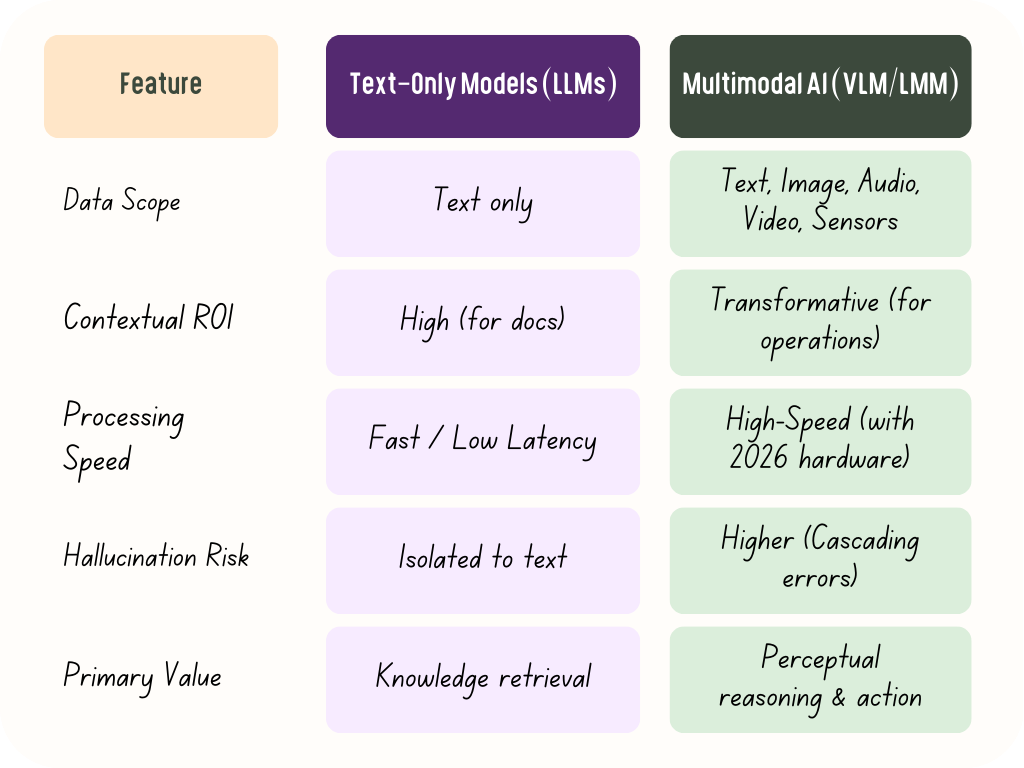
Strategic Comparison: LLM vs. Multimodal
Deployment in the Field: Vertical-Specific ROI
- Healthcare: Moving past diagnostic pixel-hunting. Multimodal foundation models correlate imaging with live vitals and genomic history, reducing the “admin load” that consumes 70% of physician time.
- Life Sciences: While AlphaFold mapped proteins, 2026’s multimodal models are writing them. Researchers are now simulating 500 million years of evolution in seconds to design new enzymes via cross-modal structural reasoning.
- Marketing & GEO: Traditional SEO is a legacy tactic. We are entering the era of Generative Engine Optimization (GEO). Multimodal AI audits visual trends and competitor sentiment simultaneously to build “Information Gain” assets that AI models prioritize in summaries.
- Finance & Insurance: Combatting “Synthetic Identity” fraud. By cross-referencing voice biometrics, behavioral data, and spatial analysis of claim photos, systems can verify legitimacy in seconds, accelerating valid claims by 30%.
Agentic Ecosystems and the “USB-C” of AI

The next evolution is Agentic AI — systems that don’t wait for a prompt but proactively monitor data to execute tasks.
To prevent these agents from becoming “black boxes,” the Model Context Protocol (MCP) has emerged as the universal standard. MCP acts as a “USB-C” for your intelligence layer, allowing agents to plug into live databases and APIs on-demand. In a high-velocity engineering environment, if your AI cannot pull its own context via MCP, it isn’t an agent — it’s a bottleneck.
Strategic Positioning: Takers, Shapers, and Makers
Takers: Utilize third-party APIs (e.g., GPT-4o) for generic tasks. Low cost, low moat.
Shapers: Fine-tune pre-built models on proprietary, domain-specific data. This is the “Sweet Spot” for most enterprises, offering high ROI and defensible IP.
Makers: Build and train foundation models in-house. High capital expenditure (CapEx), total control.
The Resilience Framework: Engineering for Multimodal Reliability
Deploying multimodal systems at scale is a task of managing Error Cascading — a phenomenon where a single perceptual failure in one modality (e.g., a misidentified visual defect) poisons the subsequent reasoning and automated execution. To turn these risks into managed constraints, enterprise leaders should adopt a unified engineering and governance protocol:
1. Technical Risk & Protocol-Level Mitigation
- Architectural Grounding (MCP): Transition from unconstrained agents to deterministic execution via the Model Context Protocol. MCP acts as a secure “USB-C” interface, hard-coding data access to prevent prompt injection and unauthorized lateral movement.
- Temporal Synchronization: Prevent “semantic drift” by implementing strict timestamping and normalization across 4K video, audio, and sensor feeds. If inputs are out of sync, the multimodal logic fails.
- Privacy-by-Design: Mitigate deanonymization risks inherent in cross-modality analysis by scrubbing PII through Zero-Trust Identity and differential privacy layers before the model fusion stage.
2. Operational Guardrails & Strategic Scaling
- HITL Authentication: Shift from “safety checks” to Human-in-the-Loop as a legal requirement. The AI manages the high-velocity perception, but humans must authenticate high-regret decisions in regulated sectors.
- Low-Regret Horizontal Scaling: Mitigate Model Drift by first deploying agents in controlled internal environments (e.g., R&D or code auditing) to benchmark performance before exposing the engine to market-facing risks.
- Intersectional Bias Audits: Move beyond single-mode checks. Regularly audit the fusion layer to ensure that biases in one dataset (e.g., visual representation) aren’t being mathematically amplified by the text or audio layers.
The 2026 Horizon: From Models to Autonomous Ecosystems
The transition to multimodal as the standard interface is already complete. Looking toward the rest of the decade, the field is shifting from isolated “features” to Autonomous Perception Ecosystems:
- Democratized Training & Efficiency: Following the Sony AI benchmarks, training costs have plummeted. Models that cost $100,000 in 2022 now cost under $2,000, allowing mid-sized firms to build custom, high-moat systems.
- Deeper Sensor Fusion: The next wave of “Full Multimodality” integrates 3D spatial intelligence, thermal imaging, and chemical sensors, creating systems with 360-degree environmental awareness for logistics and manufacturing.
- Specialist Vertical Models: Generic chatbots are being replaced by “Vertical AI” — models trained specifically for legal, medical, or engineering domains with a precision that general-purpose models cannot replicate.
- Agentic Orchestration: By 2028, over 33% of enterprise software will feature Agentic AI. We are moving toward “Agentlakes” — ecosystems of autonomous agents that collaborate via standardized protocols like MCP to solve end-to-end business problems.
Conclusion: The Multimodal Moat
Multimodal AI is no longer a research project; it is a prerequisite for enterprise relevance in 2026. By moving from “reading” to “perceiving,” organizations can unlock efficiencies in drug discovery, fraud detection, and operational automation that were previously impossible. The competitive advantage belongs to those who move beyond the chatbox and build systems that truly understand the world.
Frequently Asked Questions
How does Multimodal AI impact the bottom line in 2026?
AI-native companies using multimodal workflows generate roughly 10x more revenue per employee by automating high-bandwidth perceptual tasks that previously required manual human review.
Is the higher cost per token worth it?
While tokens are ~2x more expensive than text-only LLMs, the reduction in tool fragmentation (removing the need for separate OCR, audio, and vision tools) typically yields a net-positive ROI within the first year.
What is the single biggest barrier to entry?
Technical debt. Legacy systems were not built for real-time, data-intensive multimodal flows. Moving to a unified, API-first architecture is the prerequisite for scaling these engines.
Beyond the Chatbox: Why Native Multimodality is the New Enterprise Standard was originally published in Towards AI on Medium, where people are continuing the conversation by highlighting and responding to this story.
