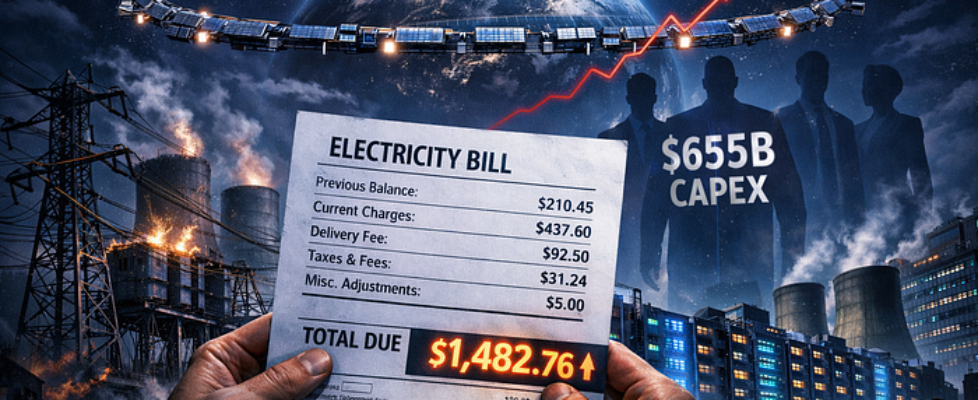
Big Tech Is Burning $655 Billion to Build AI on a Power Grid From the 1950s. Musk Says Put It in Space.

Author(s): Zoom In AI Originally published on Towards AI. Your electric bill is helping bankroll Bezos’s compute buildout. Elon wants to move the whole thing into orbit. Neither plan is proven yet. That is the terrifying part. By Zoom In AI | February 9, 2026I write about how AI actually works (not the marketing version), where safety and reality don’t match, and the economics and infrastructure behind the hype. Stop me if this sounds like satire. Four companies, Amazon, Google, Microsoft, and Meta, are signaling roughly $655 billion in capital expenditures this year to build AI data centers. That is infrastructure spending at a scale most governments would struggle to execute. Their stocks dropped anyway. Then Elon Musk did what Elon Musk does: he escalated. He merged SpaceX with xAI in a deal widely described as historic in size and started selling a different answer to the same bottleneck. Put the data center in orbit, power it with constant sunlight, cool it without water, skip the grid, skip the permits, skip the protests. CNBC: $1.25T SpaceX–xAI merger Reuters via Yahoo Finance: deal details and valuation Here’s the point nobody is stating plainly enough: Both strategies are bets against constraints you can’t PR your way around.One is betting a 70-year-old grid can absorb an AI-era load spike without political revolt. The other is betting you can run industrial compute in an environment that punishes hardware and doesn’t forgive collisions. And somewhere in the middle, your monthly bill creeps upward so a chatbot can respond faster. Let’s zoom in. I. The $655B question: what are you actually buying? Start with the scoreboard. Amazon: ~$200B Alphabet/Google: $175–185B Microsoft: ~$150B (based on guidance and reporting) Meta: $115–135B Call it ~$655B on the conservative end. The market reaction tells you the mood has shifted. Investors used to reward spending because spending meant “we’re winning.” Now they want a plausible line from capex to revenue inside a time horizon that doesn’t feel like faith-based accounting. Amazon CEO Andy Jassy argued the spend is not a vanity move and that AWS demand is outpacing supply. CNBC coverage: Amazon earnings and capex plan Why Jassy says he’s confident Wall Street looked at the same numbers, then looked at the capex overshoot versus consensus estimates, and hit sell. Investing.com: Capex above expectations One quote captured the vibe: we moved from “capex triggers euphoria” to “show me the revenue.” Irish Times: analyst quotes and market tone And here’s the detail that matters more than the headline number: how much cash gets swallowed by the build. One breakdown claims Amazon is reinvesting the vast majority of operating cash flow into infrastructure and that free cash flow has compressed sharply relative to spend. Fintool: Amazon capex and cash flow context This is the new reality of AI infrastructure: the build is the business plan. II. The part they don’t want you to read: your electric bill is part of the subsidy All of this computing needs electricity. Not “a lot.” Industrial, steady, compounding electricity. The problem is that the U.S. grid is not built for this moment. A widely cited stat: most of it was designed decades ago, and it is already strained. Data Center Knowledge: grid age and power constraints PJM Interconnection, the largest grid operator in the U.S., is the clearest case study because it serves major data center corridors and tens of millions of people. PJM has warned about reliability margins tightening as demand accelerates. CNBC: PJM shortfall, bills, and backlash Here is the mechanism that turns “Big Tech capex” into “your bill goes up”: When grid operators and utilities procure capacity and reliability resources to meet rising load, those costs don’t stay inside hyperscaler budgets. They get allocated through regulated structures and ultimately land on ratepayers. Bloomberg quantified how data center demand is showing up in procurement costs. Bloomberg: capacity and procurement costs linked to data centers Then it gets political fast. CNBC notes residential electricity prices were already up in 2025 and forecasts more increase in 2026, while local communities and national politicians begin treating data center growth as a cost-of-living issue. CNBC: price increases, Sanders + DeSantis backlash NPR: how data centers could affect your bill This is why Musk’s orbit pitch suddenly stops sounding like pure cosplay. He’s pointing at a real bottleneck. III. Musk’s pitch: “It’s always sunny in space” Musk’s story is simple: Earth is slow and expensive. Space is fast, scalable, and solar. The merger is the platform move that makes the pitch coherent. Put rockets, satellites, and an AI company under one roof, then sell the market on a future where compute is not bound to terrestrial grids. Coverage is filled with the details that make the pitch feel real: FCC filings, orbital “data-center systems,” and the idea of solar-powered compute nodes. SpaceNews: FCC filing and orbital data center push CNN: orbiting data center plans and expert skepticism And yes, the part that sounds like a fever dream is also in mainstream reporting: an IPO narrative tied to Musk’s birthday timing. CNBC: IPO talk and valuation framing He sells orbit as a way to dodge everything Earth-based compute is colliding with: grid queues local opposition water usage permitting delays rising rates That’s the sales deck. Now comes the engineering. IV. Reality check: orbit has physics, too Musk’s space thesis is not impossible. It’s just not free. 1) Timelines Some analysts see orbital compute as a longer-horizon project, potentially well into the 2030s before economics converge. CNN: timeline skepticism 2) Latency: training vs inference Quick framing: Training is bulk compute and can tolerate more latency. Inference is a real-time product behavior and is latency-sensitive. Even in low Earth orbit, the round-trip path can be a real constraint for the fastest-growing product category: interactive AI. 3) Radiation and reliability Cosmic radiation degrades electronics. A chip that performs well in a lab is not the same as a fleet surviving years in orbit. BNN Bloomberg: radiation testing context 4) Debris and collision risk […]
