Choosing Your AI Coding Engine in 2026

The enterprise guide to choosing (and governing) your AI coding assistant

Why this guide
Enterprise development isn’t just about generating code — it’s about shipping secure, reliable software across large repos, long‑running tasks, and regulated environments. That’s where GPT‑5.2 Codex, running inside Microsoft Foundry, changes the conversation: it’s not merely “autocomplete,” but sustained reasoning designed for the realities of real‑world SDLCs.
If you’ve been following the rapid evolution of AI coding models, you’ve probably noticed a shift: we’re no longer talking about chatbots that help with autocomplete — we’re seeing deeply agentic systems that can reason across massive codebases, handle long‑running tasks, and support enterprise‑grade governance.
What GPT‑5.2 Codex actually brings
Microsoft’s Foundry announcement highlights several capabilities that matter to teams working at scale:
- Long context window (up to 400K tokens) — enough to reason across large codebases and docs in one session.
- Multimodal inputs — mix code with screenshots, UI mocks, and diagrams to keep implementation aligned with design intent.
- Security‑minded assistance — from secure coding patterns to support during reviews and incident response, with Azure’s enterprise guardrails and governance.
- Enterprise‑grade delivery — run within existing Azure identity, compliance boundaries, and platform‑level controls.
These aren’t theoretical features; they map directly to pain points like brittle refactors, dependency tangles, and security reviews that block releases.
AI as a Senior Engineer (Not an Autocomplete Tool)
Microsoft’s messaging reinforces this shift. GPT‑5.2‑Codex:
- Understands design intent, not just code syntax
- Maintains continuity across lengthy engineering workstreams
- Supports secure coding, reviews, and vulnerability analysis
- Works across screenshots, diagrams, natural language, and large repositories
This aligns with a broader industry trend: AI is moving from “assistant” to “agent” — and GPT‑5.2‑Codex may be the most enterprise‑aligned version of that shift.
Why GPT‑5.2‑Codex Is a Big Deal for Engineering Leaders
Most engineering orgs today have:
- Legacy codebases that can’t be broken
- Complex CI/CD workflows
- Security reviews as bottlenecks
- Changing requirements
- Multi‑year modernization plans
- Mountains of undocumented tribal knowledge
GPT‑5.2‑Codex targets exactly this environment.
This is AI designed for critical delivery pressure — not hobby coding.
How it compares: Gemini 3 Pro and Claude Opus 4.5
Third‑party hands‑on testing paints a nuanced picture:
- Gemini 3 Pro often shines in UI/frontend scenarios (e.g., polished Figma clones, even a 3D “Minecraft” build) but stumbled on a LeetCode Hard in the referenced tests.
- GPT‑5.2 Codex shows up as a consistent all‑rounder: strong across varied tasks, including a correct algorithmic solution that still hit TLE on larger inputs.
- Claude Opus 4.5 underperformed in the small UI‑heavy sample reviewed, failing to justify its premium price in that test set.
Pricing notes from the same source (and Microsoft): expect GPT‑5.2 Codex around $1.75/M input, $0.175/M cached input, $14/M output, while the article describes Gemini 3 Pro and Opus 4.5 at differing price points; always verify for your tenant and region.
Takeaway: If your workload skews frontend/UI, Gemini 3 Pro may impress; for balanced, repo‑scale coding under enterprise constraints, GPT‑5.2 Codex + Foundry’s governance is the pragmatic default.
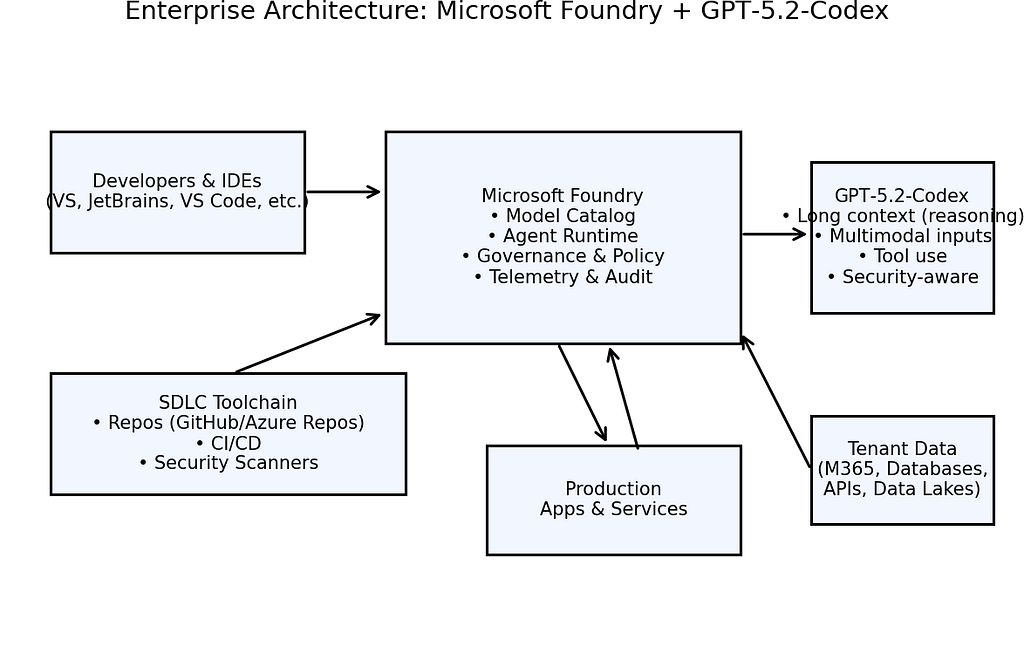
Architecture: putting GPT‑5.2 Codex to work (Azure‑mapped)
A practical deployment couples Microsoft Foundry (model catalog, governance, telemetry) with your SDLC toolchain and production runtime. Foundry brokers access to GPT‑5.2 Codex, while enterprise controls (identity, compliance, auditing) remain intact.
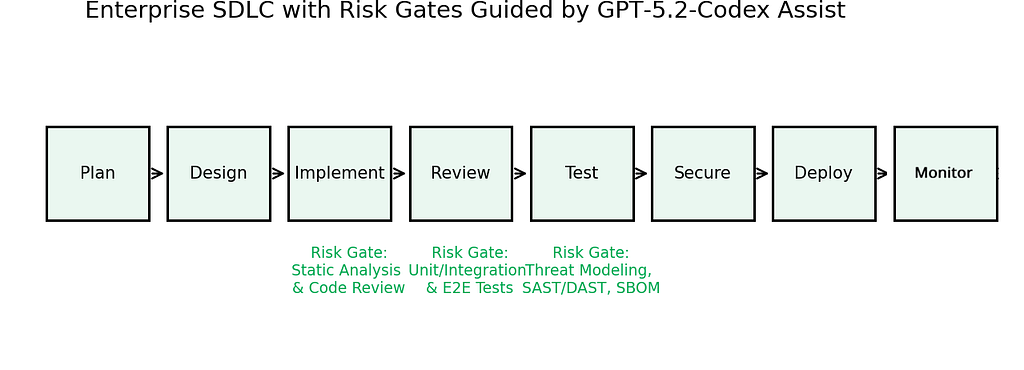
SDLC with risk gates: where AI helps without lowering the bar
Incorporate AI where it reduces toil and raises quality:
- Plan/Design: generate design diffs, flag risky patterns early.
- Implement: scaffold changes across services while preserving intent.
- Review/Test/Secure: enforce risk gates for code review, SAST/DAST, and SBOM before merge.
- Deploy/Monitor: close the loop with telemetry and regression insights.
Microsoft explicitly positions GPT‑5.2 Codex as security‑aware assistance integrated with Azure’s identity, compliance, and governance model — critical for teams operating under audits and regulatory scrutiny.
Choosing the right model for the job
When you’re balancing speed/efficiency against security/governance alignment, your short list usually lands on these three:
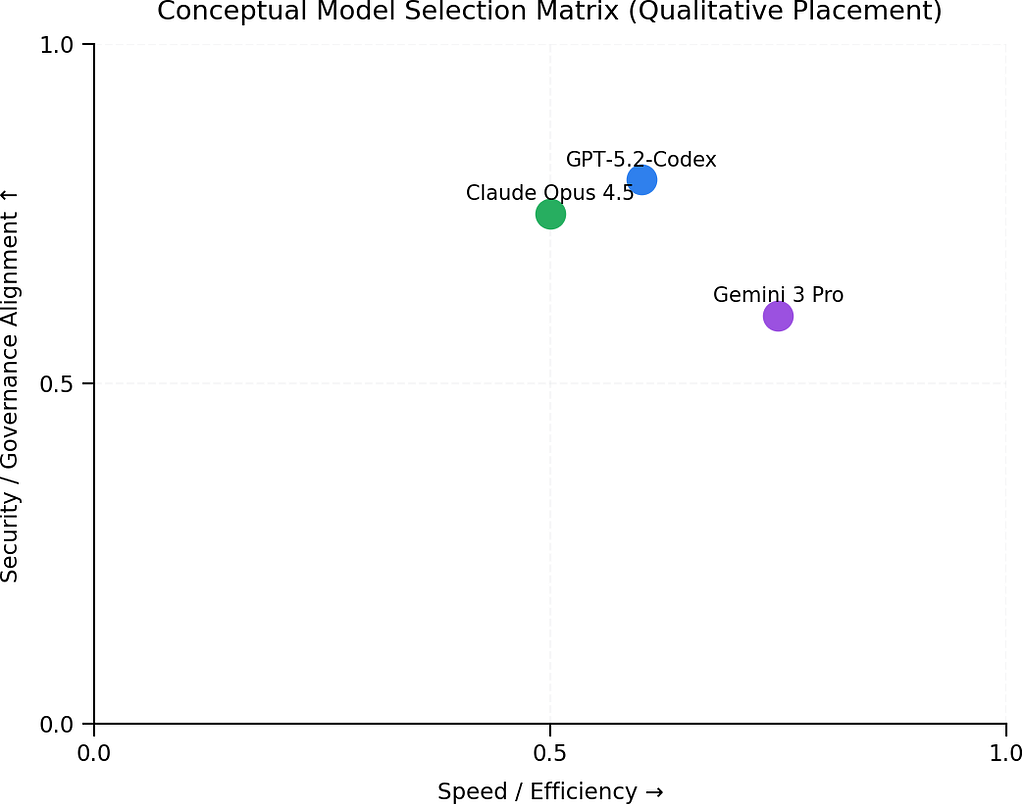
- Use GPT‑5.2 Codex when you need consistent, repo‑scale reasoning with enterprise guardrails (governance, identity, compliance) via Foundry.
- Consider Gemini 3 Pro for UI‑heavy tasks or very large context scenarios in prototyping; validate governance requirements before production.
- Try Claude Opus 4.5 for extended reasoning and code quality explorations — re‑benchmark on your repos and tests to check value vs price.
Practical next steps
- Start in the IDE, scale in Foundry. Pilot GPT‑5.2 Codex in GitHub Copilot/VS Code, then graduate flows to Foundry for orchestration and governance.
- Define risk gates. Mandate AI‑assisted code review + SAST/DAST + SBOM before merge; log rationale for audits.
- Benchmark on your workloads. Re‑run the UI, algorithmic, and integration scenarios that actually matter for your stack — don’t generalize from others’ tests.
- Track cost/perf. Use cached input aggressively and monitor per‑PR token spend; verify model pricing in your Azure environment.
Final Thoughts
We’re entering a new era of software engineering where AI doesn’t just write code — it understands systems, supports governance, manages dependencies, reasons across architectures, and keeps security in focus.
GPT‑5.2‑Codex is the clearest step yet toward enterprise‑grade AI engineers — operating safely, predictably, and at scale.
If you’ve been waiting for the moment when AI becomes a dependable engineering partner rather than a clever autocomplete trick, this might be it.
References
[1] Microsoft Community Hub — Announcing GPT‑5.2‑Codex in Microsoft Foundry: Enterprise‑Grade AI for Secure Software Engineering.
[2] Tensorlake Blog — OpenAI GPT‑5.2 Codex vs. Gemini 3 Pro vs Opus 4.5: Coding comparison.
Choosing Your AI Coding Engine in 2026 was originally published in Towards AI on Medium, where people are continuing the conversation by highlighting and responding to this story.
