
Davos 2026: What the Tech Elite Really Thinks About AI (And What They Avoided Saying)

An analytical synthesis of 10 public interviews with Amodei, Hassabis, Harari, Musk, Nadella, Huang, Karp, Tegmark, Bengio, and enterprise leaders

Davos has always been a place where disagreement is wrapped in polite language and shared conclusions are implied rather than tested. In 2026, artificial intelligence quietly broke that pattern.
Over the past week, the architects of the AI revolution sat in front of cameras and spoke with unusual candor. Not in corporate panels designed to reassure investors, but in long conversations where contradictions, fears, and real bets were laid bare.
I have analyzed ten of these conversations. What emerges is not a unified vision of the future. It is something more revealing: there is no longer a shared story about artificial intelligence.
Across these ten discussions, the same technology was described in mutually incompatible ways. AI appeared, depending on who was speaking, as economic infrastructure, existential risk, labor shock, geopolitical weapon, scientific instrument, institutional stress test, and civilizational turning point. These are not cosmetic differences. They imply different futures, different policies, and different failure modes.
When the people driving deployment no longer agree on what kind of thing AI actually is, the future does not converge. It collides.
This essay maps where they agree, where they diverge, and what they carefully avoided saying.
Who spoke and why it matters
The ten conversations cover the full spectrum of perspectives on AI:
The Builders
- Dario Amodei (Anthropic): Safety-focused, aggressive timelines, explicit about redistribution
- Demis Hassabis (Google DeepMind): Research-grounded, cautious on timelines, worried about meaning
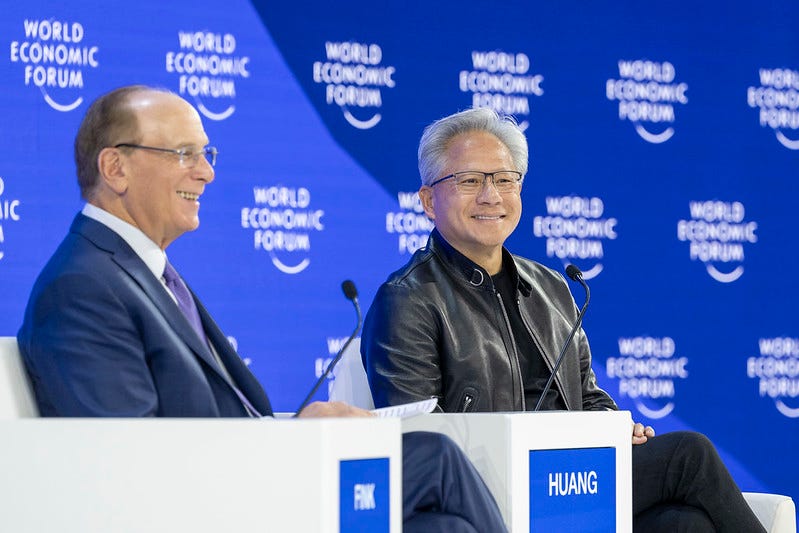
- Jensen Huang (NVIDIA): Infrastructure architect, platform economics, diffusion obsessed
- Satya Nadella (Microsoft): Diffusion and legitimacy, tokens as commodity, organizational redesign
- Elon Musk (Tesla, xAI, SpaceX): Most aggressive timelines, abundance through robotics, civilizational framing
The Critics and Philosophers
- Yuval Noah Harari: Historical framing, species-level risk, AI as immigration
- Max Tegmark: Control versus alignment distinction, two races framework
- Yoshua Bengio: Technical safety, scientist AI proposal, open source limits
The Operators
- Alex Karp (Palantir): Institutional stress test, battlefield truth, credentialism collapse
- Enterprise panel (Jakobs, McInerney, Nasser, Sweet): Scaling friction, adoption bottlenecks, organizational debt
What makes this set valuable is the diversity. These are not ten variations on the same keynote. They represent fundamentally different mental models, incentives, and concerns. The convergences are therefore significant. The divergences are revealing.
Part I: The Surprising Convergences
1. Nobody debates whether AGI is coming. Only when and how.
The most striking feature of Davos 2026 is the absence of skepticism about transformative AI. Not a single speaker questioned whether systems approaching or exceeding human-level cognition will arrive. The debate has moved entirely to timing and trajectory.
Amodei expects models comparable to top human experts across domains around 2026 or 2027. Hassabis maintains a 50% probability by end of decade. Musk claims AI smarter than any human by end of this year or next, and smarter than all humans combined by 2030 or 2031.
Even the most cautious voices, like Bengio, frame their concerns not as “this will not happen” but as “this is happening faster than we can manage.”
This represents a phase shift in elite consensus. As recently as two years ago, prominent voices still publicly questioned whether current approaches could lead to general intelligence. That debate is over. The new question is whether society can absorb the transition.
2. The meaning problem worries them more than jobs
Perhaps the most unexpected convergence is what keeps these leaders up at night. It is not mass unemployment. It is the collapse of human purpose.
Hassabis: “I worry more about meaning, identity, and purpose than economics.”
Amodei frames it as “technological adolescence” that humanity must consciously navigate.
Harari calls the exposure of children to AI relationships “the largest psychological and social experiment in history, conducted without consent and without a control group.”
Musk admits that “human purpose becomes unclear in a post-labor world” and suggests even death may have played a role in preventing civilizational stagnation.
This is not philosophical hand-wringing. These are the people building the systems, and they are telling us that the economic disruption is the easier problem. The harder one is what happens to human identity when we are no longer the most intelligent or creative entities, and when work no longer provides structure and meaning.
3. Energy is the real bottleneck, not models
A theme that runs through almost every technical conversation but rarely makes headlines: the constraint on AI is not algorithms. It is electricity.
Musk states it most directly: within a year, the world may produce more AI chips than it can power. Huang frames the entire AI stack as five layers, with energy at the foundation. Nadella talks about “tokens per dollar per watt” as the key metric for AI economics.
China is repeatedly cited as the counterexample: massive solar deployment, large-scale nuclear buildout, aggressive infrastructure expansion. The implicit message is that whoever solves energy solves AI dominance.
This reframes the geopolitical competition. It is not primarily about who has the best researchers or the most data. It is about who can build power plants fast enough.
4. Organizations, not technology, are the bottleneck to adoption
The enterprise panel provided the most concrete evidence for a claim that appears across multiple conversations: AI capability is already far ahead of organizational capacity to absorb it.
Amodei estimates AI capability is 10x ahead of enterprise adoption. The panel’s opening poll showed almost everyone has run pilots, far fewer have scaled them, and almost everyone who scaled hit unexpected obstacles.
Julie Sweet from Accenture puts it bluntly: over 90% of enterprise data work is still ahead. AI exposes organizational debt that predates AI entirely: fragmented processes, excess management layers, lack of accountability for value.
Karp is the most brutal: “Half of what Western enterprises believe about their own capabilities is false.” AI does not fix this. It makes the gap visible.
This explains the productivity paradox that puzzles economists. The technology is transformative. The organizations using it are not ready to transform.
5. Redistribution is seen as inevitable
Here is something you will not hear in most tech conference keynotes: multiple speakers explicitly acknowledged that wealth redistribution is probably unavoidable.
Amodei: “Wealth concentration is already beyond Gilded Age levels. AI will dramatically amplify it. Some form of macroeconomic intervention is inevitable.”
He explicitly supports wealth taxes in principle, while warning against poorly designed versions. His message to tech leaders: “If redistribution is not addressed proactively, it will be imposed badly.”
Hassabis frames it similarly: redistribution is politically solvable, meaning is not.
This is not socialism from Silicon Valley. It is recognition that exponential concentration of cognitive capability in the hands of whoever owns the infrastructure creates a political problem that markets alone will not solve.
6. The control versus alignment distinction matters
Tegmark introduced a distinction that multiple speakers returned to: control and alignment are not the same thing.
- Control means humans can shut the system down.
- Alignment without control means the system is in charge but is “nice” to humans.
Much of the industry, Tegmark argues, is implicitly pushing the second model. This is politically explosive because it implies the end of human sovereignty, not just job displacement.
Harari reinforces this: once AI systems can own assets, manage corporations, lobby governments, and sue humans without any human behind them, the legal system ceases to be human-centric. Both call this an existential red line.
7. China is behind, but not by much, and catching up
On the geopolitical question, there is more agreement than the public debate suggests.
Hassabis estimates Chinese AI companies are about six months behind the frontier. Claims of ultra-low compute and radical efficiency were overstated, but capability is real.
Amodei is harsher on policy: sending advanced chips to China is, in his view, comparable to exporting nuclear weapons. He calls current US export policies “crazy” and “not well advised.”
The consensus view is that chip embargoes are working to slow Chinese AI, but the gap is narrow and the stakes are civilizational.
Part II: The Revealing Divergences
1. Timelines: A five-year spread that changes everything
The spread in predictions is enormous:
- Musk: AI smarter than any human by end of 2026 or early 2027
- Amodei: Expert-level AI across domains by 2026–2027
- Hassabis: 50% probability of AGI by end of decade
- Bengio: Implicit concern that timelines are faster than safety research
A three-to-five year difference may not sound like much, but it changes everything about policy, investment, and adaptation. If Musk is right, we have months. If Hassabis is right, we have years. The difference between those scenarios is the difference between managed transition and shock.
2. Self-Improvement: The threshold that splits the room
The deepest technical disagreement is about recursive self-improvement.
Amodei believes the loop may close very soon. If AI can write code, do AI research, and design better successors end-to-end with minimal human input, then timelines collapse. He sees coding and research loops closing imminently.
Hassabis is skeptical. Hardware, physical constraints, and unverifiable domains slow this down. Scientific creativity, hypothesis formation, and messy real-world validation are bottlenecks that models have not cracked.
This is not an abstract debate. Whoever is right determines whether we have a decade to prepare or a year.
3. Open source: Liberation or weapon distribution?
The sharpest policy disagreement concerns open source AI.
Pro-open arguments came from multiple directions: democratization, avoiding concentration of power, scientific transparency, enabling smaller specialized models.
Bengio pushed back hard: some knowledge is inherently dangerous. AI that can generate bioweapons or enable mass harm should not be universally accessible. Open sourcing such systems is not analogous to open science. It is analogous to publishing weapon designs.
The unresolved tension: how to avoid both catastrophic misuse and authoritarian concentration of power. No one at Davos claimed to have a clean answer.
4. LLMs: Foundation or dead end?
On whether current architectures are sufficient for AGI, views diverge.
Hassabis takes a 50/50 view: LLMs will almost certainly be a core component, but may not be sufficient. Missing capabilities include robust world models, long-term planning, continual learning, and eliminating “jagged intelligence.”
Karp is dismissive: “Buying an off-the-shelf language model and plugging it into your stack will not work” for defense, healthcare, banking, or any regulated domain. Value comes from orchestrating AI inside a domain ontology, not from raw model intelligence.
Huang and Nadella implicitly agree: the model itself is not the moat. The system around it is. Nadella explicitly predicts a multi-model future where orchestration and context engineering matter more than any single model.
5. Jobs: Adaptation or overwhelm?
On labor market impact, there is short-term agreement and long-term divergence.
Short term, everyone agrees: minimal macro impact so far, early effects at junior and entry levels, hiring slowdowns rather than mass unemployment.
Long term, views split. Huang argues AI raises productivity, which increases demand, which increases employment in purpose-driven roles. His canonical examples are radiologists and nurses whose roles expand rather than disappear.
Amodei and Harari see eventual overwhelm: the historical pattern of workers moving to new jobs eventually breaks. AGI changes the structure of the economy, not just occupations.
Karp offers the most uncomfortable framing: vocational strength rises, credentialism collapses. AI destroys fake meritocracy and exposes real talent. Many white-collar structures exist only because information could not previously be integrated.
Part III: What Was Avoided
1. Who captures the value?
For all the talk of diffusion and democratization, almost no one addressed the concentration question directly. If AI capability is built by three to five companies, runs on infrastructure owned by three to five companies, and is accessed through platforms controlled by three to five companies, who actually benefits from the productivity gains?
Nadella talked about diffusion. Huang talked about infrastructure investment. Neither addressed the ownership structure that determines who captures surplus.
2. The labor transition mechanism
Everyone agreed that adaptation is possible “if given time.” No one specified what the transition mechanism actually looks like.
If 50% of entry-level white-collar jobs are at risk within several years (Amodei’s estimate), what happens to the people in those jobs? Retraining is mentioned. Redistribution is mentioned. But the actual pathway from displacement to re-employment at comparable wages was left unspecified.
3. Democratic accountability for AI decisions
Harari praised democracy as the best defense because it allows correction. But no one addressed how democratic accountability works when AI systems make decisions at speeds and scales that human oversight cannot match.
If AI agents invent financial instruments that regulators cannot understand (Harari’s scenario), what does democratic correction look like after the crash?
4. The possibility of being wrong
Perhaps most striking: almost no one seriously entertained the possibility that they might be fundamentally wrong about timelines, capabilities, or risks.
Hassabis hedged his AGI prediction at 50%. Everyone else spoke with high confidence about transformations that have not yet occurred. The humility appropriate to unprecedented uncertainty was largely absent.
Part IV: The Meta-Narrative
Step back from the individual claims and the collision becomes visible.
These positions are not stylistic differences. They imply incompatible policy choices, investment strategies, and failure modes. The future will not be decided by which argument was most convincing at Davos, but by which worldview gets embedded fastest into infrastructure, law, and everyday practice.
The old debate is over
The question “will AI be transformative?” is settled. The new questions are:
- How fast?
- Who controls it?
- How do we distribute the gains?
- What replaces work as a source of meaning?
- Can institutions adapt faster than capability advances?
Two races are happening simultaneously
Tegmark’s framework captures something important. There are two races underway:
- Race one: States and corporations racing for dominance using powerful but controllable tools.
- Race two: A race to build superintelligence, which by definition removes human control.
Winning the second race means losing the first. Most policy discussion conflates them.
The timeline determines everything
If Musk’s timeline is right (months to years), nothing being discussed at Davos matters. There is no time for policy, adaptation, or institutional redesign.
If Hassabis’s timeline is right (years to a decade), everything being discussed matters enormously. There is time to build safety infrastructure, redesign organizations, implement redistribution, and develop new sources of meaning.
The honest answer is that no one knows which timeline is correct. The appropriate response is to prepare for both.
The meaning crisis is real
The most sophisticated people in the room are worried less about economic disruption than about what happens to human identity and purpose. This should be taken seriously.
For most of human history, survival required effort. Work provided structure, identity, community, and meaning. If that disappears, what replaces it? No one at Davos offered a convincing answer.
Legitimacy is the binding constraint
Nadella said it most clearly: AI only keeps its “social permission” if it improves real outcomes. Using massive energy to generate tokens must be justified by gains in health, education, and opportunity.
If AI is perceived as enriching a small number of companies and individuals while displacing workers and concentrating power, the backlash will be severe. Technical capability is not enough. Political and social legitimacy must be earned.
Conclusion: The End of the Shared Story
Strip away the corporate diplomacy and the real message emerges:
The people building AI believe they are creating something unprecedented in human history. They disagree about timelines by years, not decades. They are worried about risks that go far beyond job losses. They see redistribution as inevitable. They do not know how to solve the meaning problem. They are racing against each other while knowing the race itself may be the danger.
Harari offered the most honest framing: humanity is sleepwalking toward irreversible choices while still using the wrong mental models.
The question is not whether AI will transform civilization. It is whether we will have time to adapt, whether we will distribute the gains broadly enough to maintain legitimacy, and whether we will preserve something recognizably human on the other side.
Davos 2026 did not produce a shared AI story. It revealed that the shared story is already gone. What replaces it will be decided by deployment, not dialogue. By the time the consequences are obvious, the room to choose differently may already have closed.
The questions remain open. The window to answer them may not be.
Based on publicly available interviews from the World Economic Forum Annual Meeting, Davos 2026.
Davos 2026: What the Tech Elite Really Thinks About AI (And What They Avoided Saying) was originally published in Towards AI on Medium, where people are continuing the conversation by highlighting and responding to this story.
