
How to Conduct a Literature Review in AI & Machine Learning

A Technical Guide to Surveying, Synthesizing, and Positioning Your AI Research

What’s So Lit About a Lit Review?
A literature review is the backbone of any meaningful research project. It helps you understand what has been done prior in your area of research, where the gaps lie, and why your work and contributions matters. In AI and machine learning it is especially important to know how to navigate the rapidly evolving research landscape. New papers appear daily on the internet, conferences introduce new benchmarks quarterly, and what was considered state-of-the-art (SOTA) last year may now be a baseline.
Conducting a literature review is not about reading everything, but first about — identifying the most influential work, understanding the trajectory of the field, and positioning your research in a credible and scholarly context. Apart from the abstract value a literature review adds to your research or discovery, it is often a required section in publishing research at high caliber conferences and doctoral programs.
This article breaks down essential components of an effective AI/ML literature review. From identifying seminal versus incremental papers, searching using disciplined strategies, building a structured literature matrix, to synthesizing(rather than simply summarizing what you have read).
A literature review helps you understand what has been done prior in your area of research, where the gaps lie, and why your work and contributions matters.
Seminal Papers vs. Incremental Work
One of the first challenges candidates face is determining which papers represent foundational contributions and which are incremental extensions. Seminal papers are those that introduce new paradigms, architectures, or concepts that shape the direction of the field. These papers establish vocabulary, methodology, and benchmarks that subsequent research builds upon. For example, “Attention Is All You Need” fundamentally reshaped NLP, and “Generative Adversarial Networks” created an entirely new research area. Seminal papers typically exhibit strong citations, appear in top-tier conferences (NeurIPS, ICML, ICLR, ACL, CVPR), and introduce ideas that later works repeatedly reference or refine.
Seminal papers are those that introduce new paradigms, architectures, or concepts that shape the direction of the field
Incremental papers, by contrast, make smaller improvements — higher accuracy on a benchmark, slight architectural modifications, or niche applications. Incremental work is not inferior; doctoral students often build on incremental ideas, and many “small” papers later become influential when combined with other insights. The key is not to disregard incremental papers but to recognize their role in the broader research ecosystem.
Your literature review should highlight seminal papers to establish the foundation of your research domain, while incremental papers help define the current frontier and expose unresolved issues. Understanding this distinction would help avoid drowning in irrelevant papers while giving appropriate weight to the work that truly shaped your field of interest.
The key is not to disregard incremental papers but to recognize their role in the broader research ecosystem.
Finding the Right Papers
Efficient literature searching begins with clear keywords derived from your domain, research problem, and potential methods. For an AI/ML project, keywords usually fall into three categories: problem keywords (e.g. “dataset shift,” “long-context modeling”), method keywords (e.g., “variational inference,” “transformer pruning”), and application keywords (e.g. “clinical NLP,” “network intrusion detection”). Using combinations of these terms can help you quickly locate relevant papers rather than sifting through thousands.
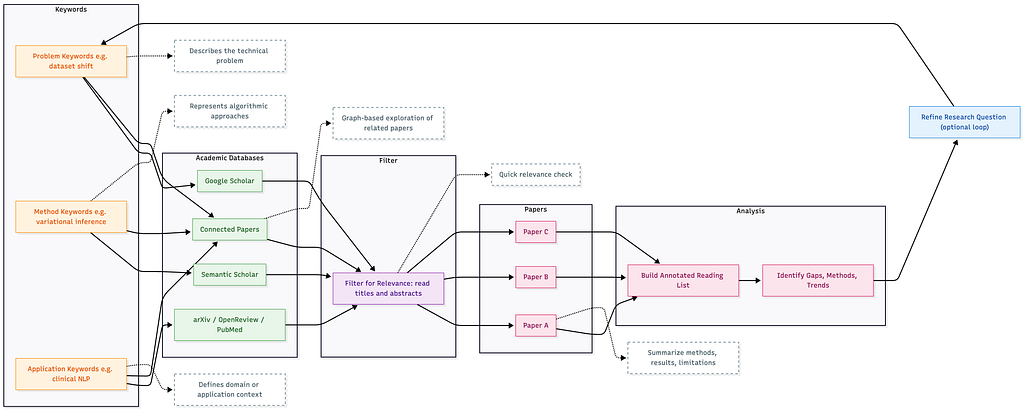
For structured search, academic databases such as ACM Digital Library and IEEE Xplore are especially useful because they provide peer-reviewed papers with precise metadata. This is important as some doctoral program mandate that you cite a certain number of peer reviewed papers in your literature review. Searching here helps you filter by conference, year, research area, and citation impact, which helps identify established work. You can also use Google Scholar alerts to track new papers on specific topics through the course of your research program. In fast-evolving fields, arXiv is often the first place groundbreaking papers appear. However, because arXiv is not peer-reviewed, you must evaluate papers carefully — checking whether they were later accepted to a conference or heavily referenced by reputable authors.
In fast-evolving fields, arXiv is often the first place groundbreaking papers appear. However, because arXiv is not peer-reviewed, you must evaluate papers carefully
Effective literature searching is iterative. You start broad and narrow down as you discover patterns, terminologies, and recurring authors. A useful strategy is “backward and forward citation tracing” i.e looking at which papers a key paper cites (backward) and which papers cite it afterward (forward). This helps you uncover both origins and modern extensions of important ideas. Another useful tool to explore this particular strategy is Connected Papers — a graph tool for exploring related research papers. You can think of it as a database/graph-based exploration tool that feeds into the relevance filtering step in your process.
A useful tool to explore the backward and forward citation tracing strategy is Connected Papers — a graph tool for exploring related research papers.
Building a Literature Review Matrix
Now that you are finding papers, you will need a way to keep track of important ones relevant to your research. A literature review matrix is an organized way to keep track of the papers you read, the methods they use, their limitations, and how they relate to your own research. Instead of collecting scattered notes, the matrix allows you to compare papers across consistent dimensions. A typical matrix includes columns for authors, year, problem addressed, methodology, datasets used, evaluation metrics, strengths, limitations, and relevance to your project.
A literature review matrix is an organized way to keep track of the papers you read, the methods they use, their limitations, and how they relate to your own research
The power of the matrix lies in its ability to reveal patterns. When you line up papers side by side, you start to notice what datasets are overused, which evaluation metrics dominate the field, and where the literature repeatedly falls short. These patterns often expose research gaps that are not obvious when reading papers individually. For example, you may notice that many papers evaluate on synthetic benchmarks but not real-world datasets, or that certain fairness metrics are used inconsistently across models. These insights become the seeds of strong research questions and hypotheses. The matrix also prevents redundancy — you avoid revisiting papers unnecessarily because you have a clear record of what each paper offers.

Synthesizing (Not Summarizing) Prior Work
One of the biggest mistakes candidates make is treating a literature review as a collection of summaries. Summarizing is listing: “Paper A did this, Paper B did that.” This approach is shallow and does not demonstrate understanding. Synthesis, on the other hand, is the process of identifying relationships, patterns, tensions, contradictions, and trajectories across studies. It is analytical rather than descriptive. Instead of writing isolated paragraphs, you integrate insights: “Methods relying on KL divergence tend to fail under distribution shift, whereas MAUVE-based methods show greater alignment with human judgments in generative evaluations.”
Summarizing says “Paper A did this, Paper B did that.” This approach is shallow and does not demonstrate understanding.
Synthesis requires you to compare methods, contrast assumptions, critique limitations, and cluster papers into conceptual categories. You might group papers by methodology (e.g. transformer-based vs. linear models), by evaluation approach (e.g. intrinsic vs. extrinsic metrics), or by problem framing (e.g. supervised vs. self-supervised approaches to anomaly detection). Doing so helps you build an argument for why your research is needed. Your literature review becomes a coherent story about the evolution of your research area, culminating in the gap you intend to fill.
Synthesis requires you to compare methods, contrast assumptions, critique limitations, and cluster papers into conceptual categories.
When done well, synthesis shows reviewers that you understand the field at a structural level, not just as a list of disconnected papers. It also provides the intellectual foundation for a strong methodology section, because you have already articulated the limitations of what exists and justified why your chosen approach is appropriate.
When done well, synthesis shows reviewers that you understand the field at a structural level, not just as a list of disconnected papers.
A Practical Blueprint for an AI/ML Literature Review Chapter
We already established that a strong literature review is not a list of papers. It is a structured argument that moves from what is known to what is missing, and ends by motivating your thesis and hypotheses. Below is a practical, end-to-end blueprint showing the core elements on display, why each exists, and how they connect in practice.
Part 1 — Problem Framing (Why This Area Matters)
Purpose: Establish the research area, its importance, and why it deserves to be studied now.
What you do:
- Define the problem space (not your solution yet)
- Explain why it is relevant (technical, societal, or scientific)
- Narrow the domain early
Example (Research area — AI text detection):
Large language models have significantly improved text fluency, making it increasingly difficult to distinguish human-written content from AI-generated text. This challenge has implications for education, journalism, and online trust.
Key insight: This section answers: Why should a reader care before knowing any methods?
Part 2 — Canonical Approaches (What the Field Already Does)
Purpose : Show that you understand the standard solutions and dominant paradigms in the field.
What you do:
- Group prior work by approach, not by paper
- Describe how methods work at a high level
- Avoid critique (for now)
Example:
Prior work on AI-generated text detection primarily falls into three categories: perplexity-based methods, classifier-based approaches using fine-tuned language models, and watermarking techniques embedded at generation time.
Key insight: You are mapping the intellectual terrain, not competing yet.
Part 3 — Empirical Findings & Benchmarks (What We Know Works)
Purpose: Summarize what has been empirically demonstrated and under what conditions.
What you do:
- Highlight reported performance
- Reference common datasets and benchmarks
- Note evaluation conventions
Example:
Classifier-based detectors often report high accuracy on in-distribution datasets such as GPT-2 output but experience significant performance degradation under paraphrasing or domain shift.
Key insight: This anchors the review in evidence, not opinions.
Part 4 — Limitations & Failure Modes (Where Existing Work Breaks)
Purpose: Surface weaknesses without yet proposing your solution.
What you do:
- Identify failure modes reported in the literature
- Note assumptions that do not hold in practice
- Highlight inconsistencies across studies
Example:
Several studies note that perplexity-based detectors assume access to the same or similar language models used for generation, an assumption that breaks down as model access becomes restricted.
Key insight : This section creates intellectual tension — the reader should feel something is missing or unresolved.
Part 5 — Research Gap (What Is Missing or Underspecified)
Purpose: Translate limitations into a precise, actionable gap.
What you do:
- State what has not been adequately tested, explained, or resolved
- Be specific (conditions, datasets, settings)
- Avoid proposing your method yet
Example:
Despite growing evidence that paraphrasing degrades detector performance, few studies systematically evaluate robustness across controlled paraphrase transformations using curvature-based detection signals.
Key insight: This is the hinge point of the chapter. Everything before leads here.
Part 6 — Positioning Your Thesis (How Your Work Fits)
Purpose: Explain where your work sits relative to prior research.
What you do:
- Clarify the type of contribution (empirical, algorithmic, methodological)
- State what you will and will not claim
- Connect directly to the gap
Example:
This thesis focuses on an empirical and algorithmic contribution, evaluating curvature-based detection methods under paraphrasing attacks. It does not propose new language model architectures or theoretical generalization bounds.
Key insight:
This protects you from over claiming and reviewer misinterpretation.
Part 7 — Transition to Hypotheses & Methods (What Comes Next)
Purpose: Bridge the literature review to the rest of the thesis.
What you do:
- Signal that hypotheses follow naturally from the gap
- Preview evaluation logic
- Avoid details (those come later)
Example:
Based on these gaps, the following chapter formulates hypotheses comparing curvature-based and perplexity-based detectors under controlled paraphrase transformations.
Key insight:
A good literature review ends by pointing forward, not by summarizing backward.
How the Pieces Flow Together
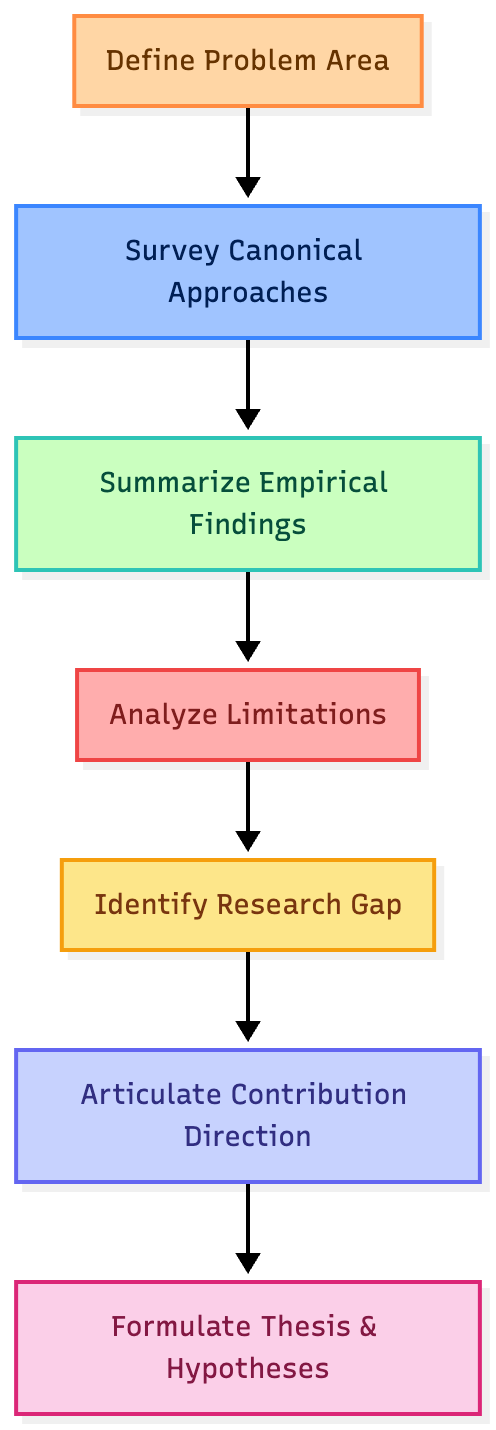
You can describe the literature review chapter as answering five sequential questions:
- What problem area are we in?
- How has it been approached historically?
- What do experiments show?
- Where do these approaches fail or fall short?
- What precise gap remains — and why does it matter?
Only after these are answered does your thesis statement and hypotheses become inevitable, rather than arbitrary.
Mistakes & Pitfalls to Look out for
- Listing papers instead of synthesizing themes
- Jumping to your method too early
- Critiquing without evidence
- Failing to articulate a concrete gap
- Treating the review as background instead of argument
A literature review is a thinking exercise
Final Thoughts
A well-crafted literature review is not merely a requirement — it is a critical thinking exercise that sharpens your understanding of the field and shapes the direction of your research. By distinguishing seminal from incremental works, applying disciplined search strategies, structuring your findings in a literature matrix, and synthesizing insights rather than summarizing them, you build a deep and meaningful understanding of your domain. More importantly, you position yourself to identify research gaps that are both impactful and feasible. Mastering the literature review process gives you the confidence to contribute impactful research, articulate your research contribution clearly and to design a methodology that is grounded, coherent, and defensible.
Mastering the literature review process gives you the confidence to contribute impactful research, articulate your research contribution clearly and to design a methodology that is grounded, coherent, and defensible.
I write weekly posts explaining AI systems, ML models, and technical ambiguity for builders and researchers. Follow if you want the clarity without the hype.
For more on AI Research 🔬, Check out other posts in this series:
List: AI Research | Curated by Ayo Akinkugbe | Medium
How to Conduct a Literature Review in AI & Machine Learning was originally published in Towards AI on Medium, where people are continuing the conversation by highlighting and responding to this story.
