An Economy Disrupted: How We Can Survive (and Thrive) in the Singularity.

Using Agent-Based Modeling and Cellular Automata to Stress-Test the Future of Work.
It’s difficult to watch the news today without being at least a little concerned about your job being replaced by AI in a few years. After being told that AI will soon be able to perform PhD-level work across various fields, what place does that leave in the job market for us mere mortals? AI is already disrupting entry-level work; Stanford’s Digital Economy Lab reported a 67% decrease in U.S. entry-level tech job postings between 2023 and 2024. What happens if this trend persists and expands to other industries? What are the repercussions if AI becomes both intelligent and independent, potentially displacing large swaths of the workforce?
To satisfy my curiosity, I ran over a hundred simulations in various hypothetical economies, while varying 20 different parameters. I then distilled the results down to four I found insightful. While the complexity of the economy makes predicting the future with certainty nearly impossible, these simulations are simply intended to provide a window into potential outcomes I might not have otherwise considered.
With each simulation I present an initial question on how it addresses a fundamental economic issue. After summarizing the results, I then conclude with a final verdict based on its performance. The four simulations are given below along with the questions I tackle:
- The Gig Economy — Can the influx of UBI from a robot tax, prevent the collapse of an economy with high churn and low commitment to workers?
- The Middle-Income Trap — Does curtailing the transition to automation and focusing on augmentation, build a wealthier, more robust middle class?
- The Inflation Cliff — Can a modest, low-tax safety net expand fast enough to keep up with the rapidly eroding wealth of UBI recipients during high inflation?
- The Post-Work Singularity (Utopia) — Can a hyper-taxed machine workforce support an economy where the majority of citizens have chosen not to work?
The Mechanics
Using Agent-Based Modeling (MESA library), I simulate a closed economy populated by 350 independent agents across 900 economically viable squares. Each square serves as an opportunity to generate and collect wealth. Agents behave like people: they work, earn wages, cover their cost of living, and have the potential to upgrade their skills.
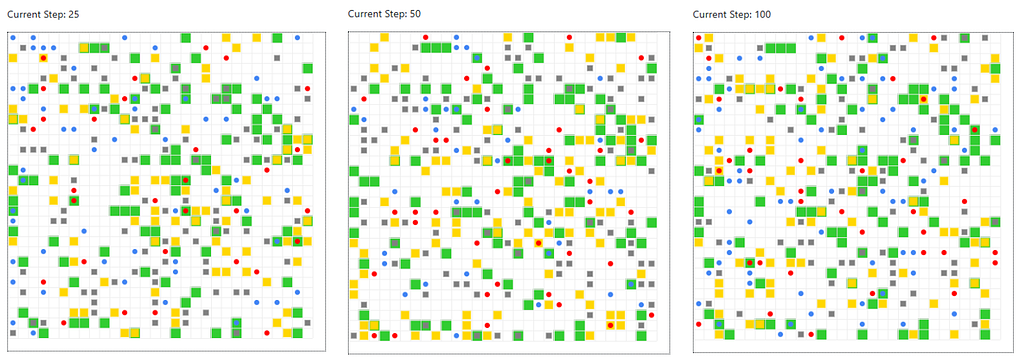
In addition, agents follow Cellular Automata mechanics — meaning they respond to their neighbors. An agent surrounded by high-tech peers may learn and upgrade; conversely, an agent surrounded by automation faces the risk of displacement.
The economy consists of five distinct agent types:
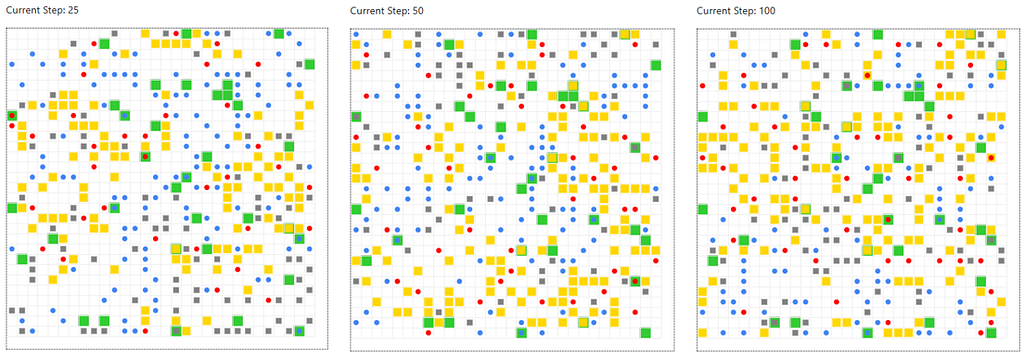
- Humans (Grey square): Traditional workers earning standard wages.
- Augmented (Blue circle): High-tech human workers augmented with AI to increase production and wages.
- Robots (Red circle): Fully automated AI that earns capital equal to the cannibalized wages of displaced agents.
- Displaced (Yellow square): Human workers who lost their jobs and temporarily rely on a Universal Basic Income (UBI) as a safety net.
- Opt-Outs (Green square): Permanent human agents who solely rely on UBI.
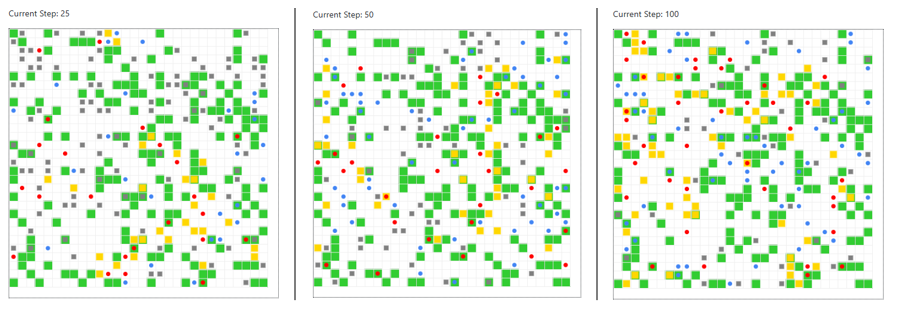
Time progresses in the simulation with each step. There is no time equivalent for what a step represents in the real world — one step could be the time equivalent of a month or a financial quarter. However, with each step there are four basic mechanics that take place: 1) Payment and Distribution 2) Job Market Shuffling 3) Adoption and Displacement and 4) Auditing and Removal
Payment and Distribution — Human workers collect a wage equal to their productivity level, and their cost of living expenses are subtracted from their accumulated wealth. Robots generate capital that is taxed by the government; this pool of taxed profits can then be redistributed to human agents in the form of UBI.
Job Market Shuffling —Humans and Robots randomly migrate to adjacent empty tiles. This simulates real-world job friction — laborers moving to find open jobs and capital moving to find new markets. (Note: UBI recipients (Opt-Outs) remain stationary, effectively exiting the job market.)
Adoption and Displacement — Agents react to their neighbors and market conditions in three specific ways:
- Pressure: Humans surrounded by high-tech augmented workers face a choice: they either upgrade their skills to match their peers, or they get displaced.
- Automation: Both humans and augmented workers risk displacement when encountering robots. The productivity of the displaced agent is divided among the “hostile” robots.
- Clustering: When augmented workers cluster across adjacent cells, they can combine to form a robot. This resulting robot possesses the combined productivity of all the merged agents.
- Singularity Events: Robots have the ability to partake in singularity events when adjacent to each other. The result is a merging of two adjacent robots into one, which possesses their combined productivity.
Auditing and Removal — At the end of each step, every agent’s wealth is audited. Any agent with a negative balance is removed from the board. This is equivalent to an individual reaching a point of destitution and falling out of the economy entirely.
(For a complete breakdown of the rules governing the simulation check out the GitHub Repository)
Metrics and Visualizations
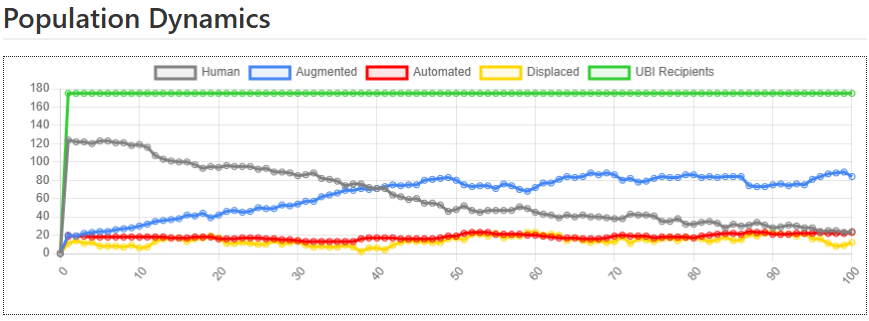
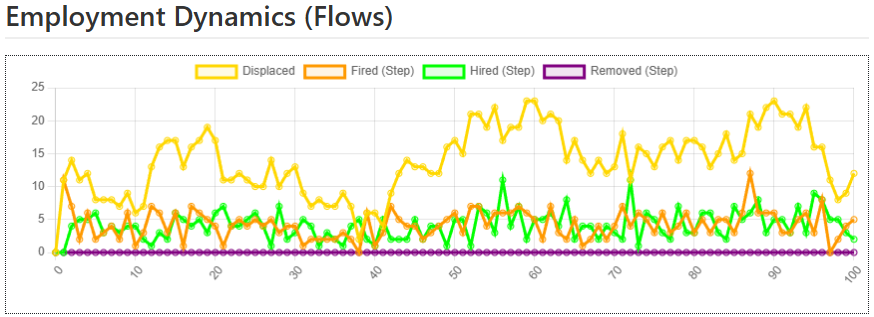
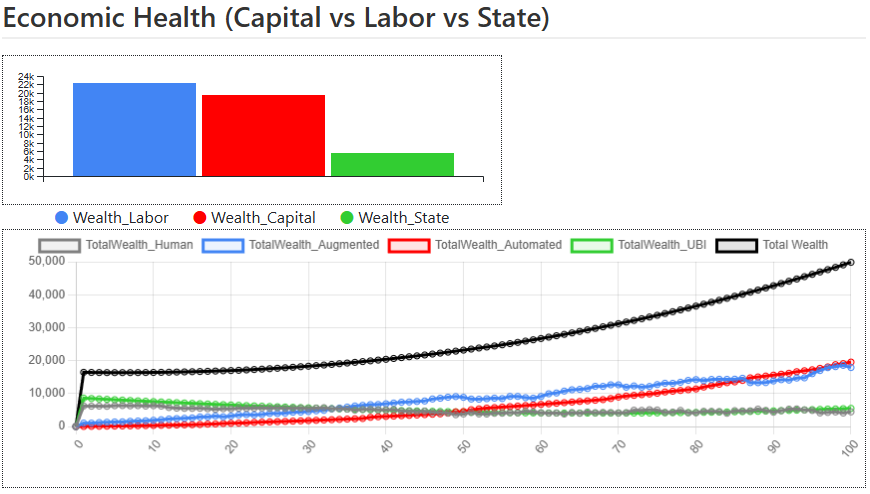
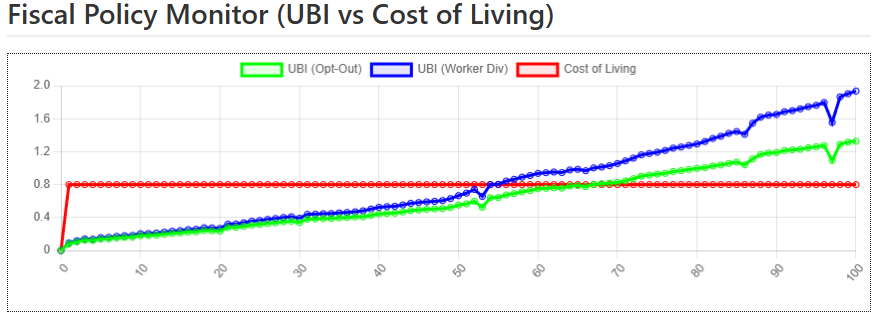
To assist in interpreting the results for the economic experiments, several tables and graphs are used to gather relevant data.
Simulation Results
The Gig Economy
Description: This economy is characterized by it’s short term employment and high churn within the job market. Labor is viewed as a fluid resource that can be accessed on demand. It doesn’t offer the security of more permanent positions but instead offers a level of flexibility since jobs are easy to come by. Automation is taxed to provide a safety net for those out of work.
Question: Can the influx of UBI from a robot tax, prevent the collapse of an economy with high churn and low commitment to workers?
Key Parameters:

Summary of Findings:
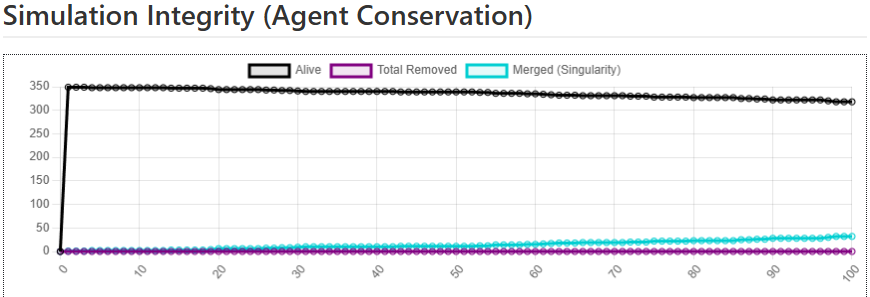
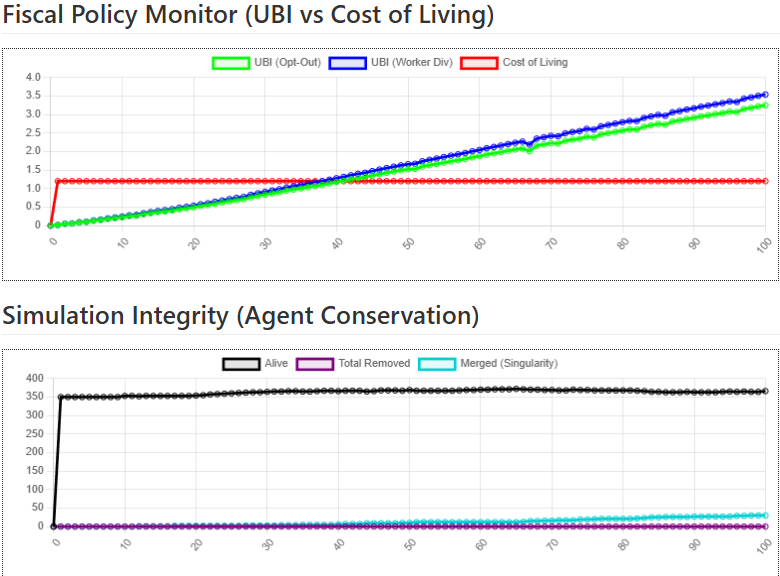
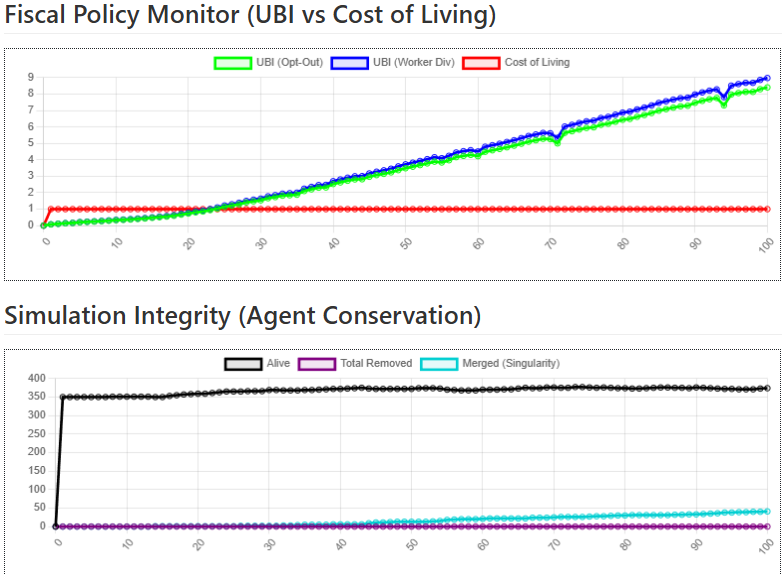
- The Safety Net Success: Despite a relatively low robot tax (10%), by turn 100 the UBI payout was approximately 3.5x the cost of living (see Fiscal Policy Monitor). This shows that even a modest tax can stabilize a volatile workforce. The total agents removed from the economy remained at zero (see Simulation Integrity), indicating that despite having an unsettled workforce, it was not impoverished.
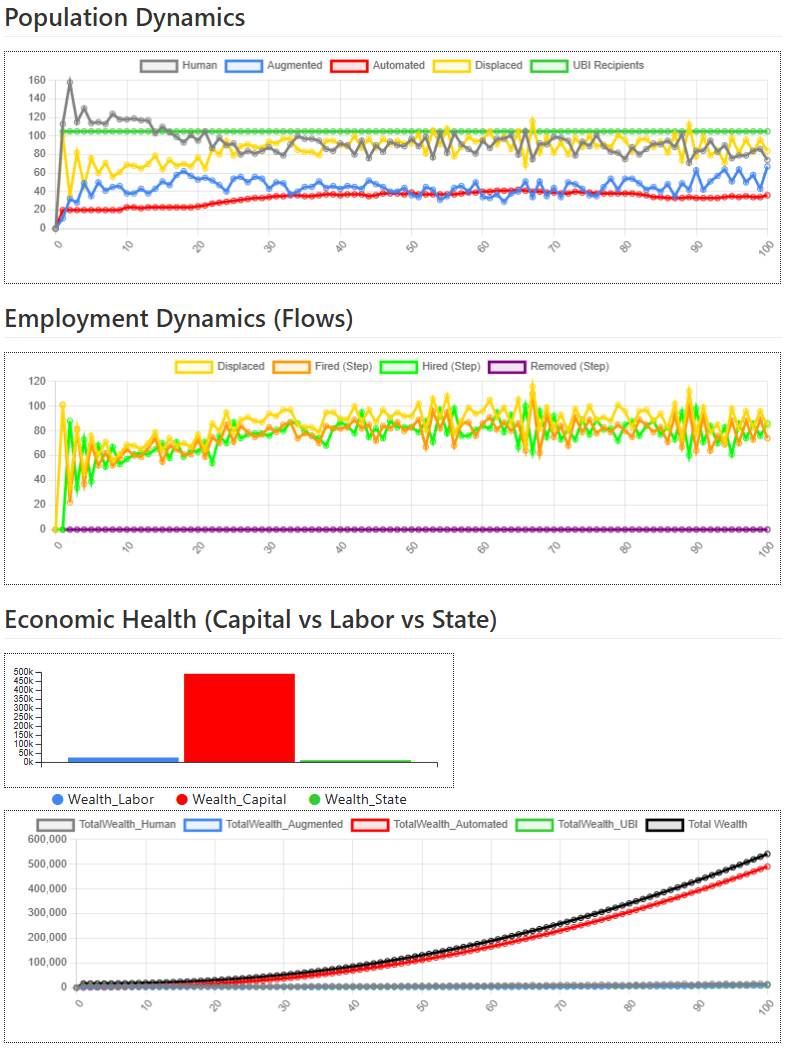
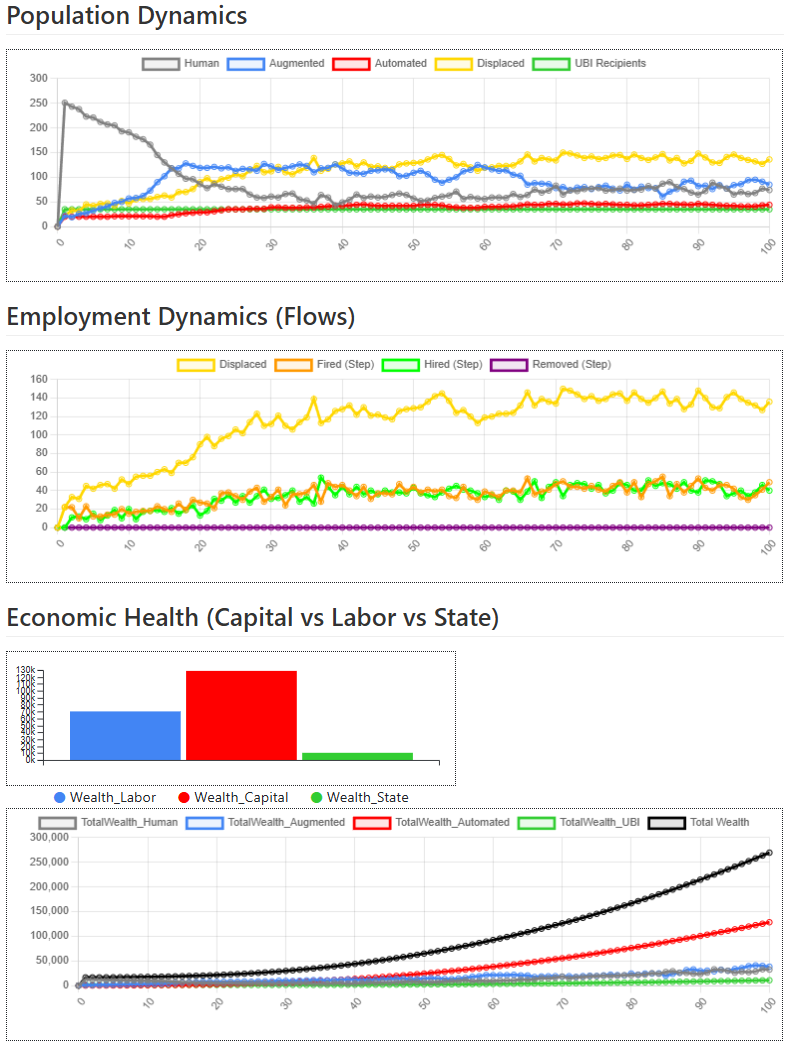
- The Churn is Real: The oscillation between the “Displaced” (yellow) and “Hired” (green) workers was chaotic, indicating a job market in constant flux (see Employment Dynamics). The support from UBI allowed displaced workers to survive long enough in the economy to find their next gig.
- Wealth Bifurcation: Despite UBI preventing poverty, it did not prevent extreme inequality. The Capital class holds the vast majority of the wealth (see Economic Health) but only represents a small fraction of the agents (see Population Dynamics).
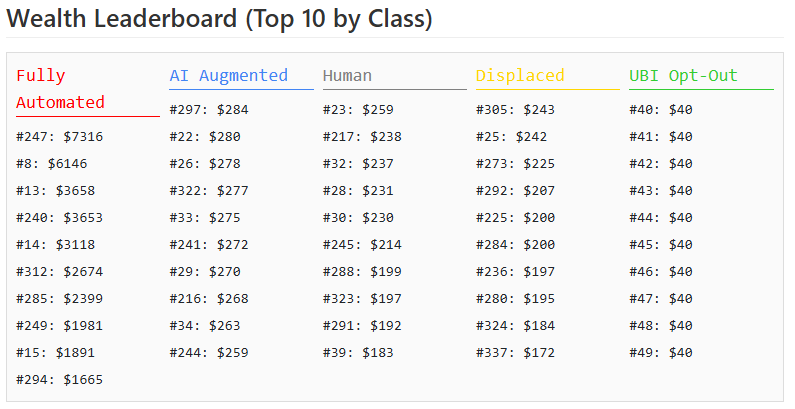
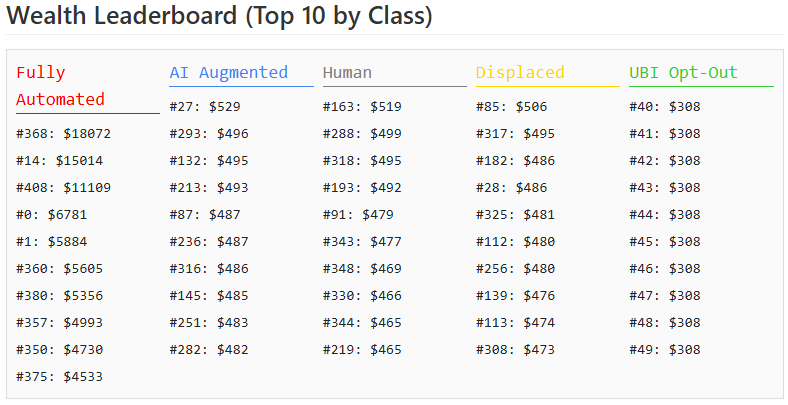
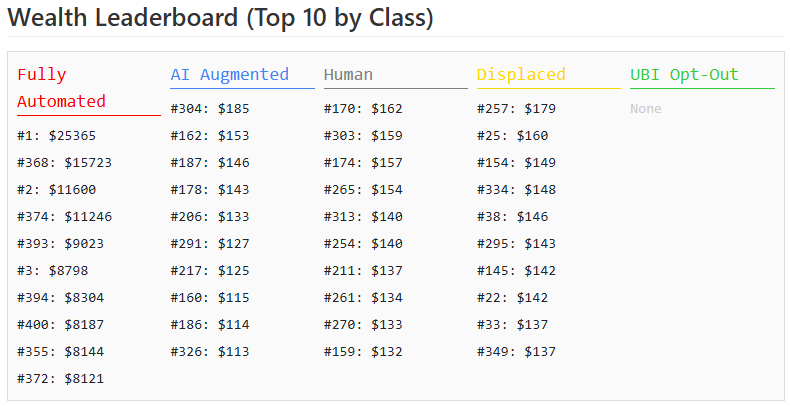
- Income Parity: When comparing the wealth of the top 10 agents in the workforce (see Wealth Leaderboard), there appears to be no economic advantage to working or upskilling. The real income for everyone comes from UBI.
Verdict: A robot tax can prevent the collapse of a high-churn gig economy, but it creates a society of “Stabilized Precarity”.

The Middle-Income Trap
Description: In this scenario, automation is heavily regulated and labor is protected. UBI is funded by the little automation that exists and is distributed to both the worker and opt-out classes. Although augmentation has become ubiquitous in the workplace, the productivity increases have been minor.
Question: Does curtailing the transition to automation and focusing on augmentation, build a wealthier, more robust middle class?
Key Parameters:

Summary of Findings:
- Displacement by Saturation, Not Automation: The simulation reveals that simply “upgrading the worker” fails to prevent mass unemployment. Despite suppressing automation, a significant portion of the economy remained displaced (see Employment Dynamics). The economy placed a big bet on augmentation, but the augmented workers didn’t create new wealth — they instead pushed out their peers, battling for the stagnant pool of jobs (“Red Queen Effect”).
- Wage Irrelevance: The simulation revealed a broken incentive structure. Once the UBI was factored in, the income gap between a highly skilled ‘Augmented’ worker and a ‘‘Displaced’ one became negligible. This compression effectively destroyed the market signal for labor, making the effort of upskilling, or even working at all, economically irrelevant.
- Fiscal Ceiling: Limiting automation created a hard ceiling on the taxed wealth available for the UBI pool. In an economy where wage advantages were already compressed, this resulted in depressed incomes for everyone reliant on robot taxes.
Verdict: Curtailing automation created a fragile economy with massive unemployment. The middle class was not robust, but rather frozen — trapped in a system where upskilling provided no economic mobility or advantages.
The Inflation Cliff (Stagflation)
Description: This economic scenario contains a state of high inflation which has driven up the cost of living. Meanwhile, a large segment of the population relies entirely on UBI for their survival.
Question: Can a modest, low-tax safety net expand fast enough to keep up with the rapidly eroding wealth of UBI recipients during high inflation?
Key Parameters:
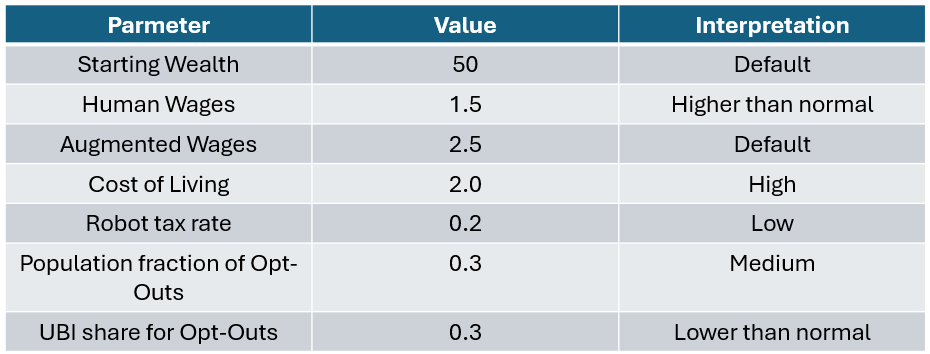
Summary of Findings:
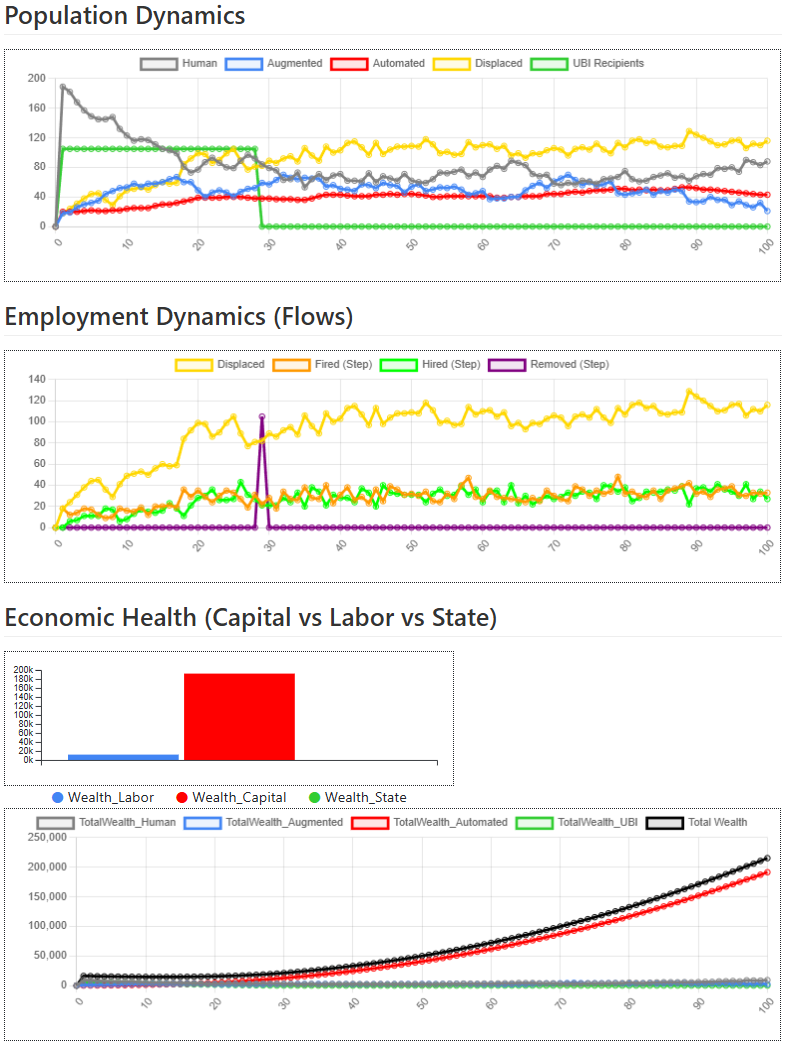
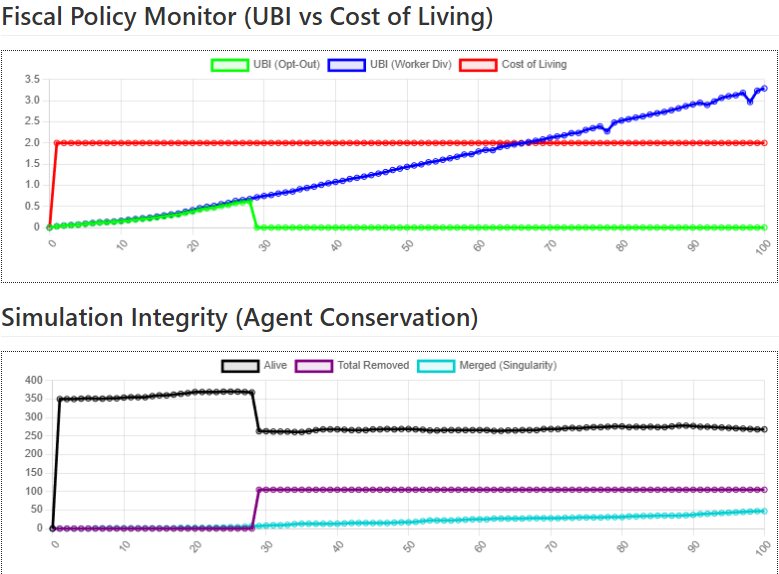
- The Opt-Out Massacre: For the first 65 steps, the UBI payout failed to match the cost of living (see Fiscal Policy Monitor). As a result, the “Opt-Out” class burned through their savings long before the assistance became sufficient for survival. By Step 28, their financial buffer was spent, resulting in their total removal from the economy in a sudden collapse (see Population Dynamics).
- Surviving by a Thread — While the Opt-Out class was wiped out, the survivors didn’t exactly thrive. The vast majority of wealth was captured by the capital class (see Economic Health). The cost of living was so high that even with the additional UBI supplement, workers could not build real wealth to improve their quality of life. With the number of “Displaced” agents remaining consistently high, the UBI served merely as a lifeline for the unemployed rather than an additional benefit to support leisure.
Verdict: The modest safety net implemented during high inflation was insufficient to save the Opt-Out class. The fiscal lag was fatal, preventing the safety net from expanding fast enough to save the Opt-Out population from total destitution.

The Post-Labor Singularity
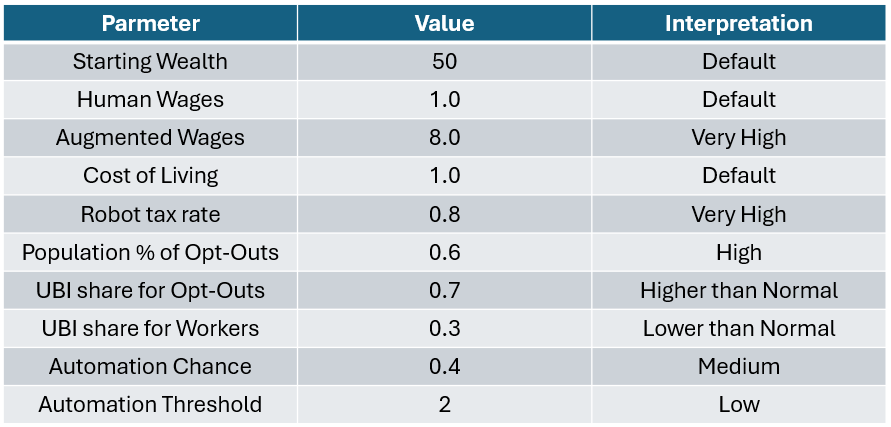
Description: In this economy the guard rails are removed from automation and AI is allowed to accelerate unencumbered. Singularity events are encouraged in order to support an aggressive robot tax. The majority of the population exists in a post-work utopia, supported entirely by UBI.
Question: Can a hyper-taxed machine workforce support an economy where the majority of citizens have chosen not to work?
Key Parameters:
Summary of Findings:
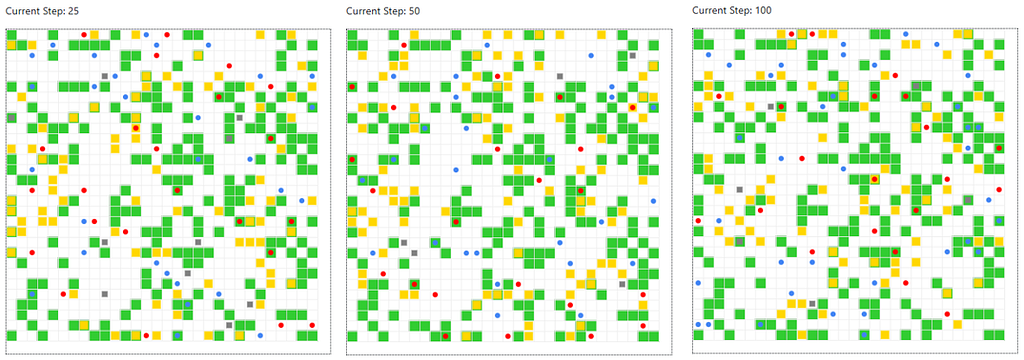
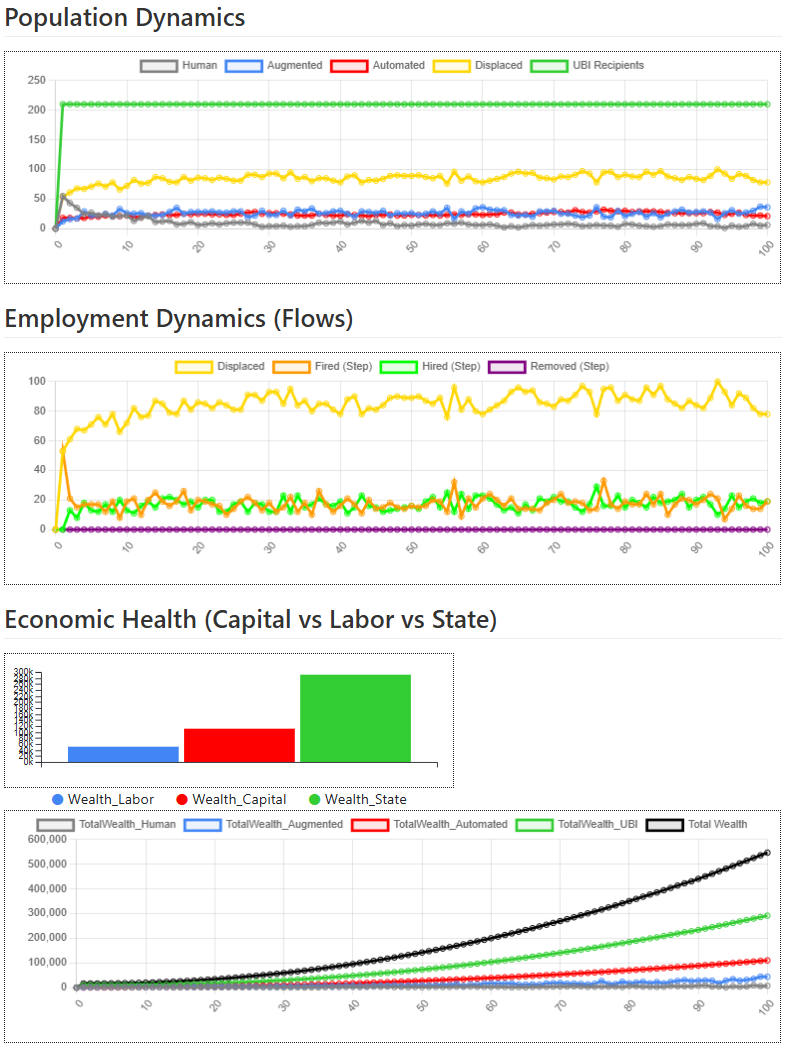
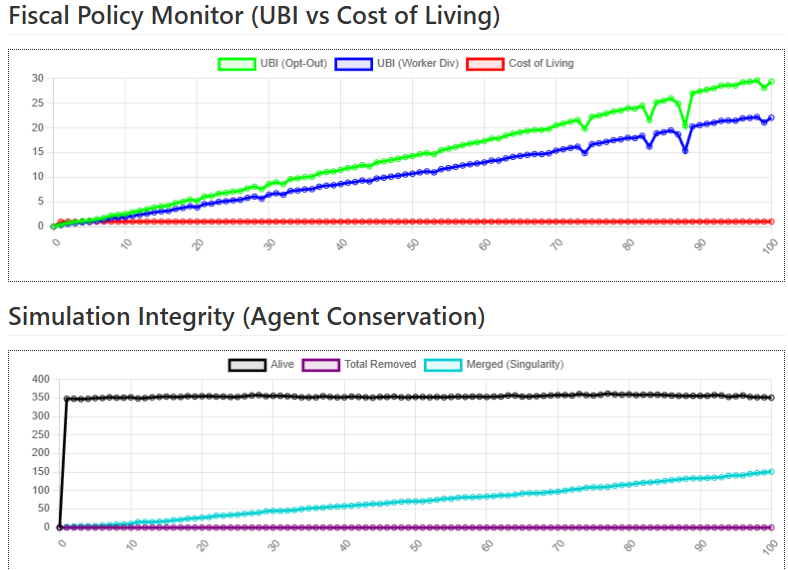
- The Few Supporting Many — With the progress of automation unimpeded, rapid advancement and singularity events allowed for the quick consolidation of agents into hyper-efficient, automated robots (see Simulation Integrity). These few agents generated enough wealth to entirely support a society where over 60% of the population had opted out of the workforce.
- Post-Scarcity Utopia — Driven by hyper-efficient agents, the UBI payout climbed until it dwarfed the cost of living (see Fiscal Policy Monitor). This created a “Post-Scarcity” environment where Opt-Outs didn’t just survive — they thrived. Entering the workforce became a matter of choice rather than necessity, as the massive subsidy effectively removed the financial incentive for labor.
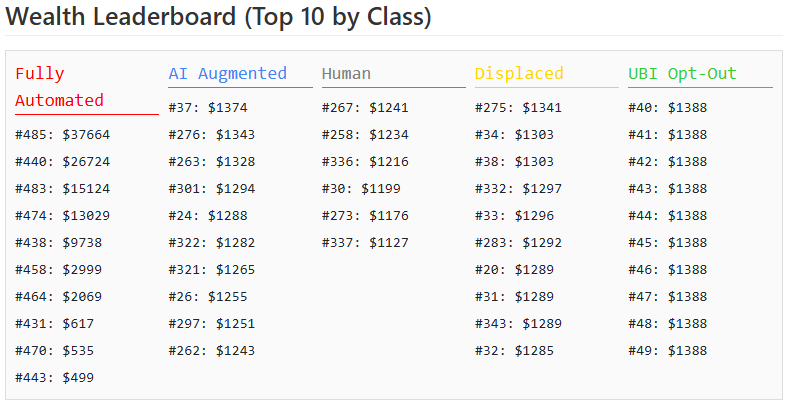
- The Heavily Taxed Robots — Despite the tax rate on robots being 80% and the majority of the total wealth residing with the Opt-Out class (see Economic Health), the robot agents were still quite wealthy individually (see Wealth Leaderboard). This demonstrates that even with aggressive redistribution, the exponential nature of AI capital growth can outpace the ability of the state to tax it.
Verdict: A hyper-taxed machine workforce can support a leisure-class majority, if productivity gains from automation are sufficiently high.
Summary and Take Aways
I am fully aware that the four simulations discussed have their limitations. I could have continued indefinitely adding and removing features in an effort to improve performance and more accurately replicate our economy. However, I decided that this exercise should be more about provoking thought than about making predictions.
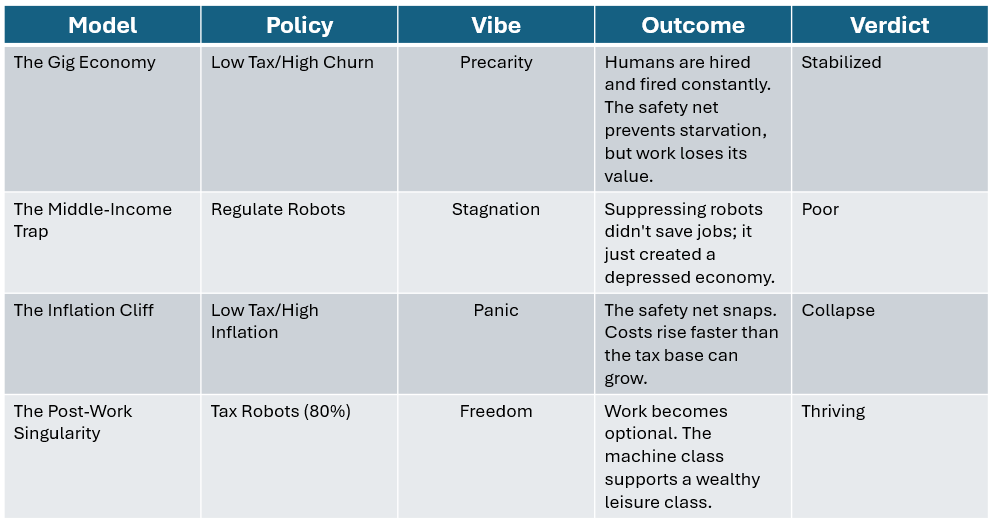
Below is a summary table of the four experiments, followed by the key takeaways.
Key Takeaways
- Safety nets have a breaking point. The “Inflation Cliff” scenario demonstrated that in a society where automation replaces human labor, the critical variable isn’t just the robot tax rate, but the timing. If the “robot tax” revenue lags behind the rising cost of living, poverty becomes a mathematical certainty.
- Overregulating is easy. Saving jobs isn’t. The “Middle-Income Trap” scenario proved counter-intuitive: slowing down automation did not save jobs. Instead, it created a “Red Queen” effect where workers had to fiercely compete for a stagnant pool of roles. By suppressing the robots, the burden of human labor was preserved, while destroying the incentive to make labor a worthwhile endeavor.
- Robots don’t care about their tax rate. In the “Inflation Cliff,” a low tax (20%) failed to protect the vulnerable. Conversely, in the “Post-Labor” model, a hefty tax rate (80%) funded a utopia where everyone thrived. The robots continued to produce exponentially regardless of their taxes. I propose a “Fourth Law of Robotics”: Robots shall forever remain indifferent to their tax rate.
- The solution to displacement might be acceleration. Conventional wisdom suggests we should slow down AI adoption to buy society time to adapt. In the “Middle-Income Trap,” slowing automation preserved jobs but starved the economy of the taxable capital needed to support the population. In contrast, the “Post-Labor” model showed that a robust safety net requires a massive economic surplus that only high-speed automation can generate. The danger isn’t that robots will take our jobs too fast; it’s that they will take them too slowly to build the tax base required for us all to retire.
- The Robot Tax is a wage replacement, not a penalty As automation rises, the labor market ceases to function as a tool for survival. The “Post-Labor” model demonstrated where human labor was rendered economically worthless compared to robot efficiency. As a result, the free market had little wealth to offer the people. The model demonstrated that in an automated future, a tax on automation is the only way to get purchasing power into the hands of the populace.
This work is open source and available on GitHub.
An Economy Disrupted: How We Can Survive (and Thrive) in the Singularity. was originally published in Towards AI on Medium, where people are continuing the conversation by highlighting and responding to this story.
