The Missing Piece of Your AI Strategy: Distribution

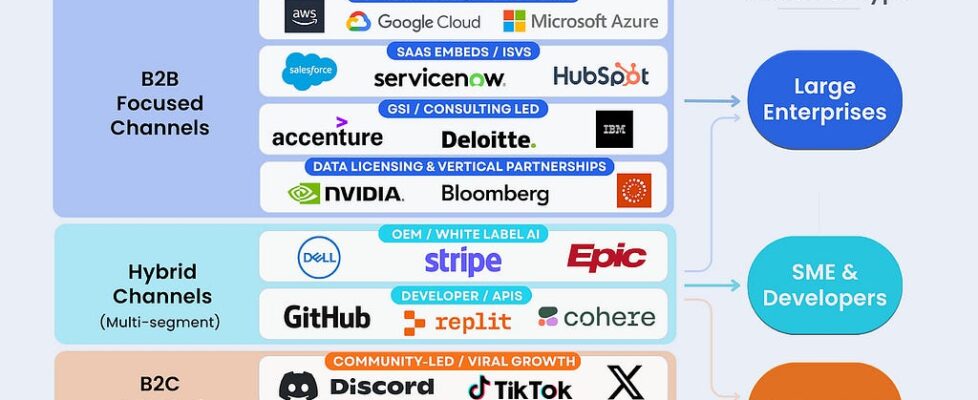
Author(s): Tyler Moynihan Originally published on Towards AI. The past three decades have taught a simple truth: the best product rarely wins on its own. In the 1990s, the coolest websites without distribution vanished. In mobile, countless apps out-innovated peers only to be crushed by those who secured App Store placement, carrier deals, or platform integration. Generative AI is no different. AI isn’t adopted in isolation. It’s discovered through marketplaces, embedded in workflows, routed through consulting programs, bundled into IT upgrades, remixed in communities, or disguised as data inside trusted incumbents. A great product and a sales force aren’t enough. As Stratechery’s The AI Unbundling argued, AI’s value chain may start with model creation, but power shifts downstream — toward whoever controls distribution and consumption. Distribution — not innovation — will separate winners from losers. Look at SEO today: if your brand isn’t surfacing in Google Gemini’s instant answers, you may as well not exist. The same applies in enterprise — if your SaaS product isn’t on AWS Marketplace or embedded in Salesforce, you’re invisible when buying decisions get made. In the AI era, go-to-market strategy is distribution strategy. Companies must either own the distribution platform or scale through someone else’s. Only a handful of players — like OpenAI, Google, Meta, and Amazon — truly own distribution. Everyone else needs to master how to ride it. This article lays out eight key distribution strategies. For each, I explain how it works, which companies it fits, and illustrate it with a real-world case study. These channels fall into three groups: enterprise, hybrid, and consumer. The lesson is consistent: innovation gets you noticed, distribution gets you scaled. Enterprise-Focused Channels 1. Cloud Co-Sell & Marketplaces Best For: B2B SaaS and AI companies targeting enterprise customers and looking to shorten procurement cycles. In enterprise sales, great demos rarely kill a deal — procurement does. Security reviews and vendor approvals can stretch sales cycles from months to years. Cloud marketplaces (like AWS, Azure, and GCP) flip that script by turning procurement itself into a distribution engine. Think of them as digital storefronts where enterprises buy software through their existing cloud accounts. Instead of becoming a new vendor that has to clear security and budget hurdles, listing your product on a marketplace makes it part of a pre-approved contract and spend. This is further amplified through co-sell, where cloud provider reps actively help sell your product because when you win, they hit their own sales targets too. In effect, the cloud stops being just infrastructure and becomes a highly leveraged sales channel. This isn’t a niche strategy. Recent research shows that about 70% of software vendors now sell through cloud marketplaces, and major resellers like CDW and SHI use special cloud programs to bundle AI tools into standard IT upgrades — so adoption happens almost automatically. Case Study: Databricks → AWS. Databricks had strong enterprise demand but long procurement cycles. Listing its Data Intelligence Platform on AWS Marketplace changed the game. Customers could use AWS credits, and reps co-sold Databricks to hit their own numbers. Marketplace sales quadrupled, average deal size doubled, and Databricks says its AWS marketplace business surpassed a $1B run rate. Distribution turned a bottleneck into a growth engine. Keys to Success: Treat marketplaces as sales engines, not just shelves. Pre-build private offers so deals close instantly with credits. Co-map accounts with AWS/Azure/GCP reps so your wins drive theirs. 2. SaaS Embeds / ISVs Best For: AI tools that add the most value inside existing workflows. Most AI tools fail when they sit outside daily workflows. Embedding into established SaaS platforms turns your product into a native feature, cutting friction and accelerating adoption. Salesforce, ServiceNow, Microsoft 365, HubSpot aren’t just apps — they’re distribution rails. As Notion Capital puts it: “AI isn’t bought, it’s adopted.” Adoption happens fastest when intelligence shows up inside trusted workflows. Many platforms call partners “ISVs” (independent software vendors), but the label matters less than the outcome: your AI becomes part of the system. Case Study: Grammarly → Google Docs. Grammarly gained mass adoption not just through its standalone app, but by embedding directly into Google Docs and Microsoft 365, where users were already writing. Instead of asking users to switch tools, Grammarly showed up exactly where they worked. That workflow embed transformed it from a consumer product into a default layer of enterprise writing infrastructure. Keys to Success: Make installation one-click and self-serve. Ship templates and recipes, not just APIs. Win over platform architects — they decide which integrations thrive. 3. GSI / Consulting-Led Distribution Best For: Enterprise AI solutions needing governance, organizational change, or regulatory clearance. Global system integrators (GSIs) like Accenture, Deloitte, PwC, and Capgemini don’t sell tools — they sell transformation. By embedding AI into their modernization programs, you gain access to enterprises that might otherwise hesitate. Customers don’t buy “an AI product”; they buy a roadmap from a trusted partner. Research shows much of AI adoption in regulated industries flows through GSIs, not direct deals. As one investor said: “Accenture can get you into a hundred enterprises faster than a hundred AEs — if you package yourself as part of their transformation stack.” Case Study: Anthropic → Deloitte. Deloitte formed a strategic alliance with Anthropic to bring Claude-powered assistants into regulated enterprise programs. Deloitte packages the tech into transformation offerings, so clients feel they’re buying a roadmap, not a tool. Keys to Success: Package AI into repeatable “solution kits.” Land one flagship deployment and use it as a reference. Accept long cycles; once embedded, scale comes fast. 4. Data Licensing & Vertical AI Partnerships Best For: AI in regulated, IP-heavy, or trust-dependent industries. In verticals like healthcare, finance, and media, trust and governance drive adoption. Here, AI scales by embedding through incumbents who own distribution and credibility. Your tech powers outcomes, but the trusted partner owns the customer. Case Study: Getty Images → NVIDIA. Rather than race to build its own generative model, Getty leaned into its rights-cleared library. In 2023, it licensed […]
