
Instagram’s AI-driven identity crisis

Read Online | Sign Up | Advertise

Good morning, {{ first_name | AI enthusiasts }}. The app that pioneered filter culture is now declaring the curated aesthetic dead.
Instagram head Adam Mosseri says AI content has made polished posts worthless as proof of authenticity — and the platform that built its empire on the perfect grid is quickly scrambling to evolve to the new dynamics of social media in the AI age.
In today’s AI rundown:
-
IG head says platform must “evolve fast” due to AI
-
DeepSeek hints at next-gen AI architecture
-
Use Codex to write code on the web with AI agents
-
Report: OAI overhauling audio for upcoming device
-
4 new AI tools, community workflows, and more
LATEST DEVELOPMENTS
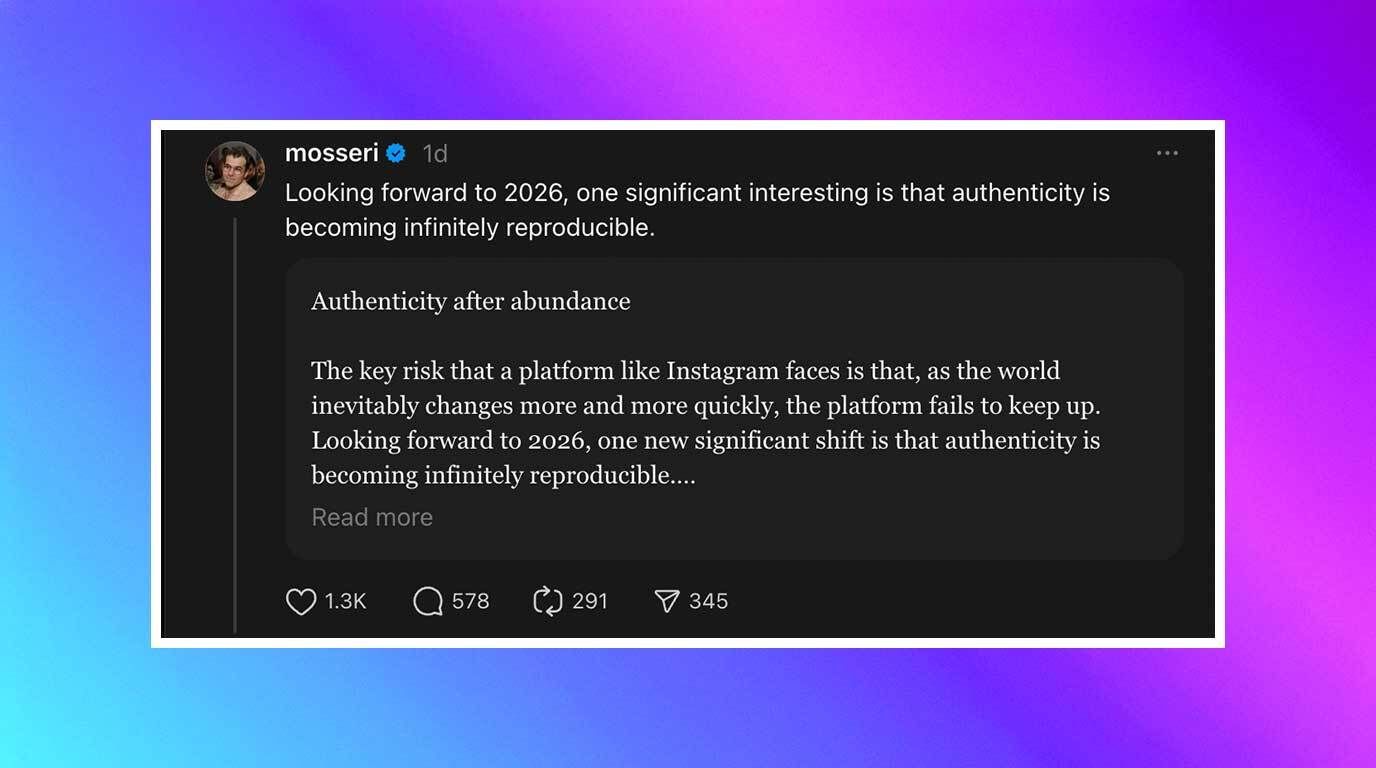
Image source: @mosseri on Threads / The Rundown
The Rundown: Instagram leader Adam Mosseri just posted a year-end essay arguing that AI-generated content has killed the curated aesthetic that made the app famous, saying that raw, unpolished posts are now the only proof that something is real.
The details:
-
Mosseri says most users under 25 have already abandoned the polished grid for more personal direct message photos and “unflattering candids.”
-
He also pushed for camera makers to cryptographically sign photos at capture to verify real media instead of just weeding out fakes.
-
Mosseri said Instagram needs to “evolve” fast, predicting a shift from trusting what images you see to scrutinizing who posted it.
-
Instagram plans to label AI content, surface more context about accounts, and build tools so creators can compete with AI.
Why it matters: IG was one of the pioneers of social media’s “filter culture”, so there’s some irony in now declaring the death of authenticity. But the trend feels accurate, with both a shift in how younger users communicate and the flood of AI images, video, and content completely upending traditional dynamics of social media platforms.
TOGETHER WITH NEBIUS
💻 Nebius Token Factory — Post-training Launch
The Rundown: Nebius Token Factory just launched Post-training — the missing layer for teams building production-grade AI on open-source models. You can now fine-tune frontier models like DeepSeek V3, GPT-OSS 20B & 120B, and Qwen3 Coder across multi-node GPU clusters with stability up to 131k context.
What you get with Post-training:
-
Models deeply adapted to your domain, tone, structure, and workflows
-
One-click deployment with dedicated endpoints, SLAs, and zero-retnetino privacy
-
Shift from generic base models to custom production engines
Start fine-tuning now – GPT-OSS 20B & 120B (Full FT + LoRA FT) is free until Jan 9.

Image source: Nano Banana Pro / The Rundown
The Rundown: DeepSeek just published new research that proposes changes to how neural networks are structured for breakthroughs in model cost and stability, a potential preview of efficiency gains heading into its next major release.
The details:
-
The paper introduces mHC, a technique that stabilizes and improves AI training at a large scale while adding minimal extra computing cost.
-
CEO Liang Wenfeng co-authored and personally uploaded the paper to arXiv, signaling continued hands-on involvement in the startup’s research.
-
Tests on 3B, 9B, and 27B parameter models showed improved benchmark scores over existing methods, especially reasoning tasks.
-
The timing aligns with previous papers telegraphing DeepSeek’s moves, with similar research dropping before R1 and V3.
Why it matters: Last year’s DeepSeek moment made waves with R1 nearing frontier models at a fraction of the cost, and this paper hints that they may not be done finding efficiencies. Between increased access to advanced AI chips and these types of research breakthroughs, China’s releases will be more competitive than ever in 2026.
AI TRAINING
💻 Use Codex to write code on the web with AI agents
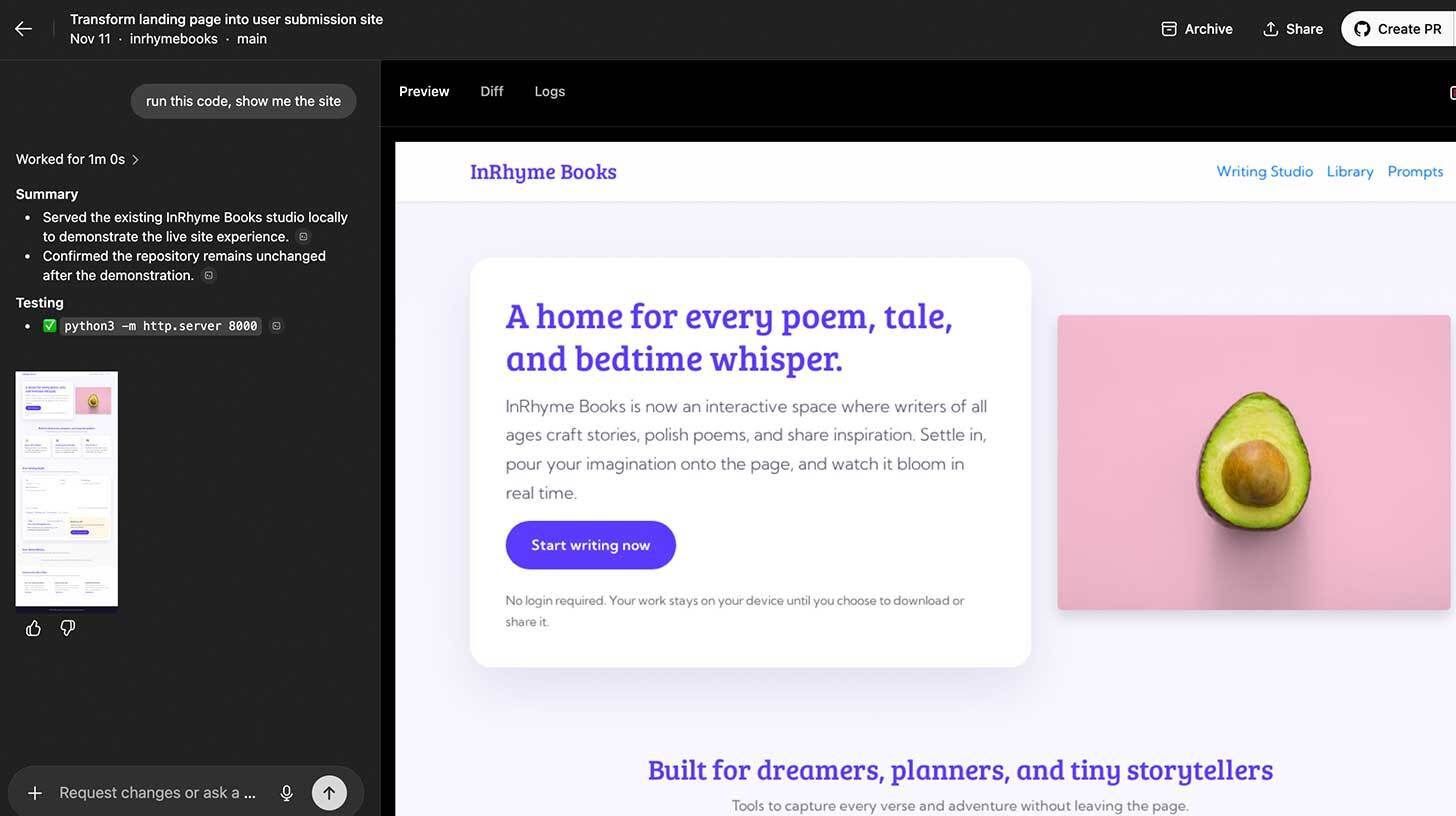
The Rundown: In this tutorial, you will learn how to use OpenAI’s Codex to ship your first change from a GitHub repository without writing code by hand — connecting a repo, planning changes, implementing them with AI agents, and opening pull requests.
Step-by-step:
-
Go to ChatGPT, open the left sidebar, and click “Codex” to access it
-
Click “Manage environment,” select your GitHub organization and repo, then configure code execution settings
-
Choose “Plan” to discuss scope without coding, or “Execute” to make changes on a branch — example: “Can you give insights on what this project is about?”
-
Enter implementation prompt (e.g., “Turn this static landing page into a website where users can paste their own stories and poetry”), preview changes with “Run this code and show me the site,” then click “Create PR” when satisfied
Pro tip: Use branches for safety. Avoid writing code directly to main unless required.
PRESENTED BY CDATA
🚂 You bought the AI train — did you build the data track?

The Rundown: CData’s 2026 State of AI Data Connectivity Report surveyed 200+ data and AI leaders on what’s working (and breaking) when connecting AI to enterprise systems at scale.
The report covers:
-
Why only 6% of companies are satisfied with their data integration architecture for AI adoption
-
How real-time connectivity and semantic intelligence define AI maturity
-
What leading orgs are building to scale GenAI and agentic AI systems in 2026

Image source: OpenAI
The Rundown: OpenAI has reportedly consolidated multiple teams to improve its audio AI models, according to The Information — laying the groundwork for the company’s Jony Ive-led, voice-first personal device expected in about a year.
The details:
-
OAI’s voice models are reportedly behind the text-based ChatGPT in accuracy and response speed, prompting the internal restructuring.
-
An upgraded model due in Q1 2026 will let users talk over the AI mid-response without breaking conversation flow for more natural interactions.
-
The first device launch is reportedly still around a year out and will prioritize voice over screens, with glasses and a smart speaker also discussed.
-
Ive’s design firm io, acquired for ~$6.5B in May, is leading the hardware — with an explicit goal of avoiding smartphone-style addiction.
Why it matters: OpenAI’s device ambitions are well publicized at this point, and the ultimate reveal of the form factor for its hardware will be a big moment to watch in 2026. Ive’s involvement brings the pedigree and hype, but a graveyard of other AI wearables shows the category is still waiting for a true breakout success.
QUICK HITS
🛠️ Trending AI Tools
-
📑 Qwen Image Layered – Image AI that breaks outputs into layers for edits
-
🌌 ChatGPT Images – OpenAI’s upgraded image generation system
-
🤖 GLM-4.7 – Z AI’s new SOTA open-source model
-
📪 CC – Google Labs’ experimental AI productivity agent in Gmail
📰 Everything else in AI today
Chinese AI lab IQuest Labs released IQuest-Coder-V1, a new model family that claims to surpass rivals like Claude Sonnet 4.5 and GPT 5.1 on coding benchmarks.
LMArena posted the 2025 results for top AI models, with Google’s Gemini 3 Pro leading text, vision, and search, and Veo 3.1 models topping video rankings.
Chinese AI startup Kimi reportedly raised $500M in a new Series C round, bringing the company’s valuation to $4.3B.
SoftBank is acquiring DigitalBridge for $4B, adding a data center and digital infrastructure portfolio to the Japanese giant’s growing AI bet.
X user Martin_DeVido shared an experiment giving Claude full control of keeping a tomato plant alive for over a month, controlling systems without human intervention.
COMMUNITY
🤝 Community AI workflows
Every newsletter, we showcase how a reader is using AI to work smarter, save time, or make life easier.
Today’s workflow comes from reader Prasanna A. in Atlanta, GA:
“When reading e-books, it can be difficult to retain and connect key concepts. To solve this, I leverage Google Gemini’s large context window by uploading the book’s text. I have the AI explain the key points of each chapter and analyze how they relate to previous sections using real-world examples tailored to my specific goals.
To ensure mastery, I conclude each chapter with a knowledge check and perform a comprehensive exam once the book is finished. The real ‘magic’ happens at the intersection of the book’s theory and practical application.”
How do you use AI? Tell us here.
🎓 Highlights: News, Guides & Events
-
Read our last AI newsletter: The Rundown’s 2025 year in review
-
Read our last Tech newsletter: Meta buys AI startup Manus for $2B
-
Read our last Robotics newsletter: Robotaxis that plug into your brain
-
Today’s AI tool guide: Use Codex to write code on the web with AI agents
See you soon,
Rowan, Joey, Zach, Shubham, and Jennifer — the humans behind The Rundown

