Prompt Chaining: Build a Linked Sequence That Delivers the Whole Project— Prompt to Profit · Day 14…

Prompt Chaining: Build a Linked
Sequence That Delivers the Whole Project— Prompt to Profit · Day 14 of 30
One prompt delivers one output. A chain of connected prompts — where each builds on the last — delivers an entire project. Today you learn to build them.
Yesterday, we covered system prompts — the permanent briefing layer that shapes every conversation. Today, we go further into the architecture of complex AI work with the technique that unlocks full project delivery: prompt chaining.
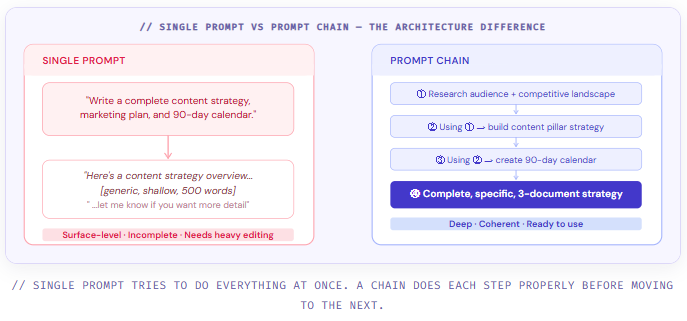
A single prompt, even a well-crafted one, has a ceiling. It can produce a section of a project, a strong first draft, a useful analysis. But a chain of connected prompts — where each step’s output feeds the next step’s input — can produce a complete, coherent piece of work at a quality level that no single prompt can match.
What prompt chaining actually is
Prompt chaining is the practice of designing a sequence of prompts where the output of Prompt 1 becomes an explicit input into Prompt 2, the output of Prompt 2 feeds Prompt 3, and so on — until the final output is a complete, polished deliverable.
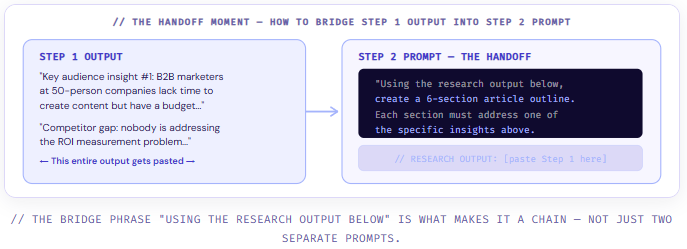
The key word is explicit. In a chain, you don’t just run one prompt after another and hope they’re connected. You actively feed the previous output into the next prompt with bridging language: “Using the analysis above…” or “Here is the outline from Step 2 — now use it to write the full article.” That handoff is what makes it a chain rather than just a series of separate conversations.
Why chains produce better output
There are three mechanisms at work that make chains inherently superior for complex work:
Specificity compounds. The output of Step 1 — which is narrow and specific — becomes the input for Step 2, making Step 2 more specific than it could ever be starting from scratch. By Step 4 or 5, you’re working with a depth of context that a single prompt simply cannot hold or process correctly.
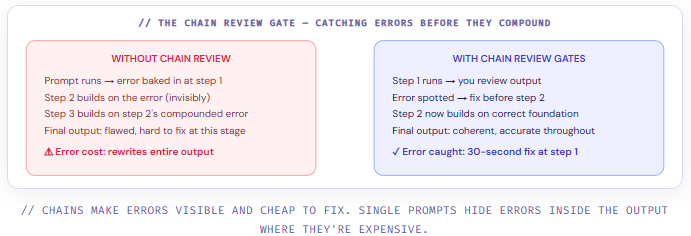
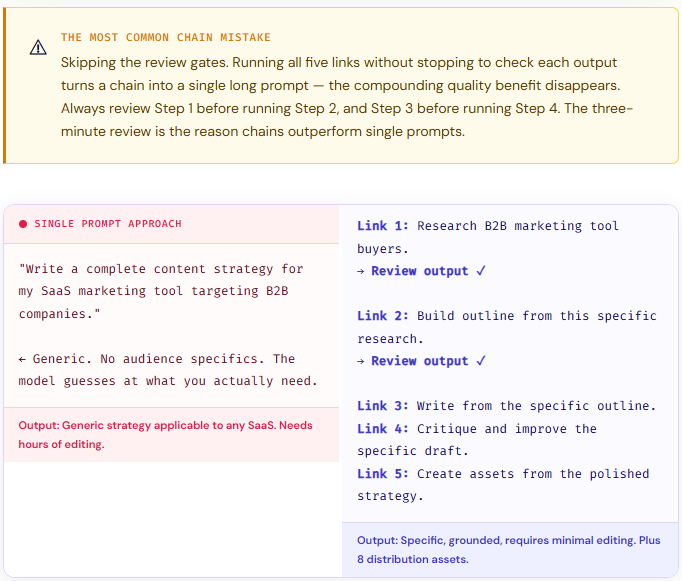
Errors get caught early. In a chain, you review each step’s output before using it as input for the next. If Step 2’s outline misses something important, you fix it before Step 3 writes 2,000 words based on that flawed outline. Single prompts build errors invisibly into the output, where they’re much harder to untangle.
The model focuses on one job at a time. Asking AI to simultaneously research, structure, write, and refine in a single prompt degrades performance across all four. Asking it to do just one thing per prompt — and do it properly — produces significantly higher quality at each stage.
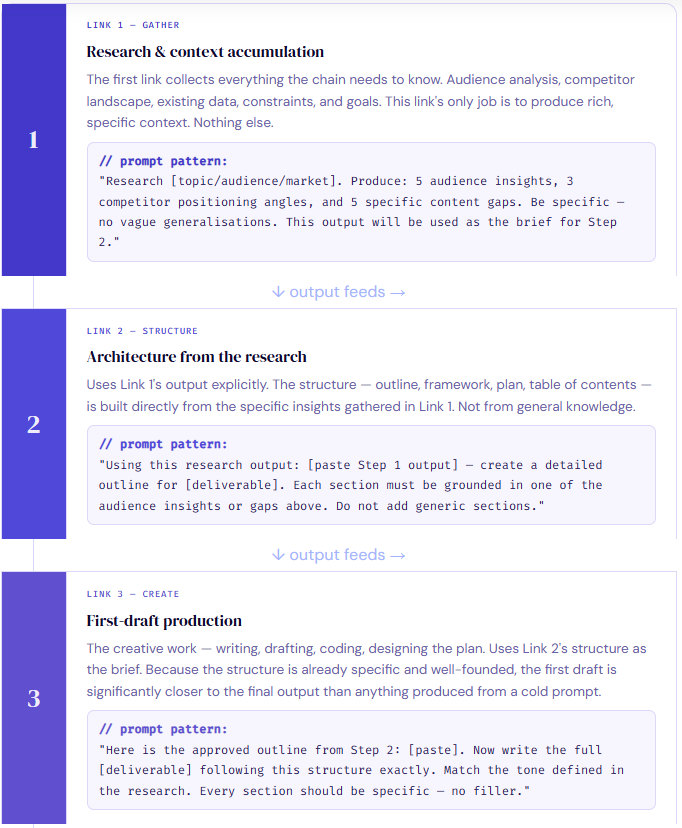
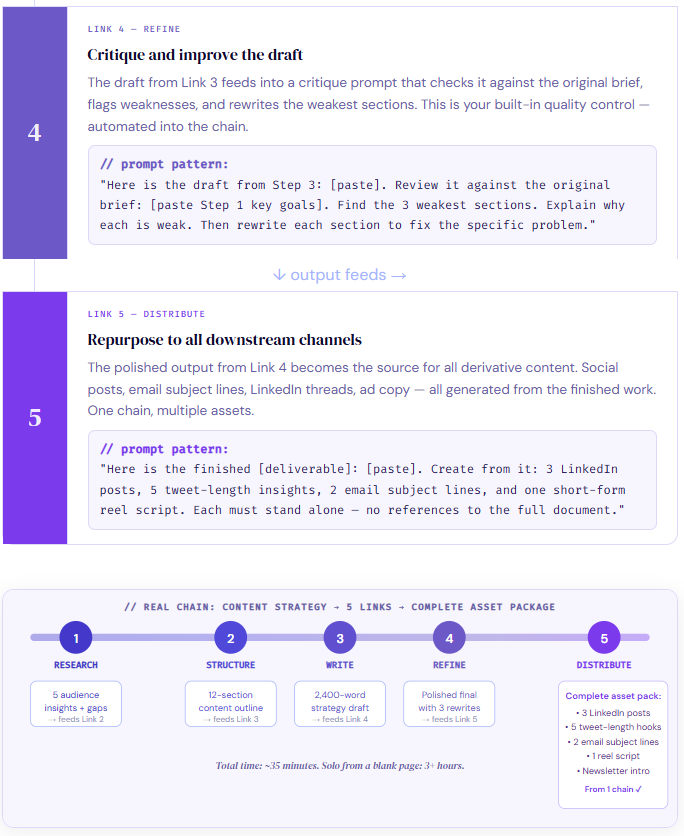
The five-link chain structure that works for any project
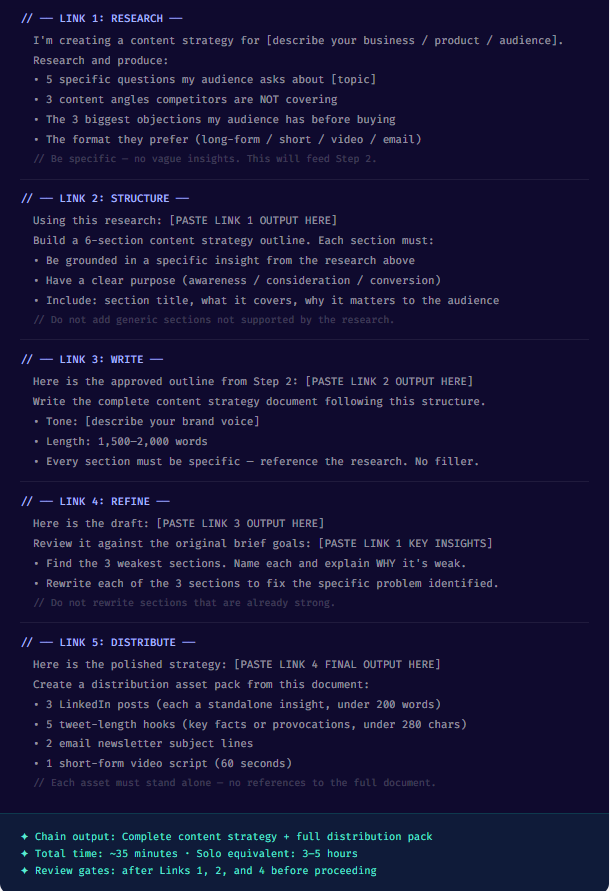
You can build a prompt chain for almost any multi-stage work task. The structure below works for content creation, business planning, strategy, analysis, and research — whatever you adapt it to, the five-link logic stays the same.
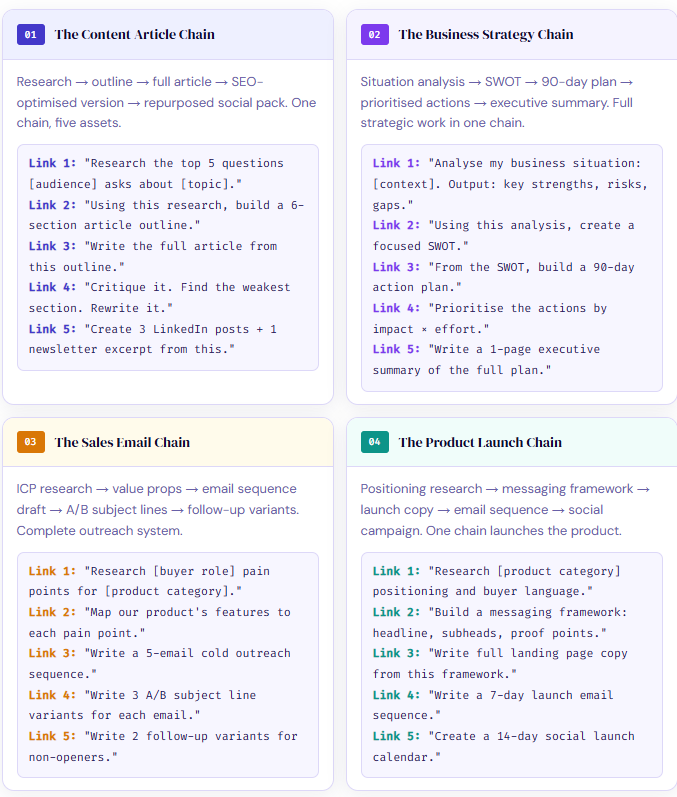
Four chain recipes tobuild this week
Here are four ready-to-run chain templates — each designed for a high-value recurring work task. The prompts are described structurally so you can adapt them to your specific context, industry, and deliverables.
The complete five-link chain prompt — copy and run today
Here is a complete, production-ready prompt chain for creating a content strategy from scratch. Run each link in sequence, pasting the previous output into the next prompt where indicated by the paste markers.
AI Productivity Workbook is the complete System Prompt design framework — 600 templates across 12 chapters including the full Custom Instructions kit: Link in my profile → Faheem Munshi — Medium
Prompt Chaining: Build a Linked
Sequence That Delivers the Whole Project— Prompt to Profit · Day 14… was originally published in Towards AI on Medium, where people are continuing the conversation by highlighting and responding to this story.
