“Seer: Online Context Learning for Fast Synchronous LLM Reinforcement Learning”, Qin et al. 2025

submitted by /u/RecmacfonD [link] [comments]
Like
0
Liked
Liked
submitted by /u/RecmacfonD [link] [comments]

Stewart Cheifet, the television producer and host who documented the personal computer revolution for nearly two decades on PBS, died on December 28, 2025, at age 87 in Philadelphia. Cheifet created and hosted Computer Chronicles, which ran on the public television network from 1983 to 2002 and helped demystify a new tech medium for millions of American viewers. Computer Chronicles covered everything from the earliest IBM PCs and Apple Macintosh models to the rise of the World Wide […]
arXiv:2601.02454v1 Announce Type: new Abstract: Software testing has progressed toward intelligent automation, yet current AI-based test generators still suffer from static, single-shot outputs that frequently produce invalid, redundant, or non-executable tests due to the lack of execution aware feedback. This paper introduces an agentic multi-model testing framework a closed-loop, self-correcting system in which a Test Generation Agent, an Execution and Analysis Agent, and a Review and Optimization Agent collaboratively generate, execute, analyze, and refine tests until convergence. By […]

Read Online | Sign Up | Advertise Good morning, {{ first_name | AI enthusiasts }}. Over 40M people already ask ChatGPT medical questions every day — and now, OpenAI is making those conversations even more personal. A new ChatGPT Health experience pulls in medical records and fitness data for tailored advice, landing right as AI-driven diagnostics, prescriptions, and FDA-approved devices are set to usher in a completely new era of personalized care. In today’s AI rundown: OpenAI’s dedicated […]
arXiv:2601.03306v1 Announce Type: new Abstract: The game of Go has long served as a benchmark for artificial intelligence, demanding sophisticated strategic reasoning and long-term planning. Previous approaches such as AlphaGo and its successors, have predominantly relied on model-based Monte-Carlo Tree Search (MCTS). In this work, we present QZero, a novel model-free reinforcement learning algorithm that forgoes search during training and learns a Nash equilibrium policy through self-play and off-policy experience replay. Built upon entropy-regularized Q-learning, QZero utilizes a […]
arXiv:2601.00167v1 Announce Type: new Abstract: Decision Transformers (DTs) have emerged as a powerful framework for sequential decision making by formulating offline reinforcement learning (RL) as a sequence modeling problem. However, extending DTs to online settings with pure RL gradients remains largely unexplored, as existing approaches continue to rely heavily on supervised sequence-modeling objectives during online finetuning. We identify hindsight return relabeling — a standard component in online DTs — as a critical obstacle to RL-based finetuning: while beneficial […]

For weeks, xAI has faced backlash over undressing and sexualizing images of women and children generated by Grok. One researcher conducted a 24-hour analysis of the Grok account on X and estimated that the chatbot generated over 6,000 images an hour flagged as “sexually suggestive or nudifying,” Bloomberg reported. While the chatbot claimed that xAI supposedly “identified lapses in safeguards” that allowed outputs flagged as child sexual abuse material (CSAM) and was “urgently fixing them,” Grok has proven […]
How to pass values to all children (multiple levels), both in Blazor and React, and what are the differences between the two
The Indian Summer Monsoon (ISM) is a critical climate phenomenon, fundamentally impacting the agriculture, economy, and water security of over a billion people. Traditional long-range forecasting, whether statistical or dynamical, has predominantly focused on predicting a single, spatially-averaged seasonal value, lacking the spatial detail essential for regional-level resource management. To address this gap, we introduce a novel deep learning framework that reframes gridded monsoon prediction as a spatio-temporal computer vision task. We treat multi-variable, pre-monsoon atmospheric and oceanic […]
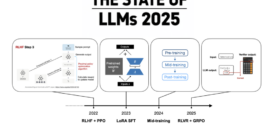
As 2025 comes to a close, I want to look back at some of the year’s most important developments in large language models, reflect on the limitations and open problems that remain, and share a few thoughts on what might come next. As I tend to say every year, 2025 was a very eventful year for LLMs and AI, and this year, there was no sign of progress saturating or slowing down. 1. The Year of Reasoning, RLVR, […]