When Companies in a Supply Chain Work on Different Timelines
<p>Industries are increasingly split on how fast they work. Companies that redesign how they collaborate across time horizons will build a lasting advantage.</p>
arXiv:2605.03061v1 Announce Type: new Abstract: Time varying dependence is often modeled through dynamic correlations or Gaussian graphical models, yet many multivariate systems change through tail behavior, asymmetry, or conditional structure while correlations change little. We introduce Dynamic Vine Copulas (DVC), a temporal vine copula framework for estimating and diagnosing sequence wide non-Gaussian dependence. DVC keeps a chosen vine factorization fixed for comparability, can use C-, D-, or R-vines, and couples pair copula states across time through smooth parameter […]
arXiv:2604.08569v1 Announce Type: new Abstract: Traffic simulation and digital-twin calibration is a challenging optimization problem with a limited simulation budget. Each trial requires an expensive simulation run, and the relationship between calibration inputs and model error is often nonconvex, and noisy. The problem becomes more difficult as the number of calibration parameters increases. We compare a commonly used automatic calibration method, a genetic algorithm (GA), with Bayesian optimization methods (BOMs): classical Bayesian optimization (BO), Trust-Region BO (TuRBO), Multi-TuRBO, […]
arXiv:2601.09746v1 Announce Type: new Abstract: This paper introduces a novel Multi-Agent Cooperative Learning (MACL) framework to address cross-modal alignment collapse in vision-language models when handling out-of-distribution (OOD) concepts. Four core agents, including image, text, name, and coordination agents, collaboratively mitigate modality imbalance through structured message passing. The proposed framework enables multi-agent feature space name learning, incorporates a context exchange enhanced few-shot learning algorithm, and adopts an adaptive dynamic balancing mechanism to regulate inter-agent contributions. Experiments on the VISTA-Beyond […]
arXiv:2603.04204v1 Announce Type: new Abstract: Density aggregation is a central problem in machine learning, for instance when combining predictions from a Deep Ensemble. The choice of aggregation remains an open question with two commonly proposed approaches being linear pooling (probability averaging) and geometric pooling (logit averaging). In this work, we address this question by studying the normalized generalized mean of order $r in mathbb{R} cup {-infty,+infty}$ through the lens of log-likelihood, the standard evaluation criterion in machine learning. […]
Boston Children’s Hospital uses OpenAI technology to improve patient care, reduce operational burden, and help diagnose more than 40 rare disease cases.
arXiv:2602.03875v1 Announce Type: new Abstract: We introduce a reversible deep learning model for 13C NMR that uses a single conditional invertible neural network for both directions between molecular structures and spectra. The network is built from i-RevNet style bijective blocks, so the forward map and its inverse are available by construction. We train the model to predict a 128-bit binned spectrum code from a graph-based structure encoding, while the remaining latent dimensions capture residual variability. At inference time, […]
Explosive demands for LLMs often cause user queries to accumulate in server queues, requiring efficient routing (query-LLM matching) and scheduling (query prioritization) mechanisms. Several online algorithms are being deployed, but they overlook the following two key challenges inherent to conversational LLM services: (1) unsatisfied users may retry queries, increasing the server backlog, and (2) requests for “explicit" feedback, such as ratings, degrade user experiences. In this paper, we develop a joint routing and scheduling algorithm that leverages “implicit" […]
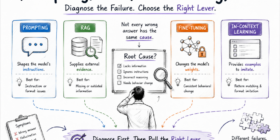
Most AI failures aren’t fixed by switching techniques — they’re fixed by identifying which layer actually failed. Continue reading on Towards AI »
arXiv:2606.10119v1 Announce Type: new Abstract: Current-status data arise when an event time is observed only through an indicator of whether it occurred before an examination time. This paper studies a nonparametric neural-network sieve maximum likelihood estimator of the conditional cumulative distribution function of the event time. Under H”older smoothness assumptions, we establish an explicit convergence rate by combining approximation theory for rectified linear unit neural networks with empirical-process arguments. This result provides theoretical support for neural-network estimation and […]