
Fresh off bond sale, Amazon borrows $17.5 billion from banks as AI spending continues

As AI spending continues to climb, the e-commerce giant has taken out a fresh $17.5 billion loan from a small coterie of banks.
Like
0
Liked
Liked
As AI spending continues to climb, the e-commerce giant has taken out a fresh $17.5 billion loan from a small coterie of banks.

DiffusionGemma Last May Google briefly released an experimental Gemini Diffusion model. I tried the preview at the time and recorded it running at 857 tokens/second. It was an exciting model, but Google made no further announcements about it. That research has returned in the best possible way: as a new open weight (Apache 2 licensed) Gemma model, google/diffusiongemma-26B-A4B-it. NVIDIA are currently hosting the model for free on their NIM cloud API. I used that API to generate this […]
Access OpenAI models and Codex through Oracle Cloud, using existing commitments to build and deploy AI with enterprise security and governance.

I see it often. Hardworking professionals in cafés, airports, or parks hunched over a laptop while carefully dragging their fingers over their PC’s trackpad to navigate some email, project, or alert that can’t be ignored. They would prefer a mouse to a trackpad, but are reluctant to travel with one. When you’re on the go, carrying a mouse can seem burdensome or unnecessary. But I’d argue that it’s worth the boost in efficiency and comfort when navigating your […]

Another day, another AI model from Google. This time, Google DeepMind has released a new member of the Gemma 4 open model family, but it’s fundamentally different from the rest of the lineup. DiffusionGemma doesn’t generate outputs linearly like most AI models. Instead, it can produce an entire block of text in parallel. Google says this makes it faster and more efficient when running on local hardware like an Nvidia DGX or a humble gaming GPU. Most AI […]
Full disclosure: this is directional, not a paper. n=120 tasks, one internal evaluator, not peer reviewed. I work at an LLM infrastructure company. This experiment was done on my own time and is not a company claim. Karpathy’s framework classifies tasks by verifiability. Can output be mechanically checked? High verifiability tasks like code compilation and structured JSON extraction are safer because the verifier catches errors. Low verifiability tasks like creative writing are riskier. I wondered if high verifiability […]
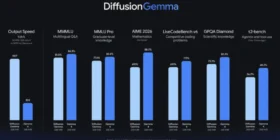
Google AI team including the Google DeepMind researchers have just released DiffusionGemma, an experimental open model for text generation. It uses text diffusion instead of standard autoregressive decoding. The model ships under a permissive Apache 2.0 license. Google positions it for devs and researchers exploring speed-critical, interactive local workflows. Examples include in-line editing, rapid iteration, and generating non-linear text structures. Most language models in use today are autoregressive. They generate one token at a time, left to right. […]
Contact-rich manipulation requires force sensitivity, but many robot arms lack dedicated force sensors due to their high cost. We present Neural External Torque Estimation (NEXT), a data-driven method that estimates external joint torques without needing any dedicated force sensors. NEXT trains in 1 minute from only 10 minutes of free-motion data, yet achieves estimates comparable to dedicated joint-torque sensors. NEXT enables force-feedback teleoperation on low-cost arms and improves policy learning through Force-Informed Re-Sampling Training (FIRST), which up-samples pre-contact […]
Advancing scientific understanding through mechanistic modeling requires posing the right experimental questions to yield maximally informative data. To automate this pursuit within cognitive science, we introduce ATLAS (Active Theory Learning for Automated Science), an active learning framework for the data-driven discovery of interpretable behavioral models. ATLAS iterates between generating mechanistic hypotheses–instantiated as a diverse ensemble of sparse neural networks (Disentangled RNNs)–and designing experiments that optimally distinguish between them. We test this approach on the problem of recovering reinforcement […]
Human-in-the-loop reinforcement learning (HiL-RL) has emerged as an effective paradigm for real-world robotic manipulation, enabling online policy improvement with human guidance. However, current HiL-RL frameworks remain intervention-intensive, relying on frequent human corrections to redirect the policy out of unproductive exploration, which incurs high labor cost and limits real-world scalability. To address this, we propose UniIntervene, an agentic intervention model that detects unproductive exploration and autonomously recovers the policy toward high-value states, taking over the bulk of interventions from […]